
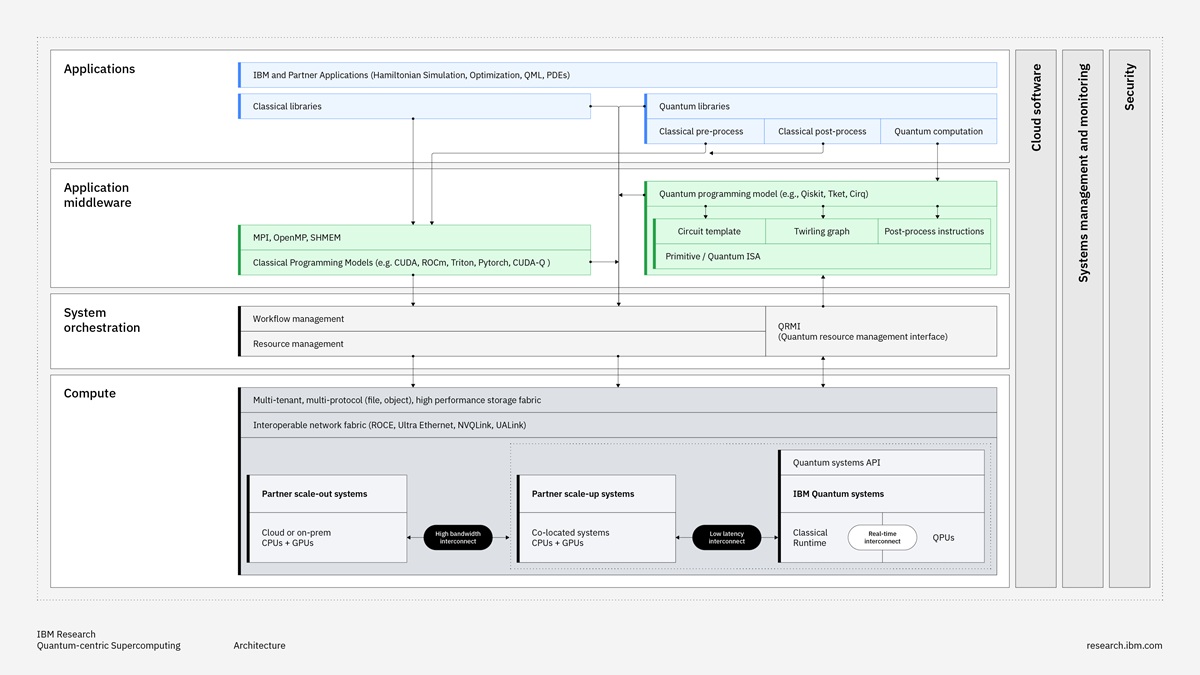
IBM today unveiled the industry’s first published quantum‑centric supercomputing reference architecture, a new blueprint for integrating quantum computing into modern supercomputing environments.
The architecture shows how quantum processors (QPUs) can work alongside GPUs and CPUs – across on‑premises systems, research centers, and the cloud – in order to tackle scientific challenges that no single computing approach can solve on its own.
Designed for today’s workloads and built to evolve over time, the architecture brings quantum and classical systems together into a unified computing environment. It combines quantum hardware with powerful classical infrastructure, including CPU and GPU clusters, high‑speed networking, and shared storage, to support computationally intensive workloads and algorithms research.
On top of this foundation, IBM’s approach enables coordinated workflows that span quantum and classical computing. Integrated orchestration and open software frameworks, including Qiskit, allow developers and scientists to access quantum capabilities through familiar tools and workflows—making it easier to apply quantum computing to problems in areas such as chemistry, materials science, and optimization.
“More than four decades ago, Richard Feynman envisioned computers that could simulate quantum physics,” said Jay Gambetta, director of IBM Research and IBM Fellow, in a statement. “At IBM, we’ve spent years turning that vision into reality. Today’s quantum processors are beginning to tackle the hardest parts of scientific problems—those governed by quantum mechanics in chemistry. The future lies in quantum-centric supercomputing, where quantum processors work together with classical high-performance computing to solve problems that were previously out of reach. IBM is building the technology and systems that brings this future of computing into reality today.”
Scientists are already using IBM’s quantum-centric architecture to deliver accurate results for real experiments. Recent results represent some of the strongest evidence yet that quantum computers combined with classical computing workflows can be used to accelerate scientific discovery:
• Researchers from IBM, the University of Manchester, Oxford University, ETH Zurich, EPFL, and the University of Regensburg created a first‑of‑its‑kind half‑Möbius molecule, verifying its unusual electronic structure with a quantum centric supercomputer published in Science.
• Cleveland Clinic simulated a 303‑atom tryptophan‑cage mini‑protein, one of the largest molecular models ever executed on a quantum centric supercomputer.
• A team from IBM, RIKEN, and the University of Chicago uncovered the lowest‑energy state of engineered quantum systems, outperforming state-of-the-art classical‑only approaches.
• RIKEN and IBM scientists achieved one of the largest quantum simulations of iron‑sulfur clusters, a fundamental molecule in biology and chemistry, through closed loop data exchange between a co-located IBM Quantum Heron processor and all 152,064 classical compute nodes of RIKEN’s Fugaku supercomputer.
• Algorithmiq, Trinity College Dublin, and IBM collaborators published methods in Nature Physics to accurately simulate many-body quantum chaos systems, such as collections of atoms and electrons, using classical compute resources for noise mitigation.
These results confirm the ability of IBM’s quantum computers to deliver value to scientific problems.
As new quantum‑centric algorithms emerge, IBM’s global ecosystem of clients and partners will continually evolve this architecture to support sophisticated resources, networks and software capabilities. For example, IBM and Rensselaer Polytechnic Institute are improving how workflows can be seamlessly scheduled and orchestrated across quantum and highperformance computing resources. Deploying new algorithms on top of this maturing architecture will drive the next wave of applications in chemistry, materials science, optimization, and beyond, poising them to scale exponentially.
You can read more about IBM’s progress in quantum-centric supercomputing here.
Jerry Chow and Ryan Mandelbaum of IBM said in a blog post that the mission is to bring useful quantum computing to the world—so, what is useful quantum computing, and how do you bring it to the world?
They wrote that, for physicists, quantum computers have been useful since IBM put them on the cloud a decade ago. These systems served as hands-on ways to explore the rules underlying the universe, where each new quantum computer was the largest test of these rules to date. But to the broader world, quantum’s value will come from its advanced computation abilities— such as predicting a chemical’s physical properties beyond anything possible on today’s computers. This would be a revolutionary tool for problems like drug discovery or catalyst design.
Famed physicist Richard Feynman put it best during a lecture at the MIT and IBM Physics of Computation Conference: “Nature isn’t classical, dammit, and if you want to make a simulation of nature, you’d better make it quantum mechanical, and by golly it’s a wonderful problem, because it doesn’t look so easy.”