
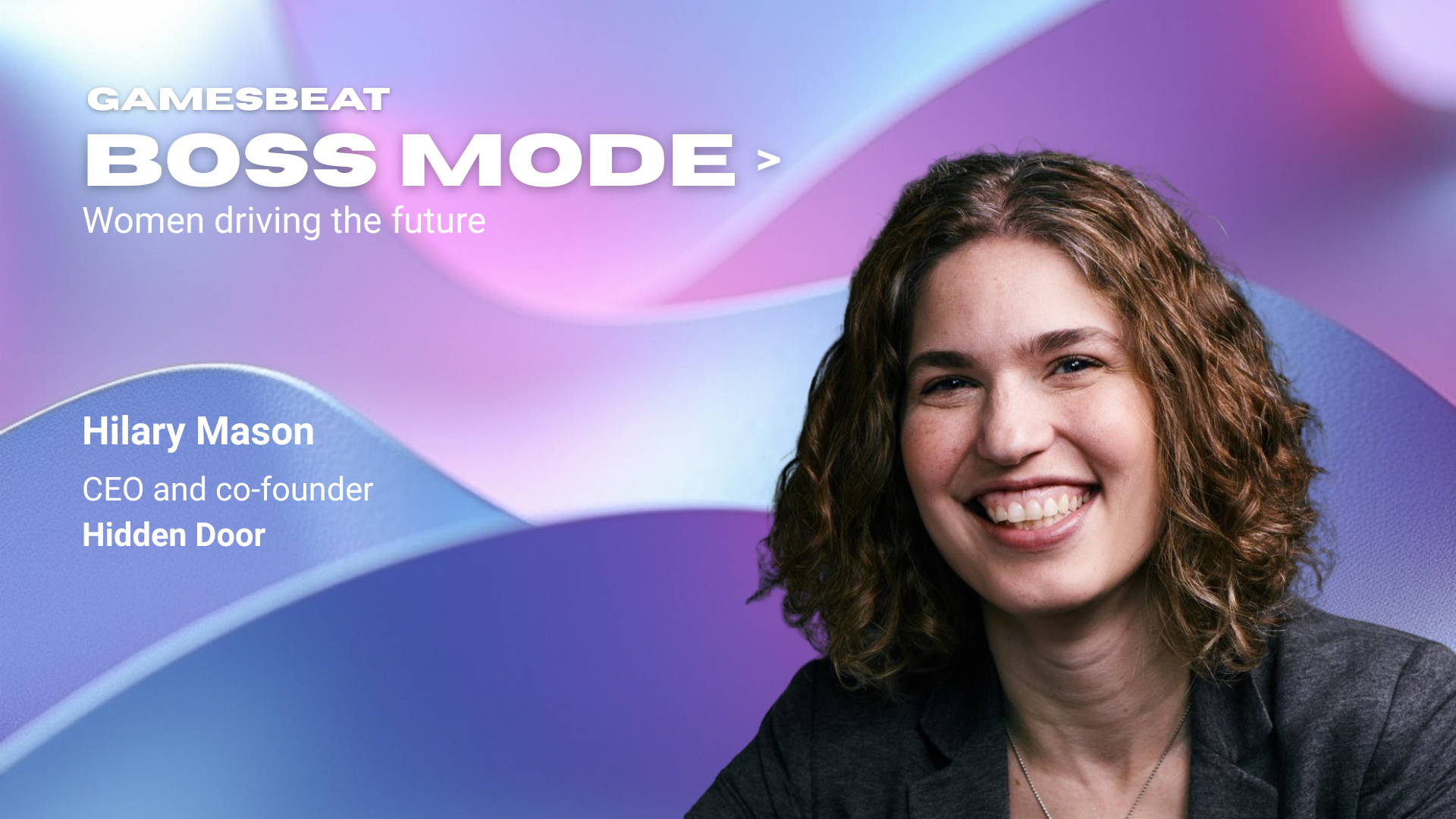
Not chosen by title. Chosen by impact.
BOSS Mode is a GamesBeat series highlighting the women leading change across gaming and every industry it touches.
This isn’t a moment. This is a movement. New chapter. New era. Welcome to BOSS Mode.
If you were to ask anyone in the games industry what the big disruptor of 2026 is, there’s a very good chance they’d say AI — for good or for ill. Some developers are looking for ways to incorporate AI into their creative process, while others are actively avoiding it. And other companies are basing their entire product on AI.
So when I spoke with Hilary Mason, the CEO and co-founder of Hidden Door, I decided to pick her brain about AI and creativity.
Hidden Door is best known for its AI-based storytelling platform which allows players to build their own roleplaying games and stories using existing media properties. The company’s core technology of the same name provides an omniscient AI narrator that helps create different spins on classic stories, like Pride & Prejudice and Dracula.
Even before Mason and I properly began the interview, we fell into a discussion about the benefits of using AI to create stories. One point Mason brought up was that AI can be viewed not as a replacement for those who are already creating, but as a tool for those who otherwise wouldn’t create.
Here is an edited transcript of our (“proper”) interview.
GamesBeat: We can start with the standards, I think. Tell me about your background!
Mason: I mean, I’m a weird one. I studied computer science and English, and then went on to do grad work in machine learning a long, long time ago. So long ago that it was impractical and not cool. In today’s world, it’s hard to imagine that, I know.
I’ve been a lifelong gamer. When I was still in academia, I did some work building machine learning behavioral models based on game environments. It’s always been an interest of mine — not for gaming purposes, more for exploring dynamic environments.
I ended up leaving academia and moving back to New York, where I became the chief scientist at a startup called Bitly, which was short links on social media.
GamesBeat: Oh I know Bitly! We all used Bitly back in the day.
Mason: It was a wild adventure and really fun! I left Bitly and became the data scientist in residence at Excel Partners. Along the way I also co-founded a non-profit called HackNY, helping students join New York’s creative technical economy.
In 2014, I started a company called Fast Forward Labs that was an applied machine learning research company-slash-product code development company. I called it a halfway house for wayward academics like physicists, computer scientists or neuroscientists who really loved building things that people could touch, that solved problems.
Then I sold that to a company called Cloudera, and became the general manager of their AI machine learning business unit for a couple of years.
GamesBeat: Now I’m curious how you came back to gaming.
Mason: I left Cloudera, and was still really fascinated by this area of language generation. At the beginning of 2020, end of 2019, there was no ChatGPT yet, but there was a bunch of early work like GPT2. I was convinced that there was a ton of really cool product surface area to explore there, but I didn’t know what that was going to be.
So my co-founder [Matt Brandwein] and I looked at a bunch of different things we thought we would be able to build in a coming year or two. The one thing I couldn’t get out of my head was that I played so many tabletop games in college and grad school, and the magic of having a structure for a creative social interaction with your friends.
That gives you stories to tell. It brings you closer together as people. To think about ways we could do that in a digital game (I also play a ton of open-world games, RPGs are my favorite), we thought there might be a chance we could start to build that.
I feel like half of this is me saying how old I am, but nobody was excited about AI at that time. Our vision at the time was, what would it take to build something safe and controllable? LLMs were, and still are, tremendously biased. They’re very good at being very mid at tropes, but they are not themselves going to come up with a great novel. They’re not built for that.
LLMs were, and still are, tremendously biased. They’re very good at being very mid at tropes, but they are not themselves going to come up with a great novel.
How do you build what was essentially a game engine layer around this so that we can have a good experience. What we ended up building back then, that we still use the core of today, was an architecture. Instead of, “text goes in, text comes out,” like most LLMs, we have, text goes in, it gets processed into a game engine layer which is a database layer. It gives us a bunch of superpowers around consistency and controllability.
Then we decided to that we wanted to work with authors and with folks who were making shows and movies, because wouldn’t it be cool if we could create something that approximated your favorite author sitting down with a table at you and riffing like a roleplay adventure? Sort of the best of that tabletop energy, or fanfic energy.
It’s really about being able to explore the thing you love, not replace it. To do that in a way that you can share it with friends, and bond with your friends through the things that you love, your jokes, your shared media. That’s really what we’re doing at Hidden Door. It took more years than I expected to get the system built, but we’re really proud of it now. I think we’ve nailed coherent, open storytelling.
The next step is opening up who gets to tell those stories. We still work with many authors, publishers, film producers. We have a lot of really cool licensed content, which we used with their permission and collaboration with revenue share. We’re also creating a creator program that will let anyone bring their fictional world to the platform.
GamesBeat: What’s it like having games as part of your career after being part of your personal life for so long?
Mason: The games industry is really different than social media, software, consumer tech, enterprise tech. It’s good to have that broader perspective because I think it lets me as some questions such as, “Why does it work this way? Doesn’t this look bad? Isn’t this really cool?”
Or, “How do people structure their careers? How do you find out who’s great at what, or what they can do? How do you think about designing companies and businesses? How do you fund them? What do you think about for payment and revenue models and go-to-market? How do you do publishing and distribution?”
No offense to enterprise software developers, but they do not usually wake up every day thinking about how they can give people a new emotional experience or a new way to see the world. Even though the tools look very similar, the creativity and constant drive to make something new … I love that about the games industry!
GamesBeat: How do you maintain identity in this market? How do you make space for your own studio to fit into the larger industry?
Mason: We’ve had our existential crisis. Our team is half-technology folks and half-games and entertainment folks. We call ourselves a game technology studio, because we’re not blindly following the pattern of a game studio. It’s a question of being deliberate and thoughtful about what we’re doing. What are our values? How are we going to do that? Where do we fit in?
How do we choose language that helps people when their assumptions are going to match what we are and what we do? Language that helps them understand that their assumptions of what a game studio does would not apply to us at Hidden Door.
“How do you do distribution?” We’re all on the web. That was a deliberate choice. We’re not finishing a game and shipping it. We ship 12-15 times a day. That’s one of the wonderful things about being an internet product. It changes how we do engineering and it changes how we do QA. It changes a whole bunch of stuff.
GamesBeat: I’m curious, because AI is a hot-button issue right now. It’s a very controversial thing in the industry. How, as a leader, do you build goodwill with the games community? Not just developers, but players who might see AI and get their backs up? How do you present your product to them?
Mason: That’s not an easy answer, because a lot of the anger at AI is justified. The anger at a lot of the big tech companies is very justified. Yet, we are over here doing this so long that when we first went out to raise money for Hidden Door, everyone was asking me, “Why don’t you put NFTs in it? Where’s your blockchain strategy?” It’s a different world today.
We’ve been doing this a long time, and we’re building something we are proud of, with values we’re proud of. There’s nothing we have to do that we need to hide in that. I have no secrets. We’ll explain to anyone who listens for long enough how the whole thing works. We’re not wrapping ChatGPT — we’re using our own models and data that we’re happy to be using.
world-building itself is a skill that is underappreciated… That skill and imagination and energy is incredible. I want more of that in the world. I want to pay those people. I don’t think AI can ever do that.
One of the business questions I get a lot is, “With your number of players, don’t you have to pay $10,000 a month in token bills?” And the answer is no, because we’re very smart about our models and infrastructure. There are ways to do this that are values-forwards and technically smart.
Again, I’m not claiming we’ve invented anything. We’re using embeddings a lot. We pre-generate things. We only uses LLMs for takes that they’re good at. Then it really comes down to the core, which is always values. We’ve build this company because we love people who write. We love people who world-build. I think world-building itself is a skill that is underappreciated.
Some people end up becoming narrative designers or game designers. Some people become novelists. But that skill and imagination and energy is incredible. I want more of that in the world. I want to pay those people. I don’t think AI can ever do that. AI is about tropes and patterns. It’s really good for that.
For us, it’s really saying, “How do we design, from our data to our technology to our product game experience to our business model, an approach that puts creators first and is ethically robust?” I think we’ve done a pretty good job of it, and I’m very proud of what we’ve built.
If folks hear AI, yes, some people will get upset about that, but when they sit down and talk to us and have a look at what we’re doing, usually they’re like, “Okay, this might not be for me, but it’s fine.”
GamesBeat: How has your approach as a leader evolved over time? How do you have the best impact on your company and the industry? What do you consider to be positive impact?
Mason: This is my fourth company, and one of the things that makes me, personally, happiest in leadership is seeing people I’ve worked with over the years thrive, seeing that I’ve been able to build a space where their career got a little boost or took them in a different direction than they thought they were going, or helped them go on to something that was really the dream they had.
I think leadership is really about understanding what the world could be, having values, and then creating a space where people who believe in that can do their best work. That’s leadership at a team level. I’m doing my job if the people I work with go on to do things that are 10 times more awesome in the future. And I want to encourage them and support them in doing that.
Leadership, especially in an environment that we’re working in — like today, given our geopolitical situation, given the market that we’re in — is one of trying to understand what good looks like, and then create as much of that as I can.
I keep saying “values,” but it really does come back to that: Working on things we’re proud of, not making compromises, being very clear about what our focus is and what we’re doing, then talking about why. Especially when AI itself is such as tremendously divisive issue — again, for really good reasons.
One of the things that I love about gaming is that, if you succeed, I don’t lose. It’s not a zero-sum game, as much as it sometimes feels that way.
What would good look like if we built this in a way that really was about respecting humans and human creativity and creating spaces where people can do good work? That’s really the idea. I hope there is a business model that supports that. I think we’re making a really good attempt at it. What I try to do as a leader is be really clear in what that means to me, and talk a lot about what could be.
And then also, just lift people up! Convene, share it when you see people doing cool stuff. One of the things that I love about gaming is that, if you succeed, I don’t lose. It’s not a zero-sum game, as much as it sometimes feels that way. The better our whole community does, the better we all do.
GamesBeat: What would you say is your Boss Move, the decision or shift that defined your career?
Mason: Introducing chaos! One of the things that I’ve been really good at in my career is looking at something and saying, “Why doesn’t this exist? I can’t stop thinking about it. I’m going to try it. Oh, that was a bad idea. I’m gonna learn from that, and maybe go find a good one.” Finding those moments of chaos where you’re like, “Oh, this is really, really dumb or the most brilliant thing I’ve ever come up with” and then leaning into that hard. That is my Boss Move.
GamesBeat: And what would your boss music be?
(Mason told me about how she had what some apparently considered “bad” taste in music, but gave me some tracks anyway. I told her there is no such thing as bad taste in music.)