
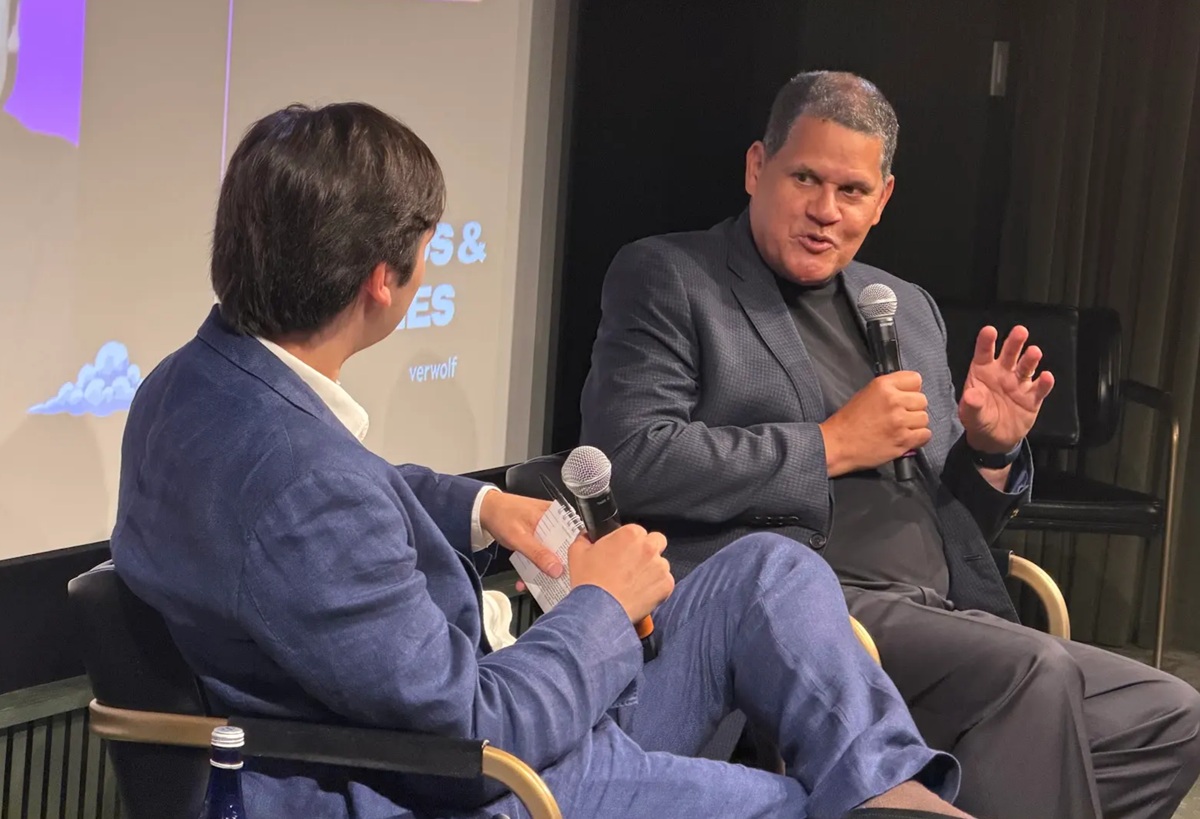
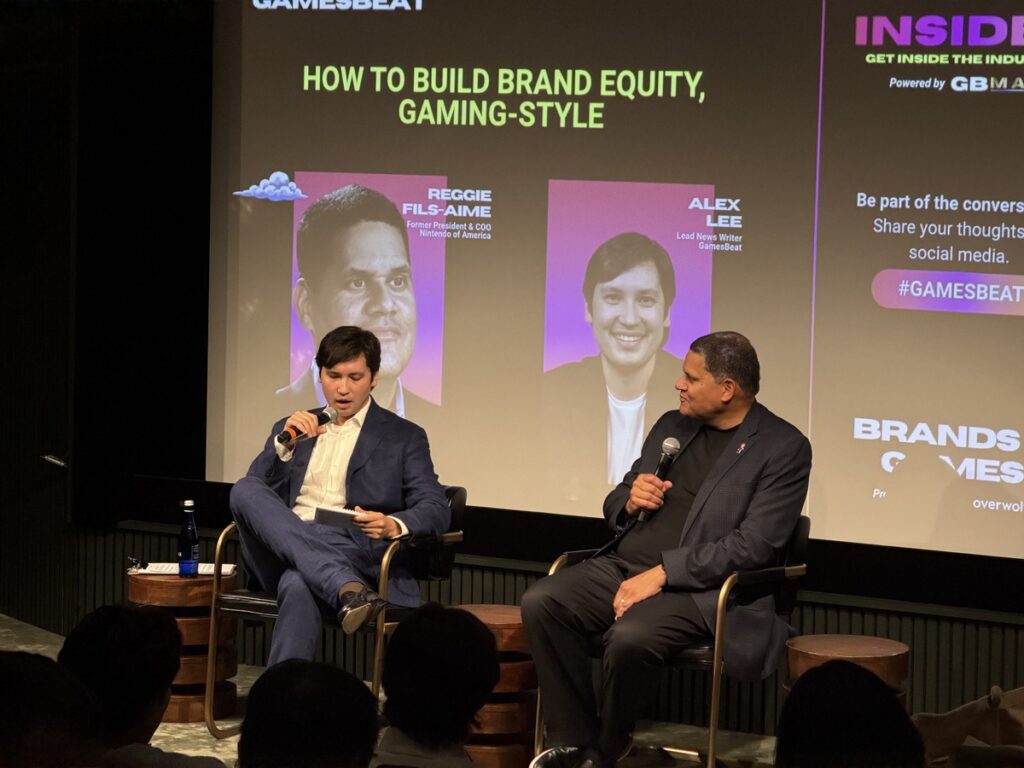
It was great to see Reggie Fils-Aimé take the stage in classic form at our GamesBeat Insider event in New York today.
Alex Lee, lead news writer for GamesBeat, walked the former leader at Nintendo of America through a conversation about how brand-building principles from consumer marketing shaped his work at Nintendo and everything he’s done with brands since that time. Our event partner was Overwolf.
Fils-Aime was president and chief operating officer at Nintendo of America when he retired in 2019. He spent 15 years in variations of that role, and I remember fondly how he obliterated me once while playing Wii Sports Tennis during a live event. Now he gets to work on projects that excite him, are fun and involve the people he enjoys spending time with.
Building consumer brands
Fils-Aime said that for those interested in brand building, he wasn’t in gaming at the outset. In his first 20 years of work, Fils-Amie spent his time outside gaming, work in consumer product marketing at Procter & Gamble, Pizza Hut, Guinness, American Express, and MTV Networks. He roles focused on training in awareness, engagement, and business growth. During that time, he learned how to build brands.
“I learned how to work with my marketing partners to drive the awareness, to drive the engagement, and to grow literally billion-dollar businesses,” he said.
From the early days, Fils-Aime talked about when he was at MTV, with the job of reviving VH1. At the time, VH1.com was a glorified schedule of what was going to be on the channel, and it had “no eyeballs, no engagement and, for me, was a bit of a wasted asset.”
“My thought process was, if we could do something engaging on that website, we would keep people there. They would connect with the brand and drive some eyeballs, and so we began working on that project. I was talking to about building these music-based games, from a company called Vicarious Visions,” he said.
Later acquired by Activision, the company became a major developer for Nintendo’s Game Boy and Game Boy Advance. He connected with the founders, developed a lifelong relationship with them, and also bridged VH1 to gaming.
“When I was a a buyer of media, the gaming business was still nascent, really, and there didn’t seem to be the type of opportunities that exist today in terms of working with gaming IP or gaming brands, other than the joint promotion or the product-based types of activities versus the wealth of activity that you could do today,” Fils-Aime said.
Building Nintendo’s brand
When he joined Nintendo of America in 2003, Nintendo’s brand needed a remake. The GameCube ranked third among consoles while Game Boy Advance remained the dominant handheld. His initial priorities were to revitalize the brand, strengthen the platform business, and use content to broaden Nintendo’s audience. Now it’s one of the most recognizable media and entertainment brands.
“For the second half of my career, it was the gaming part of thinking through how to take franchises, how to take experiences, how to take platforms, and bring them to the consumer in a way that’s relevant but unexpected,” Fils-Aime said. “That’s how we were able to have the Nintendo DS blow up to be [one of the top] best-selling systems of all time. That’s how we were able to get the Switch to blow up and become what is on the cusp of being the best-selling platform of all time.”
At the time that Fils-Aime decided to move into gaming, Microsoft had just launched its Xbox game console to compete with Nintendo and Sony.
“When I was preparing to interview with Nintendo, I had a PS2 in my house. I had an Xbox in my house. I did not have Nintendo’s current system, the GameCube, in my house,” he said. “What I brought was not only a consumer’s perspective, but a marketer’s perspective of some opportunities and things that needed to be done, in order for the company to engage with its player base.”
He added, “Clearly the company needed to shift its marketing approach, shift the way it did business, not only from a consumer-facing side but also from a retailer perspective. He told the company these things in his interviews and he had the background to back it up.
The first step is that Nintendo needed was to really understand itself. It was redesigning its log and it created a graffiti-style version of Nintendo. Fils-Aime came in and put a stop to that.
“It is not the right thing to do. We need to understand our brand. We need to embrace our brand in order to move forward and drive a bigger agenda,” he told the team. “We shored up our Game Boy Advance business. You know this was a dominant handheld platform. We were getting ready to launch our next handheld platform, the Nintendo DS. We had great games on the platform, and so we we changed the marketing to focus on the games.”
Aging up
The team also focused on targeting older gamers than were typically on Nintendo platforms. Nintendo was maxing out around 10 years old, and so it began targeting teens. These lessons are relevant to companies like Roblox, which are also trying to age up their audiences.
“We started aging up the the brand in a way, and it was all based on the content. We had great content that was speaking to that audience, as well as great content that spoke to the younger audience. We we essentially took that formula and reapplied it time and time again,” he said. “That’s how we thought through the launch of the Nintendo DS business, and that launch broke sales numbers because we were able to go beyond a typical gaming audience.”
Nintendo reapplied the formula to the Wii game console, and it worked again. In the early 2000s, games went from being played by one out of every three people in the U.S., and now it’s closing in on eight out of 10.
“It was the plethora of games, not only on our platform but on other platforms, that aged up the platform, brought more and more players to the platform, and that’s why today it’s north of a $200 billion business,” Fils-Aime said.
Lee asked how much crossovers with other brands and entertainment helped.
“We did a lot to crossover from a cultural perspective. One of the ways that we found to be effective in driving our business was just getting more and more people to play the games,” he said. “We did a tie-in with music. We did a music tour to some 20 cities a year, and we had our interactives there for you to play the game.”
Nintendo found breakthrough artists to work with and that drove more young people to fill up bigger stadiums (or stadia) with bigger marketing budgets. Product placements helped. And with the Pikmin game, the team found that real-life brand integrations into the game worked.
“That’s what the joy of the game is: finding these things and and using them to go from place to place. Pikmin is one of Nintendo’s smaller franchises, and it helped drive the awareness with the partnerships that we did,” he said.
Actionable advice
One of the funny stories was that Fils-Aime asked for a meeting with Nintendo’s global president, Satoru Iwata, before joining Nintendo. It turned out this caused a global negative reaction, like who did he think he was?
“From my perspective, I’m coming into a senior job in the largest market for this company. I needed to understand this person that I would be working with quite closely, and I needed to make sure that we would have a strong relationship,” he said. “So, from my standpoint, it was a perfectly reasonable request. But it caused quite an uproar in Japan, as I learned later.”
It was scheduled for half hour. But it went much longer than that, and the key was that we found that we both valued innovation.
“His from a hardware and game creation innovation standpoint, mine from a go-to-market strategy and innovation standpoint, and that the coupling of these really was a breakthrough, because the teams in Japan were able to create all of these wonderful pieces of hardware and all of the games that supported it, and I was able to bring a different approach from a marketing and go-to-market strategy standpoint that together really drove success for the company,” he said.
He credited the teams in Japan with coming up with cutting-edge tech and hardware. They could be used to drive gaming experiences that had never happened before. As an example, the Nintendo DS had two screens in one gaming device. One was a touchscreen, and those weren’t popular at the time as it was before the iPhone. The Wii also used gyroscopes to make the detection of motion more affordable and accurate.
“What what I brought was the mentality of how are we going to bring this to the consumer? How are we going to help them engage with the products in ways that really are going to be compel them to purchase it and to to have fun at home?” he said.
As for actionable takeaways for advertisers, he said, “Step one for any advertiser is you need to understand your brand. You need to understand your product, you need to understand where the weak points are. You need to understand where your strengths lie, because that then creates your strategy.”
It starts with that foundational knowledge. From there, you look at how you reach new forms of play and new people for your brand. That means new gamers.
“You really need to think through opportunities. And you know, the beautiful thing about this gaming industry is that there are tons of opportunities,” he said. “If I were an advertiser, I’d be trying to get smart on who some of these these (smaller) developers are and the types of products that they’re working on. That could huge opportunities to be on the ground floor of something that could then blow up and have its own unique moment.”
As far as putting brands inside games goes, Fils-Aime said, “Strauss touched on this. For a real life product to show up in a game, it needs to make sense. You’re not going to see a real life product in a Legend of Zelda game, which is you know in a fantastical environment. But as developers are working on games that are more real-world places, I do think there are opportunities for real integration and integration where both parties benefit.”
As an advertiser or brand owner, if you could bring attention and awareness to this game that otherwise might not get that attention, that’s a win, he said.
Reggie’s background
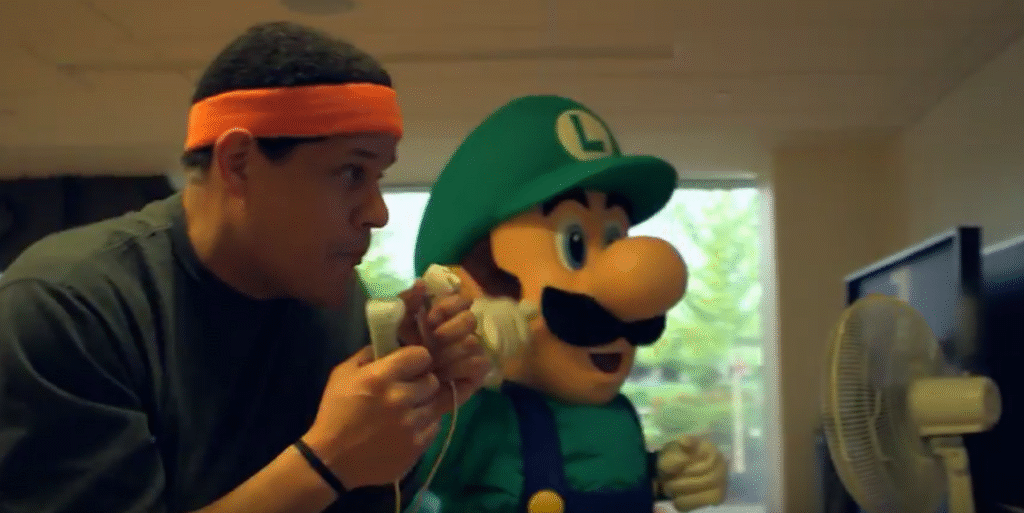
The man known as Regginator wrote a 2022 book, Disrupting the Game: From the Bronx to the top of Nintendo, about his experiences. It was a Wall Street Journal bestseller.
“That was my COVID project,” Fils-Aime said.
He has always been an aggressive defender of the Nintendo brand, and he enjoyed the intellectual sparring that came with press interviews.
Now he has been consulting and helping about charitable causes such as the New York Game Critics Circle and its efforts to educate children about journalism and communications skills. The charity helps teach communication, critique, and other real-world skills to elementary- and high-school students, with plans to expand beyond New York City.
Reggie was a memorable gaming leader because he spoke his mind. There were some stories he didn’t tell until he wrote his book. In the book, I appreciated the stories about his background growing up poor in the Bronx, after his parents had to emigrate from Haiti, leaving behind a rich life for the poverty of one of New York’s poorest neighborhoods. It turned out that one of the passions that he picked up — incessantly playing Nintendo games — would later turn out to be so important later in life, giving him credibility with Nintendo CEO Satoru Iwata.
And I appreciated that his book covered some mistakes or difficult challenges, like his management of the Bigfoot Pizza brand at Pizza Hut, the pricing for the Nintendo 3DS, and the failure of the Wii U.
Fils-Aimé’s relationship with Iwata was fascinating reading, as Fils-Aimé was an outsider as the only high-ranking black executive at the Japanese company, and Iwata was an outsider who joined Nintendo from a third-party developer. His passion project with the New York Game Critics Circle uses games to teach communication, critique, and other real-world skills to elementary- and high-school students, with plans to expand beyond New York City.
And it was interesting to read how Fils-Aimé decided to make diversity advocacy and mentorship his mission during his retirement. He will be forever known for the moments of drama and fun he brought to gaming, like his “My name is Reggie” speech that put him on the map with gamers.
During retirement, Fils-Aime said he is working with brands as a consultant. Those game makers often come to him with a game that is growing and try to figure out how to broaden their reach in a smart way.
Lee asked about advice for game makers and publishers who don’t want to disrupt their experience.
“If if you’re the game developer, I think to a certain extent you have to do your own homework,” Fils-Aime said. “I would counsel them to create the list of companies and brands that you think would work great within your particular game, and then call them.”
He said that outreach is worth its weigh in gold. If the dev is working on a passion project, they can find a way to live inside a brand or project in an excellent way, he said.
“To me, that’s a call I would take and and hear more about that opportunity,” he said.
Want the full conversation on Reggie?
Watch GamesBeat’s complete conversation on How to Build Brand Equity, Gaming Style, with Reggie Fils-Aime, former president and COO of Nintendo of America.
Starting September 21, stream the full talk exclusively with GB MAX Insider or Premium.
[Get GB MAX to Stream the Full Conversation →]