
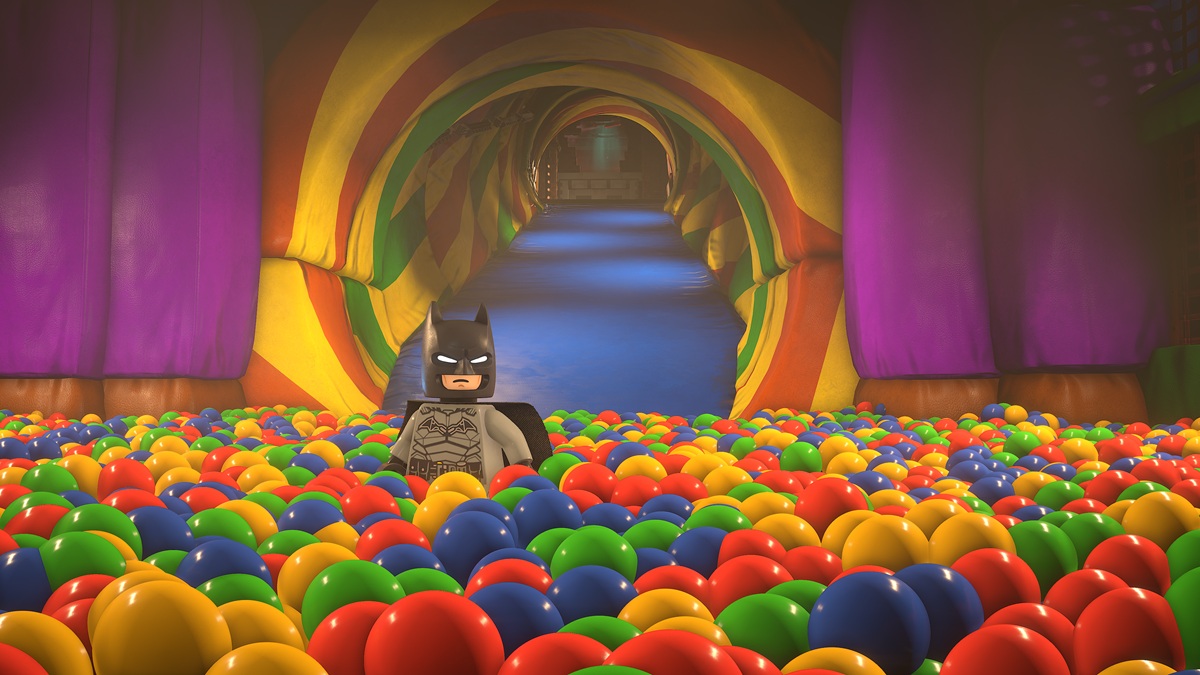
I got to play Lego Batman: Legacy of the Dark Knight for a few hours recently and I was struck by how it exceeded my expectations for a Lego game.
From the unique blending of blocky Lego art and high-resolution imagery, to the quality narrative and good sense of humor, Lego Batman is a triple-A title. That should be no surprise given the success of prior titles like Lego: Star Wars, and that’s what Jonathan Smith, head of development on the game at Warner Bros.’ TT Games, pointed out when I asked him why the quality was so good.
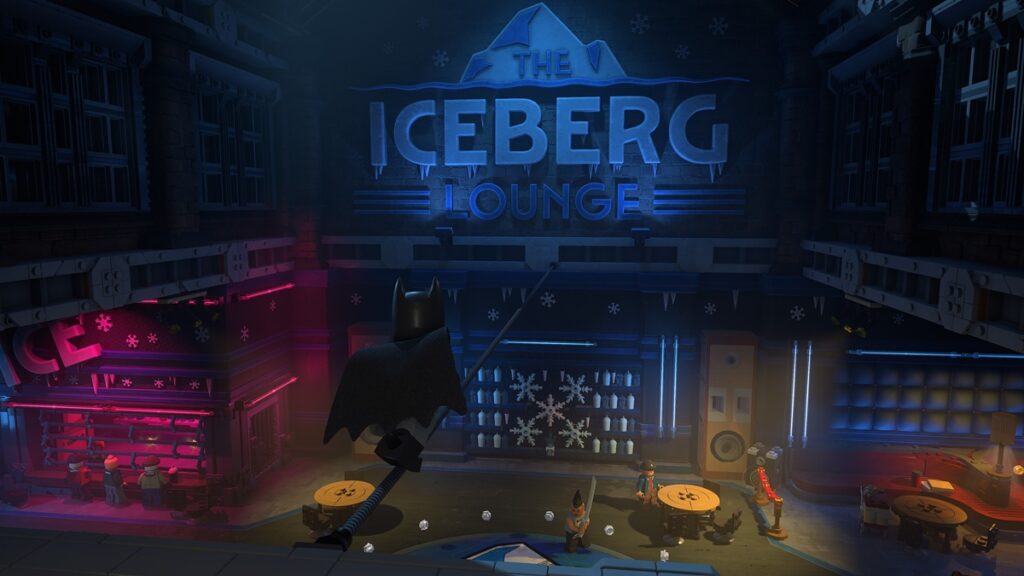
He noted that at the microscopic level, you can see how the Lego bricks deal with light, details, imperfections and more things that improve the realism of the imagery. The team poured a lot of energy into making the art better, he said.
The game is also ambitious as parts of it are like an open world. The city of Gotham is a vibrant place, much like New York in the Spider-Man games from Insomniac. There are four big islands to Gotham’s map. As for the story, it’s also ambitious as it tells the story arc of the origin of the Dark Knight in a way that is both tightly focused and entertaining. The part where Batman meets Dick Grayson, who later becomes Robin, is a great scene where the gameplay is challenging and entertaining.
Then there’s the pure joy of wreaking havoc by destroying Lego brick structures everywhere in the environment or punching out bad guys in melee fights, much like in the Batman Arkham games.
Smith said he has learned a lot from the three-plus-year process for the next game. But he won’t say what that is. Fortunately, TT Games also learned a lot from decades of Lego games to make the Batman game.
Here’s an edited transcript of our interview.
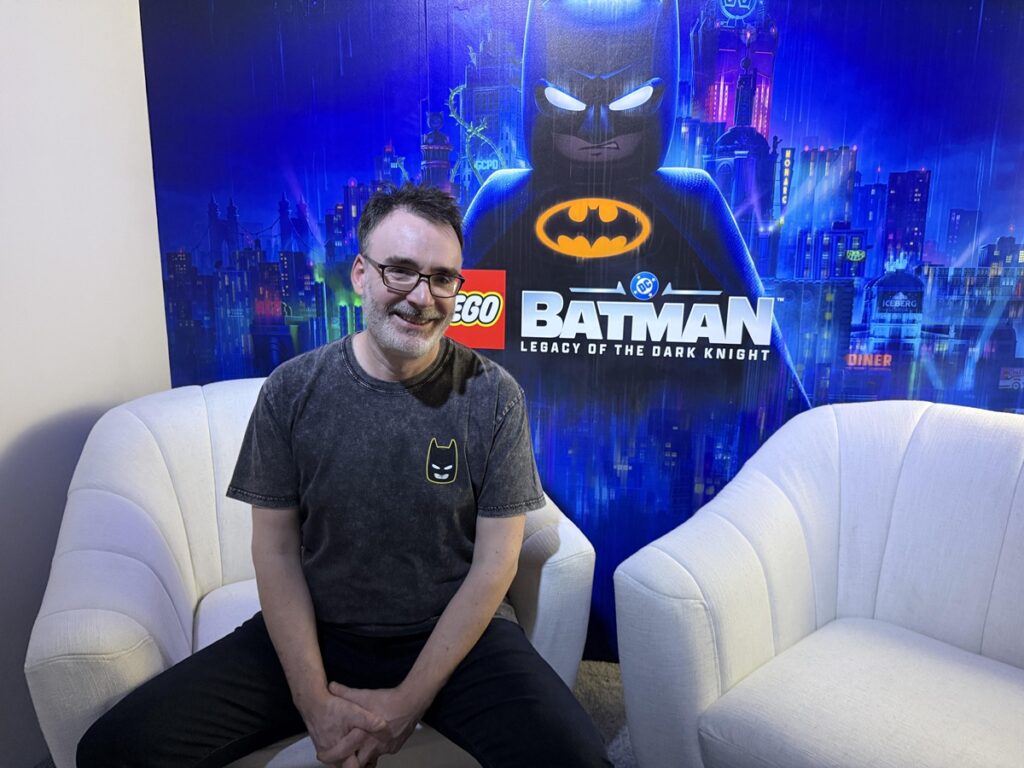
GamesBeat: I was thrown off by how Lego is supposed to be blocky, but then you blend in all of this hyper-realistic art alongside the minifig characters. How did you come to that style?
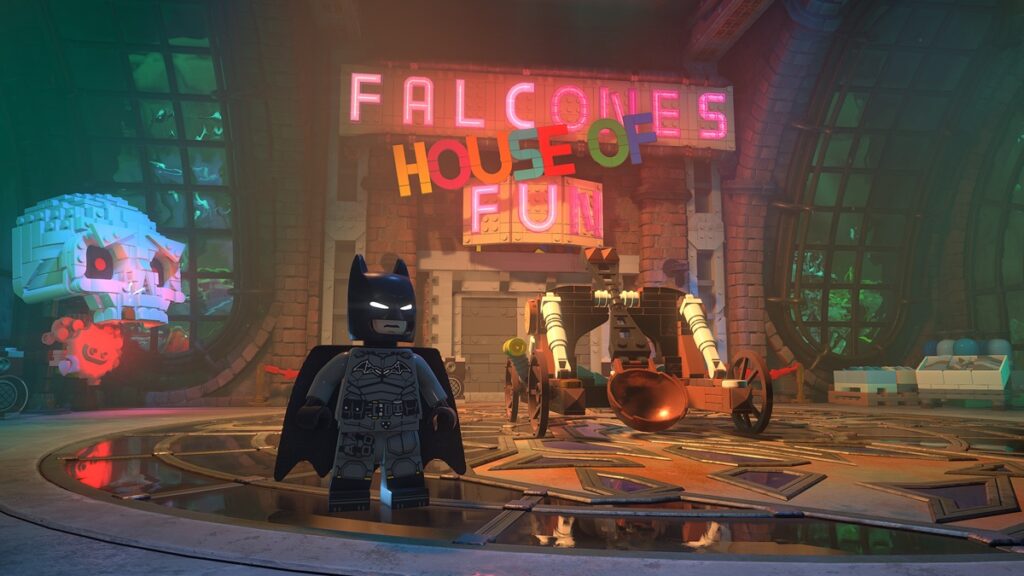
Jonathan Smith: There are two dimensions in which we’ve moved things forward visually with this game. You talk about Lego bricks being blocky, but at the microscopic level, the way they deal with light, the detail of the texture of the plastic, the imperfections, the molding elements, all of that adds visual interest to the appearance of objects made of Lego. Our artists have, with incredible fidelity and care, rendered all of those details – the fabric of the cape – with such love for the physical Lego. Even a two by four Lego brick element has got so much texture and complexity to it. I think that shines on the screen.
We then build a world that incorporates objects made of Lego with architectural facings that are made of non-Lego as well. The rule for us is, if a minifigure interacts with it – a window, a door, a trash can, a car, a pedestrian crossing – that’s made of Lego elements. But the street, the tarmac of the road, perhaps the brickwork in the buildings, the lighting and the tonality that the artists have chosen, that needs to be set together with the Lego architectural finishings. We think that coheres into a unique visual look that speaks to Lego.
You’ll see Lego cues. For example, if you look behind here, the architecture still echoes the Lego design language. That could be Lego, but it’s expanded. You’ll see Lego cues across all the designs, right down to the tiniest detail.
GamesBeat: You look at a brick or a minifigure, and you see something behind it that looks stunning. It threw me off. I’d stop and admire the art in a game where I didn’t expect to do that.
Smith: Good. The team will be really pleased to hear that. It’s a modern video game. You want to be immersed in the environment. It has to look great. We have a team who really want to achieve the highest quality visually. We’ve poured attention into that side of things.
GamesBeat: Is that some of the reason why these games take a long time to make? It sounds like this one has been in the works for quite a while.
Smith: It has. We’ve taken more than three years to make this game. It’s a labor of love from a really big team, based primarily in the U.K., TT Games. It’s a big production for us. That’s what Batman deserves. It’s a big character, big stories, so much heritage. We wanted to pull it all together into a big game. That takes time.
GamesBeat: It has a lot more open world features as well.
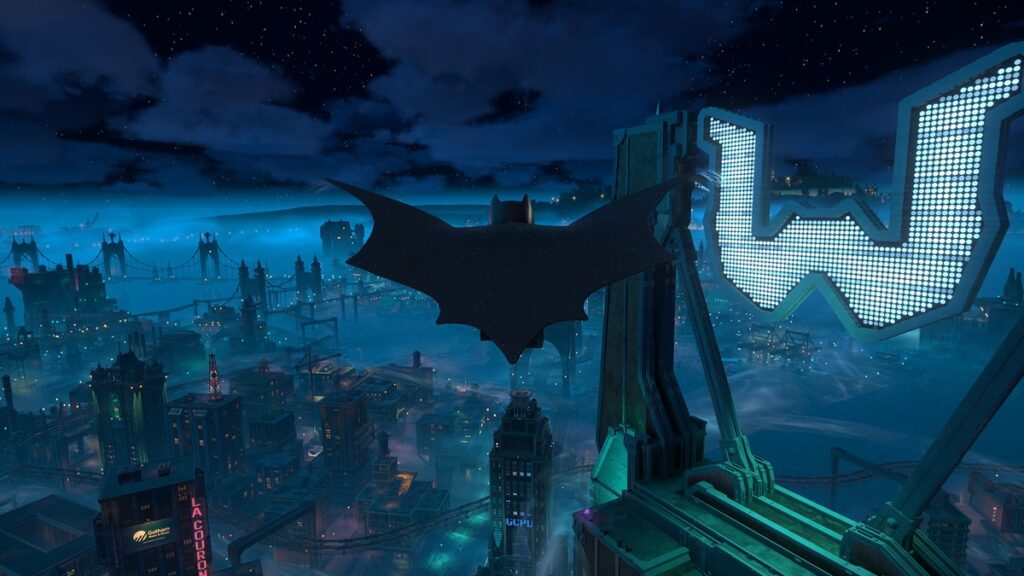
Smith: Gotham, making an interactive city that feels like a playground, that’s rich and dense, full of surprises – you can traverse with vehicles and gliders and grapples – is a big undertaking. We’re really pleased with how it’s turned out. It’s been great to have people play in Gotham today. They’ve just started to scratch the surface of all the surprises it contains.
GamesBeat: Is it as big as something like the Spider-Man games?
Smith: I don’t know how we’d directly compare. It’s a really immersive, big city across four islands. It goes high into the sky. You can go underground. It has transport networks. It’s full of gameplay. There’s plenty to discover over a long period of playing.
GamesBeat: Does it seem like there’s a lot more hours in other Lego games?
Smith: Compared to the games we’ve done in the past, yeah, it’s a rich and full experience. Plenty of time.
GamesBeat: How did you decide how to go big like that, how to be more ambitious?
Smith: Well, we had two things giving us confidence. One was the success of Lego Star Wars. We learned a lot from making that game. We raised our level of ambition. We did a lot of new things for that title that we could build on for the next game. That gave us a solid platform. And we have a team who have been together for a long time. We felt ready to take on that challenge.
The second thing that gave us confidence and really held the whole thing together throughout development was the strength of tying the story of the game and the progression of the game to the story of Bruce Wayne’s progression. A young man starting to train, all the way through as he builds his capabilities, expands the Batcave, develops new gadgets, accumulates new vehicles to become the Caped Crusader–the focus on that story and the power that gave us, the fuel that gave us, when it reaches out into all those decades of amazing stories–there’s so much detail to inspire the teams in all areas. But the single spine and the strength of that story, I don’t think it’s been put together in this way before, from beginning to end. That gave us the strength to aim for this level of completeness and quality.
GamesBeat: The fighting the melees reminded me a bit of the Arkham games. The little triangles gave you clues for what to do next. How did you decide on how much–I don’t know if you call that hand-holding. But how much you wanted to do for the player versus making that action more challenging.
Smith: We really set out to develop a combat system and enemy systems that add much deeper layers to reward skill-based play, tactical play. To become Batman you have to be a tactical assessor of the situation and demonstrate great skill. We wanted to deliver that to players.
One of the challenges there, then, is to make those systems apparent to players, so they can read them and start from that basis and explore them. Signaling when an enemy is vulnerable to a counterattack, signaling when you’ve built up enough focus to be able to use a focus takedown–signaling that clearly to players helps them come to grips with the system, and then explore some of the complexities and depth outside of that most straightforward understanding, when you start discovering what you can do in combination with different characters, with the different gadgets, against the different enemy types. We have a solid, clear foundation that will enable players of all ages and skill levels to understand the basics and progress. That gives players the confidence to discover some of the depth we’re now adding.
GamesBeat: How did you think about things like playing as a cat?
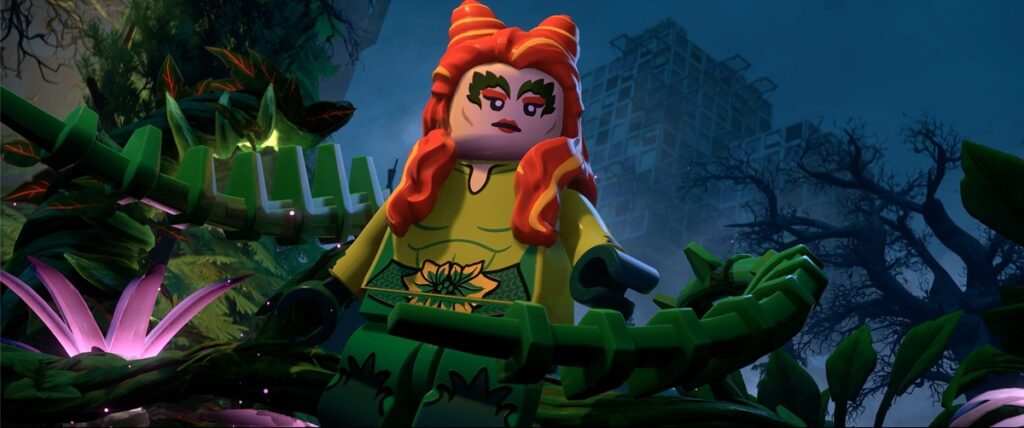
Smith: We wanted to give all the playable characters real personality and distinct capabilities with their gadgets and abilities. That sounds easy, but the craft from the design and technical design and game code teams to explore, imagine, prototype, and build at an early, rough stage what sorts of gadgets would be fun and how they would work is a process that the team is accustomed to and embarked on with real enthusiasm. It enabled lots of ideas to come out. Building them and iterating on them to find the best gadgets, the most expressive abilities for players was a major task early in development.
Some were more obvious than others. For Catwoman, the idea–once you say, “Wouldn’t it be great if you could summon a cat?” Well, what could the cat do? A lot of the people on the team, as soon as we saw the very first prototype of an animated Lego cat under your control, were immediately in love with that feature. The cat can get into small spaces. It can also activate buttons. It can pick up objects and bring them back to you. You can even use it to attack enemies. Once you have the kernel of an idea like that, the team is able to expand and develop on it in fun ways.
GamesBeat: The humor is still there. “Is this a heist?”
Smith: Throughout the whole game, we always approach the storytelling and the action with a sense of fun. We want to make people smile. It’s what we’re here for.
GamesBeat: Does this all add up to thinking of a Lego game as a triple-A opportunity?
Smith: Of course. How could it be anything else? The Lego brand is of the highest quality. Lego products are of the highest quality. We’ve always strived to deliver the most fun that people appreciate. Taking the visuals to the next level, taking the gameplay to the next level, drawing up this fantastic story and putting it together in this great narrative progression gives us that opportunity.
I will add, on that question, that we make our games for players of all ages. A substantial number of players – I count myself and many people on the team amongst those – are older gamers who have had wonderful experiences in the past with Lego games. They’re still playing new and modern games and want Lego experiences that match up to those expectations as well, that take us to new places. We’re interested in taking games forward. We want to play new games and have new experiences. We should be able to play really great, high-quality, big new Lego games. That’s why we’re making them.
GamesBeat: But you don’t take yourselves as seriously as some triple-A games, maybe.
Smith: Well, you have to have fun. That’s more a question about sensibility and tone. As a team, we can’t help but be a bit mischievous, irreverent. We love and respect the characters we have the privilege to work with. We take our responsibility to players seriously, to deliver an experience that’s of high quality. But we do want to have some fun ourselves as well. We will fool around and see what works, what makes us laugh, in the hope that some of that joy and glee does then communicate to players in the final game.
GamesBeat: What’s something you’re most proud of or happy about at this end stage?
Smith: At the end now, I can see that this game is more than the sum of its parts. We set out to do several really exciting, interesting things with combat, with the visuals, with the story. I think we weren’t prepared to see, when they all fit together in that open Gotham City playground, what that would add up to cumulatively. How coherent the experience would be, drawing upon so many different generations of Batman stories. And then the impact that would have on players.
It’s been great today at this preview event to see people come in, see it for the first time, get their hands on it for the first time, and respond in exactly the way we’d hoped, with appreciation for the depth and resonance of these characters, and appreciation for the skill of the team in bringing that to life in a completely new way.
GamesBeat: What have you learned that you want to use for your next game?
Smith: We’re still in the process of finishing this game. We’re keen to see how people react to that. We’re keen to see what resonates with people. But we are making plans for the future. I think we’ll come to the next project with even more confidence and ambition.
Disclosure: Warner Bros. paid my way to the preview event.