
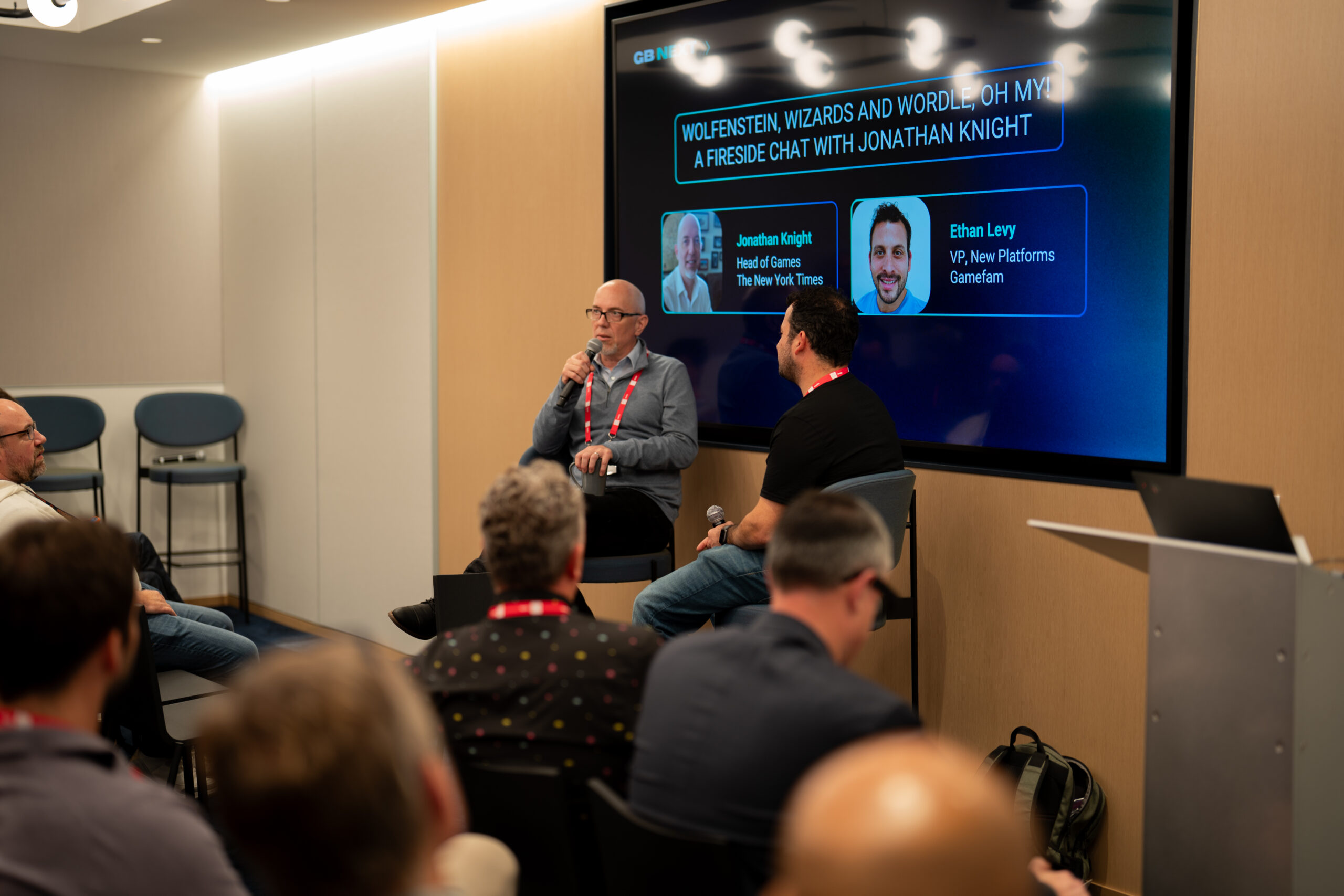
The New York Times is becoming a gaming company — and leveraging traditional gaming talent to help shepherd its evolution.
Since 2021, New York Times Games has transformed from a crossword-dominated subsection of the Times to arguably one of the publication’s main draws, with an updated app and a wide range of popular games like “Wordle” and “Spelling Bee.” Currently, New York Times Games boasts over 10 million monthly active users, with games driving the company’s acquisition of roughly 110,000 new digital-only subscribers in the first quarter of 2025.
One of the key names behind the growth of NYT Games is Jonathan Knight, the company’s head of games. Prior to joining the Times in September 2020, Knight enjoyed a long and productive career within the traditional game development industry, working at companies like Activision, Electronic Arts and Zynga to build a portfolio that includes popular titles like “The Sims 2” and “Dante’s Inferno.”
At GamesBeat Next earlier this month, Knight sat down with Ethan Levy, the host of the Deconstructor of Fun podcast, for a wide-ranging discussion about the past, present and future of New York Times Games — including the ways Knight has been able to apply his considerable experience in traditional game development to the New York Times’ unique approach. Here are some of the key takeaways.
An ‘X Statement’ is effective no matter the genre
One of the key tools that Knight said he had learned to wield effectively at triple-A studios was the so-called “X Statement” — a simple and straightforward north star statement used to align every stakeholder on what exactly the core gaming experience is supposed to be. For “Dante’s Inferno,” for example, Knight said that the game’s X Statement was simply “go to hell.”
“It was very clarifying. We were going to make a video game where you are literally going to hell — the medieval Christian mythology version of what that would really be like,” Knight said during his GamesBeat fireside chat. “And every choice we made along the way was to try to deliver on making you feel like you were really there.”
During the fireside chat, Knight disclosed that New York Times Games has an X Statement, too.
“Our mission is to be the premier destination for digital puzzles, and I laid that out in 2020 when I got there — it’s very clarifying for the team. Premier means we’re going to be the very best at this. There will be no quality compromise; ‘destination’ means that we want to have that relationship with the consumer,” Knight said. “We want them coming to our site, creating an account with us, habituating with us, whether it’s on the app or the website. We want them subscribing with us, ultimately, if they see that value, and then we want to own that lifelong relationship.”
Triple-A discipline is still important in non-standard studio environments
Knight’s role as the leader of a truly unique and innovative gaming media business requires him to say yes to a lot of new ideas — but the New York Times’ head of games said that he’s had to grow comfortable with saying “no” relatively often to avoid compromising his vision.
“What you say ‘no’ to is more important than what you say ‘yes’ to,” Knight said during the fireside chat. “I think that’s a lifelong lesson for me.”
Because New York Times games like “Wordle” have worked themselves into the popular culture, Knight said that he is constantly inundated with potentially interesting pitches regarding new games, partnerships and celebrity collaborations. To avoid feeling like too much of a “downer,” he said that he frames NYT Games’ green light process as more of a “red light” process.
“It’s like, ‘How do you have a process that stops you from doing the things that you know you’ll fall in love with, but are not going to do the impact that you need them to have?’” Knight mused.
Triple-A franchise stewardship practices are relevant to NYT Games
Working at triple-A studios, Knight was given the challenging task of stewarding long-running game franchises like “The Sims” and “Wolfenstein.” Much like he guarded the pillars of these popular gaming IPs, Knight said that he now treats Wordle and the rest of the NYT Games portfolio as modern-day cultural franchises, requiring the same delicate touch to avoid disgruntling committed fans.
Triple-A gaming principles like maintaining a core vision, managing scope creep and defending key brand values transfer cleanly to the Times’ environment as the company leans further into games.
“With Wordle, it’s like knowing what that Bible is for the do’s and don’ts — we had that for The Sims,” Knight said. “You also have your user research, to understand your audience segments that are responding to it. So much goes into all of that.”