
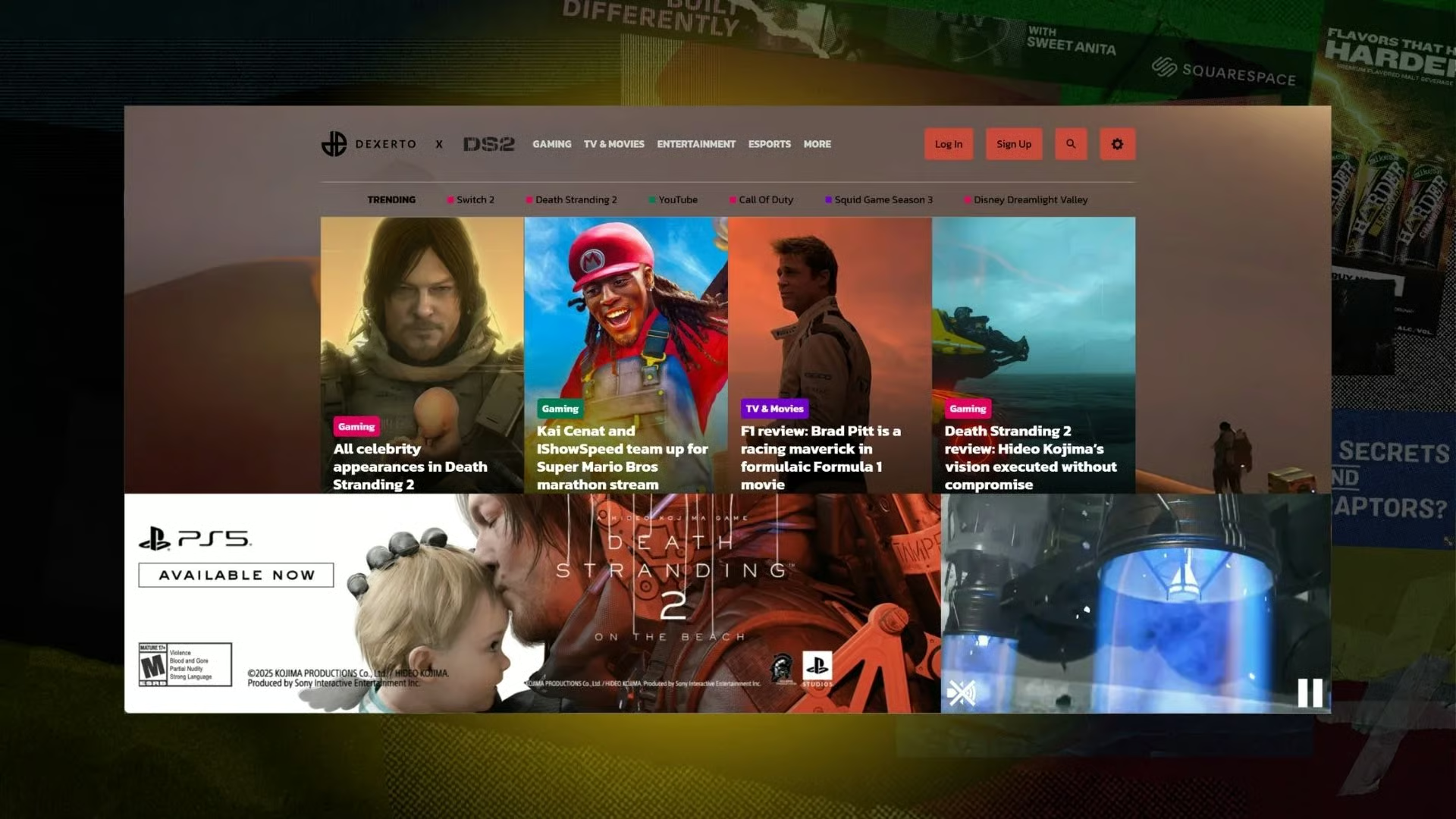
After making its name as a publisher of gaming and entertainment news, Dexerto has quietly rebuilt its business around agency services, growing the company’s revenue by nearly 150 percent since initiating the pivot in 2022.
If you’re a regular reader of quick-hit gaming industry news, you’re almost certainly familiar with Dexerto. Founded in 2015, the London-based company (which now employs more staff in the United States) initially made its name through tabloid-style coverage of gaming and internet culture, expanding into a network of websites including Dexerto and CharlieIntel, as well as social-first channels like ScreenTime and Hoops Central.
Dexerto has been actively courting brands as potential clients since 2022, offering its industry knowledge and range of inventory up to advertisers — both game publishers and non-endemic brands — as both a strategic agency and creative partner. (I covered the early days of this strategic shift for Digiday.)
By the end of 2023, the company was administering about 43 campaigns per year, with less than 10 percent of those campaigns coming from publishers or game makers, according to Dexerto chief executive and co-founder Joshua Nino in an interview with GamesBeat. In the first six months of the 2026 fiscal year, Dexerto did more than 80 campaigns, with about 50 percent of the campaigns involving game makers. Since early 2022, Dexerto’s direct sales business has grown by about 167 percent.
“Discoverability is getting much harder now for games; the amount of games that are published on Steam alone is five or six times what it was just a few years ago,” said Dexerto chief revenue officer Mike Murphy O’Reilly in an interview with GamesBeat. “So, when people come to us, with our services and the team we’ve built, it’s like, ‘help me understand what we should be doing, because you guys live and breathe on these platforms where everyone is now consuming games.’”
Game launch campaigns form a cornerstone of Dexerto’s agency business in 2026. For recent launches like Rebel Wolves’ Blood of the Dawnwalker, Dexerto used audience research and insights — including insights gleaned from Dexpert, Dexerto’s searchable, AI-powered data platform — to develop the strategy and creative, producing a live-action shoot for a launch trailer intended to mirror the game. After launch, Dexerto amplified the creative through its homegrown channels, in addition to supporting the launch with giveaways and other social activity.
“Dexerto sets itself apart by offering the total package. Rather than sourcing editorial coverage, asset creation, or social support individually, they’re able to deliver everything under one roof (and excel in every area),” said Jordyn Halpern, a marketing manager at Squanch Games, which partnered with Dexerto to launch High On Life 2 in February, in a written interview with GamesBeat.
For the launch of High on Life 2, Dexerto followed a similar playbook to its work with Blood of the Dawnwalker, creating visual assets from scratch and blasting them out across its social channels in support of the new game. Squanch Games director of business development Ben Moore told GamesBeat that Dexerto’s ability to balance the logistics of an end-to-end social campaign while understanding Squanch’s creative vision set the company apart as a marketing partner.
“We’re also a smaller, independent studio and our dollars have to be spent wisely. We know we’re getting some of the best value out there with Dexerto,” Moore said in a written interview with GamesBeat. “They’re willing to work within our budget ceilings and still deliver the way they do. They’re also able to make great suggestions and starting points no matter what our budget looks like.”
Dexerto’s shift in focus to the agency side of its business was a necessary shift made by the company amid a general collapse in traffic and ad revenue across games media and the broader world of journalism due to ongoing changes to Google’s search algorithm and the rise of AI-powered summaries and previews. Dexerto was far from the only publication to get hit by these changes, but it moved quickly to make up the lost ground. As the company grappled with falling programmatic advertising revenue, it replaced this gap on its balance sheet with revenue from its agency business, gradually turning this into Dexerto’s primary revenue stream.
“Our core business at the time is no longer our core business — and the business is bigger than ever,” Nino said.
Dexerto’s pivot to the agency business didn’t come without its growing pains. As the company pivoted from focusing on its publisher business to its agency business, it let go of some staff on the publishing side, making a wave of cuts across its editorial and social content teams in 2024. Although Dexerto’s staff headcount is now higher than ever, Nino acknowledged that the company had had to make some “calculated decisions” around its investment in editorial content as a result of Dexerto’s business pivot.
Despite Dexerto’s pivot to an agency focus, the company’s front-facing brand has not changed significantly since 2022. Many rank-and-file gamers still perceive Dexerto as a first and foremost a publisher of gaming and content creator news, with the company’s agency business largely operating in the background. Nino said this was intentional, describing Dexerto’s positioning as a publisher within the wider culture of gaming as a strength for the company’s agency arm.
“There’s a lot of different ways that people do gaming content; we think ours was one of the most defining and trend-setting, when Dexerto came about over the past 10 years,” he said. “That contribution to the business’s success hasn’t changed.”