
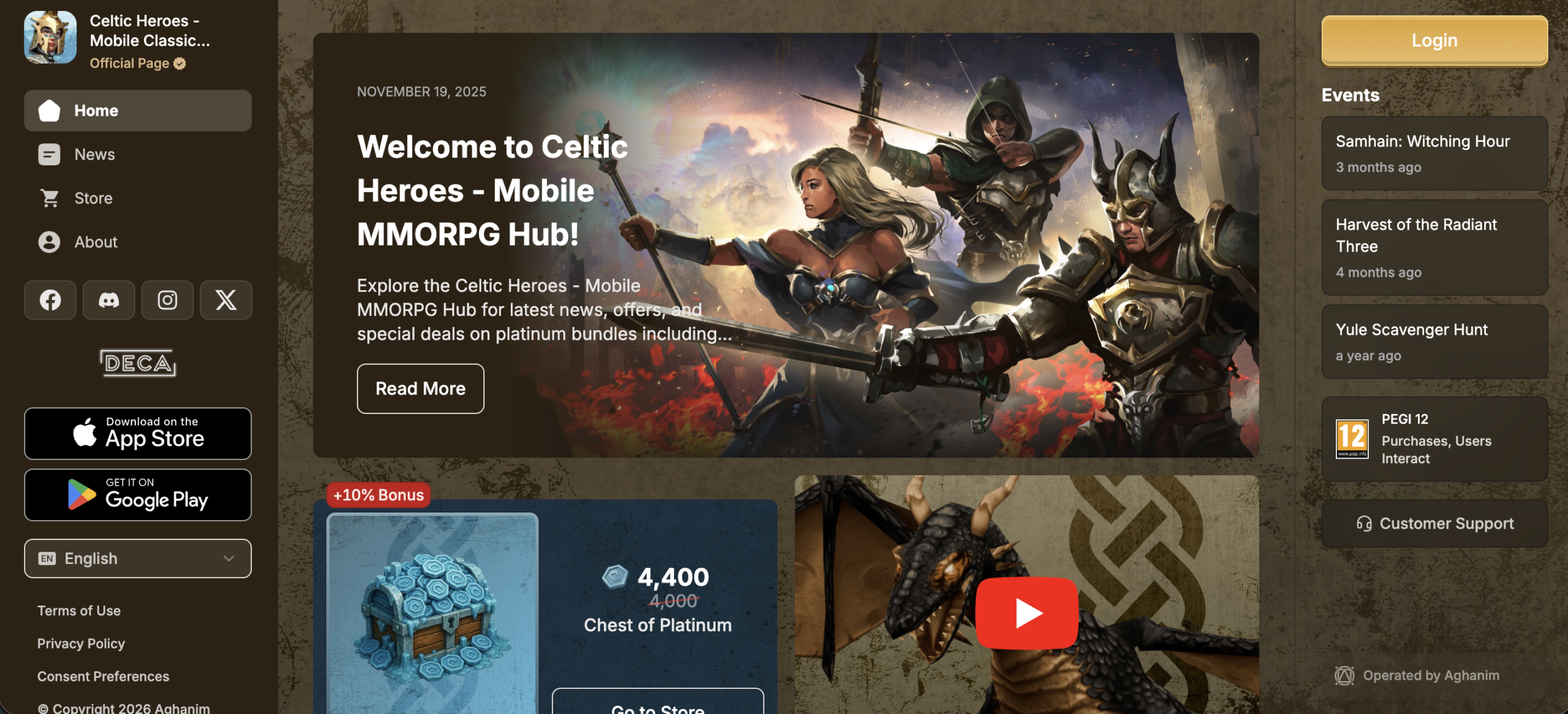
Web-based stories could offer a lifeline to mobile game companies looking to increase the value of their audiences.
Earlier this month, DECA Games, the developers of the long-running mobile MMORPG title “Celtic Heroes,” partnered with the integrated commerce company Aghanim to launch a dedicated desktop-browser web store. Using Aghanim’s tech stack, DECA Games’ “game hub” allows players to spend money on exclusive premium content bundles, acting as an extension of DECA’s previous distribution strategy.
“Aghanim’s platform has the tooling to upsell players based on events that happen on the hub,” said DECA Games product vice president Puiu Fatulescu in a written interview with GamesBeat. “This is not just a direct ‘players to webshop and hope’ — this is a sophisticated pub enablement platform that maximizes offer relevancy and therefore the probability of transaction.”
DECA Games’ web store successfully helped the game boost its per-user revenue, with “Celtic Heroes” experiencing a 44 percent increase in revenue across all platforms during the game hub’s first eight days, according to numbers shared by DECA Games and Aghanim, with the web store achieving 183 percent higher average revenue per user compared to “Celtic Heroes’” in-app purchases. 34 percent of players who visited the game hub made a purchase, with a DECA Games representative saying there was no cannibalization of mobile in-app purchases as a result of this activity.
“In platform-restricted environments, live ops is typically calendar-driven: predefined events, broad segments, and limited feedback loops. Studios plan content in advance and then wait for results, often with little visibility into why players behave the way they do,” said Aghanim chief revenue officer Conor McLaughlin in a written interview with GamesBeat. “With the game hub and direct access to player behavior across both game and the platform studios can observe how players actually move through offers, where they hesitate, where they convert and how their spending patterns evolve over time.”
In the wake of Epic Games’ legal challenges against Google and Apple in recent years, initiatives like the “Celtic Heroes” game hub represent mobile game developers’ ongoing push to free themselves from relying on platforms like Apple, Google and Steam for distribution. As a result of the freedom offered by operating an independent web store, McLaughlin flagged additional benefits of the game hub approach, including increased data about player activity and the creation of a premium environment to capture the interest of high-value spenders.
“Mature live games tend to feel this need first, because their economics are already well understood and margins matter more than raw scale,” he said. “At that stage, improving efficiency often has a bigger impact than adding new content or chasing incremental growth. That said, we don’t see this as something inherently limited to mature titles. As soon as a game reaches meaningful scale, the question naturally shifts from ‘how can we grow?’ to ‘how do we operate distribution in a sustainable and controlled way?’