
GlobalFoundries, a big contract chip manufacturer, has agreed to acquire Synopsys’ ARC Processor IP Solutions business, including its teams of about 200 engineers and designers.
The purchase price wasn’t disclosed. This strategic move, coming off its acquisition of processor architecture design firm MIPS in Augus 2025, will accelerate GlobalFoundries’ and MIPS physical AI roadmap and strengthen their capabilities in custom silicon solutions.
The proposed acquisition includes the ARC-V, ARC-Classic, ARC VPX-DSP and ARC NPX NPU product lines as well as the application-specific instruction set (ASIP) processor tools including ASIP Designer and ASIP Programmer.
Upon closing, these assets and expert teams will be integrated with MIPS, a GlobalFoundries company, to deliver a comprehensive processor IP suite, especially tailored for physical AI applications. The expanded offering will enhance engagement through IP licensing and software, enabling faster time-to-market for GF’s customers.
The integration of Synopsys’ ARC technologies, which includes high-performance, mid-range and ultra-low power compute and AI cores, will enable scalable, energy-efficient processing solutions. With a strong patent portfolio, a global customer network and proven engineering expertise, this acquisition will accelerate innovation for wearables, robotics, AI-driven consumer applications and advanced AI silicon.
“This acquisition doubles down on our commitment to advancing our leadership in Physical AI. By combining Synopsys’ ARC IP and MIPS technologies with GF’s advanced manufacturing capabilities, we are lowering the barrier for customer adoption of the essential technologies that our customers need to innovate faster for the next generation of compute and AI applications,” said Tim Breen, CEO of GlobalFoundries, in a statement. “This move will strengthen our differentiated technology roadmap and position GF to deliver end-to-end solutions for our customers that will support the expansion of AI-enabled devices into the physical world.”
Synopsys will retain and continue to grow its broad design IP portfolio spanning logic libraries, embedded memories, interface IP, security IP and subsystems.
“This transaction enhances the focus of Synopsys’ IP business on furthering our leadership in essential interface and foundation IP while winning new, high-value opportunities that advance our position as the leading provider of engineering solutions from silicon to systems,” said Sassine Ghazi, president and CEO of Synopsys, in a statement. “GF will be an excellent future steward for the processor IP solutions business, enabling customers worldwide to benefit from continued, strong competition in the development and delivery of processor IP solutions.”
The acquisition of Synopsys’ ARC and ARC-V Processor IP Solutions business is subject to the satisfaction of customary closing conditions, including the receipt of required regulatory approvals, and is expected to be completed in the second half of calendar year 2026. Following the acquisition, GF will work closely with Synopsys to ensure a seamless transition for employees, customers and partners.
James Prior, head of marketing at MIPS, said in an interview with GamesBeat at CES 2026 that MIPS has been building its portfolio under GlobalFoundries with a focus on RISC-V and AI technologies with customer-forward custom chips.
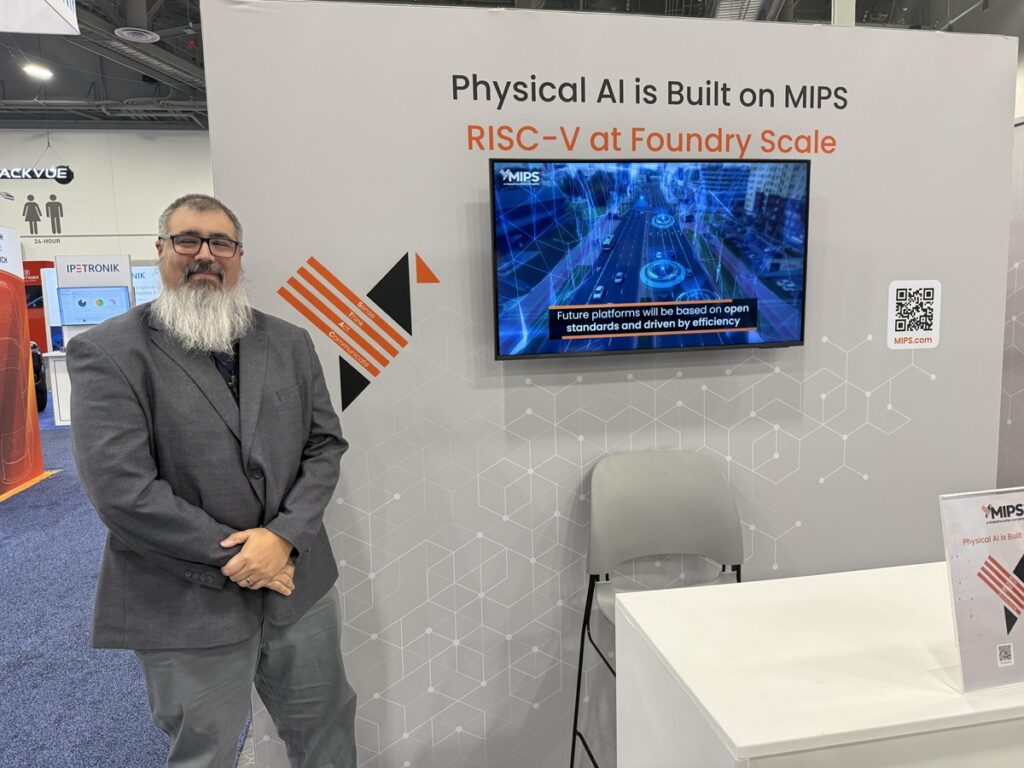
“Global Foundries and MIPS are growing the physical AI RISC-V ecosystem,” Prior said. “We are going from being just a pure IP firm to having development boards and other tools and pieces of the puzzle. We are talking about RISC-V at foundry scale.”
Prior said that customers are asking for a few things, like taking AI processing out of the data center and moving it to the edge for the sake of reduced bandwidth consumption, lower power consumption, efficient processing at the edge and better data privacy. Customers also want safety and mission-critical capabilities and they want to understand the code they will run before selecting which chips to use. That means they want virtual platforms to vet code and hardware ahead of time.
“That gives us a lot of opportunity for customization like bigger caches or more cores,” he said. “Those kinds of decisions can be done pre-silicon.”
He also said customers don’t want proprietary lock-ins and prefer standardized tech. And they also want the ability to transfer tech and manufacturing from one foundry to another. They want the benefits of economy of scale, reuse, code portability and scalability, Prior said.
In general, MIPS is not targeted at smartphones or data centers. Rather, it is focused on silicon for embedded applications like automotive, industrial robotics, aerospace/defense and industrial networking. As for physical AI, Prior thinks of it as taking AI out of the data center and putting it into physical devices like robots. MIPS is shipping a few products shortly and it has another one coming at the end of the first quarter.