
AI is rapidly reshaping game development, but most solutions today carry steep performance requirements, unpredictable cloud costs, and long-term data-governance questions. A new Toronto-based startup, Databiomes, believes it has an alternative: one designed around the realities of game production rather than retrofitted from enterprise AI.
The company has unveiled its Databiomes Platform, a suite of lightweight AI agents that run locally on consumer CPUs, enabling real-time NPC behavior, dialogue, and development automation without taxing a computer’s GPU or relying on cloud inference.
The idea is simple: GPUs are already overloaded running modern 3D engines, while cloud-based LLMs introduce latency, recurring costs, and privacy hurdles. Databiomes wants to move game-facing AI back onto the CPU, which is something co-founders Steven Gans and Tomasz Klempka say modern hardware is finally capable of handling efficiently with the right inference engine.
“We’ve been working on our Databiomes features since 2024 as we saw a need for how game developers could be better equipped,” Steven Gans, chief executive officer and co-founder of Databiomes, said in an email interview. “By offering the first CPU solution, we enable all developers to add AI to games without these issues. We think the time is right for this shift as game development continues to evolve, and developers need more ways to innovate and deliver quality to their products and experiences.”
Using $1 million in pre-seed funding and their combined experience at Intel, AMD, Arm, and IBM, the six-person team built a custom nano-language-model pipeline that trains small, specialized models in under 24 hours using developer-provided data. The result is an AI agent that a studio owns outright, with no royalties, subscription fees, or external data exposure.
“By building the inference engine from scratch for a specific language model architecture and for CPU only, we were able to build a specialized engine and not a general-purpose one,” Gans said. “Through this efficiency, we have achieved leading benchmark numbers. We’re really proud of our results, and we’re only at the beginning of what we know will pave the path for democratizing AI for game developers.”
AI agents built for game development
From a business perspective, that ownership shift is significant. As production budgets expand and live-service games demand more scalable content, studios are wary of tools that introduce long-term operational costs.
Databiomes positions its platform as a fixed-cost, local solution starting at $100 per agent for indie teams, with enterprise pricing tied to specific agentic capabilities—it mirrors the emerging trend of “small and specialized” AI replacing monolithic foundation models.
But the platform’s biggest selling point may be its performance profile. Running AI inference on the GPU can eat into frame budgets and introduce variability—problems that become acute in VR, competitive shooters, and large-scale simulations. By shifting computation to the CPU and a small RAM footprint, Databiomes claims its agents operate with minimal impact on framerate, allowing studios to deploy features like real-time NPC dialogue, dynamic state machines, or adaptive enemy behaviors without compromising visuals or responsiveness.
“We are seeing the immediate win on in-game routing/state machine augmentations,” Gans said. “Without AI, developers need to account for all cases in a state machine and continuously update these complex graphs. Our Databiomes AI agent can replace these entirely and allow games to go beyond the standard state machine, thus making gaming more immersive and expansive without the additional complexities and costs.”
There’s also a practical angle developers will appreciate: integration. The startup cites a major industry pain point—according to Gartner, more than 60% of AI initiatives fail to reach production due to complexity and inconsistent performance. Databiomes avoids external dependency chains by partnering with Intel, AMD, and Arm to optimize for consumer CPUs and NPUs, ensuring predictability across devices. The company’s platform also folds training, inference, moderation, and runtime integration into a single pipeline, reducing the engineering overhead typically required to deploy AI systems inside real-time engines.
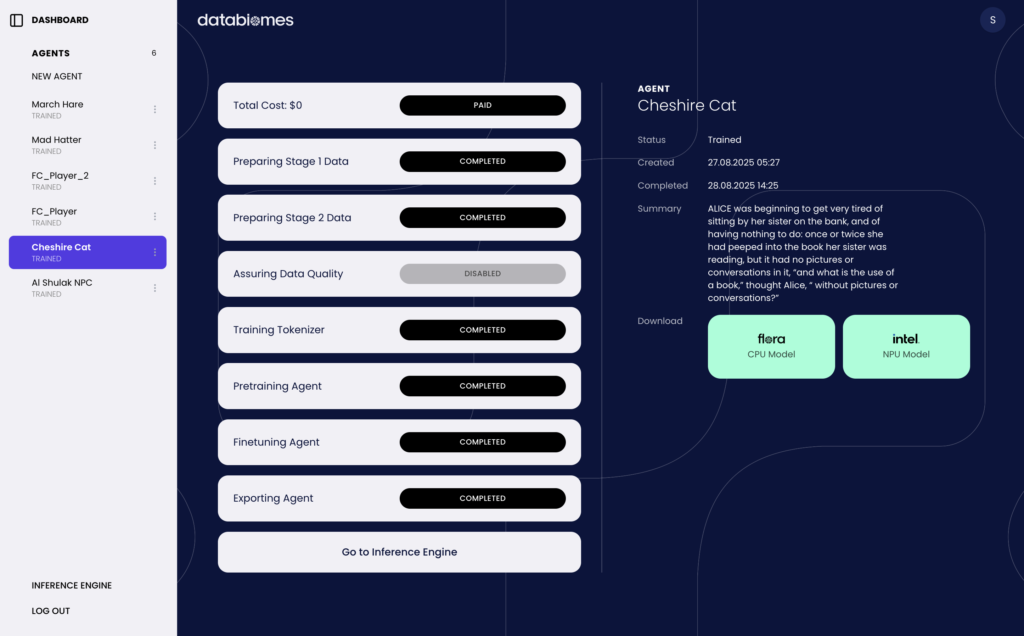
For game teams already experimenting with AI-assisted toolchains, Databiomes’ pitch is enticing: create NPCs that speak naturally, build AI-driven behaviors, prototype interactive worlds, or automate production tasks—without sacrificing frame time and without sending data to cloud providers. It aligns with a broader industry shift toward edge AI, where localized models deliver real-time responsiveness and tighter creative control.
“The model can be offloaded to the NPU (Neural Processing Units integrated into CPUs for AI processing) instead of running on the CPU,” Gans said. “We are very cognizant of how different developers and games are, so our own development has been keeping in mind the need to scale for each and every need from small indie to large-scale AAA.”
The company is still early in its lifecycle, but its positioning taps directly into conversations happening across studios—especially as publishers evaluate how to adopt AI meaningfully without destabilizing pipelines or budgets.
If Databiomes can deliver on its promise of CPU-native AI agents that scale across genres and production styles, it may become a key player in the next wave of developer-facing AI infrastructure.