
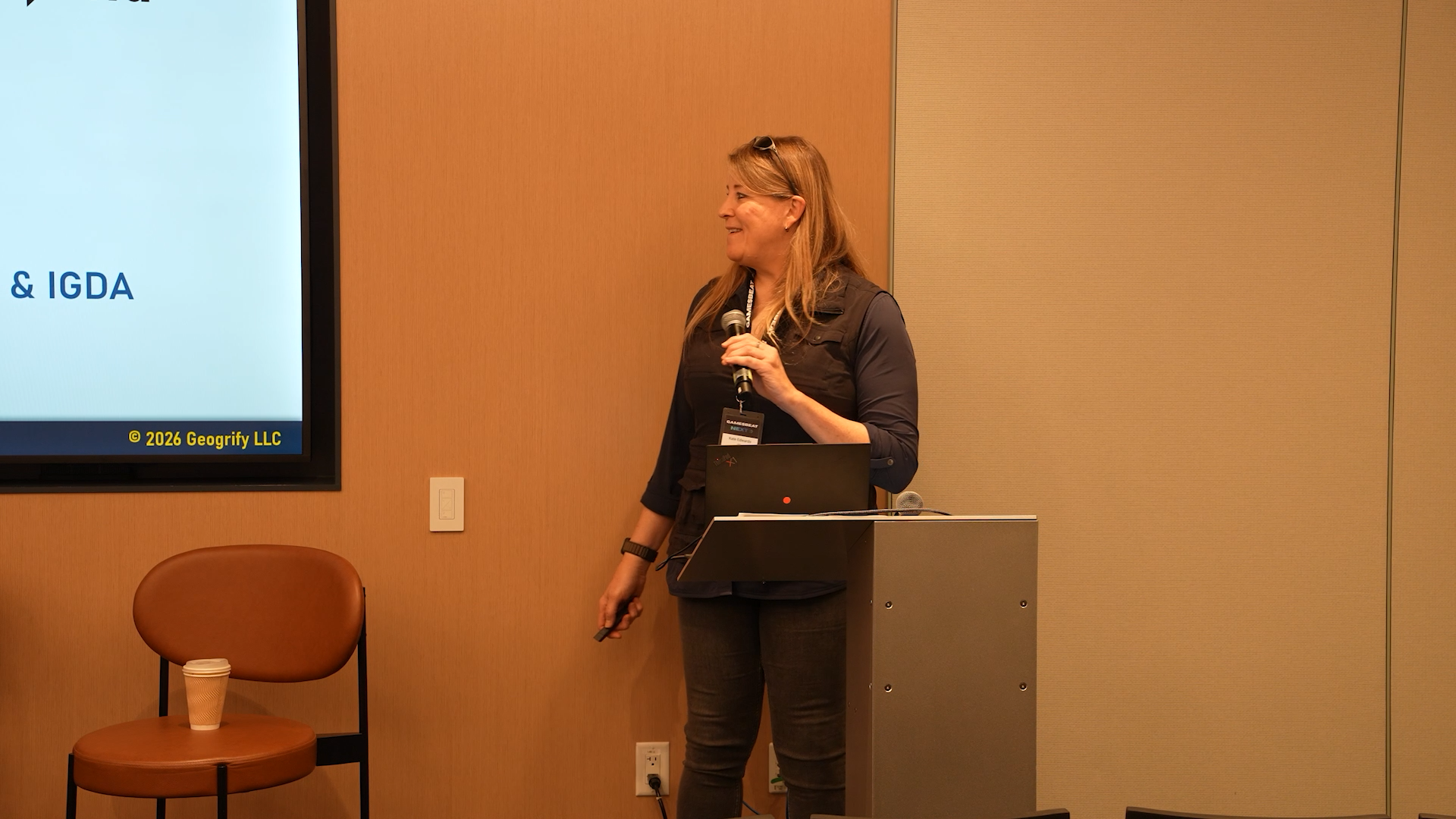
Kate Edwards, CEO of Geogrify, believes that games will be part of the record future generations use to understand our current era, and that generative AI may be a big part aof the traces we leave behind.
Edwards spoke at GamesBeat Next 2026 in San Francisco in a session on games, culture and AI. Originally a geographer, she said she has done culturalization work within the gaming industry for 33 years now, and has collaborated on over 325 titles, mostly AAA. Edwards spent 13 years of her career at Microsoft, where she brought together a Geopolitical Strategy team, and has led the IGDA and Global Game Jam in recent years.
To Edwards, every game is a cultural artifact, whether or not its creators intended for it to be received as one. She called the debate over whether games count as art a distraction, since there will always be disagreements about the quality of art. Games are culture because they are evidence of the people who made them, she argued, and a thousand years from now they will show that this generation was here and had stories to share. She pointed to BioWare’s games as an example of how a studio’s output reveals its culture.
To contextualize the introduction of AI, Edwards referenced three moments from history in which a culture was met with a new technology. After Rome absorbed Gaul, she said, Celtic artisans known for their metalwork began making Roman-style pottery, which she described as disruption. The Akkadians adopted Sumerian cuneiform, and learning the script required learning Sumerian, which kept the culture alive for centuries. That was preservation. Japan took in Chinese writing in the sixth century, then developed its own kana characters because Chinese could not capture Japanese sounds well, which was adaptation.
Edwards also noted that each pattern has a modern parallel. She cited an Aboriginal group in Australia that said AI-generated art attributed to it did not represent them, a Canadian project using AI to revive Indigenous languages, and a New Zealand effort that used AI to adapt a Maori dialect for another region. History offers no single ending, she expalined, and developers shouldn’t assume extinction is the only outcome.
However, she did not reject AI entirely. Edwards specified her belief that AI can generate content in volume, while “only humans create meaning,” Edwards said, and she defined “slop” as content that lacks clear meaning and intent.
Her concerns around AI centered on what happens when many studios use the same tools. She said that produces unintentional cultural convergence, makes the most represented cultures the default answer, and replaces cultural specificity with cultural plausibility, so output can appear to be correct without being accurate. Motifs can also become detached from their meaning. AI learns broad patterns, she said, while culture lives in the exceptions, expressing little hope that this issue will be resolved in the near future.
Edwards also added that technology is never culturally neutral. As countries build sovereign AI systems, she said, developers in China, the Middle East and North America could get very different answers to the same question that the US is seeking out. Games made through those systems would then be evidence of the system’s rules rather than of what their creators wanted to say. She urged developers to decide where human creative agency ends and the technology’s begins, and to ask whether they are checking AI output or trusting it too much.
She tied the argument to players’ attachment to physical media, calling it a desire for proof that they took part in something.
In Q&A, an attendee asked whether sovereign AI would counter the convergence she described. Edwards said it would, but by pushing cultures further apart and reinforcing local narratives that outsiders struggle to read. Asked whether people trust AI too much, she said people assume maps are correct even though every map carries bias, citing California’s appearance as an island on maps for roughly 400 years. AI, she said, speeds up that kind of error.