
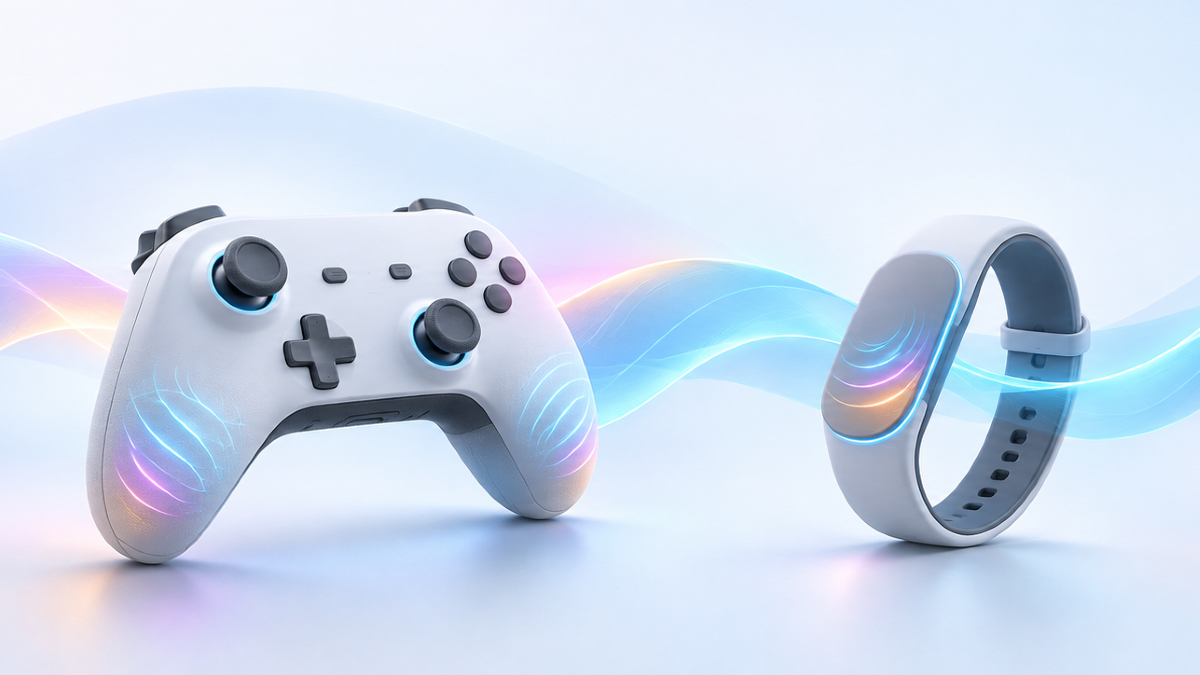
The Haptics Industry Forum (HIF) has announced Universal Haptics Protocol (UHP) 1.0, an industry-developed framework for communicating touch feedback between software and haptic devices. Created through HIF’s Protocols and APIs Working Group, UHP gives applications, game engines and device manufacturers a common vocabulary for haptic playback across a wide range of hardware.
Haptic technology has advanced across controllers, simulators, wearables and other devices, yet the interfaces used to deliver touch feedback remain fragmented. Similar effects may require different commands and integration work from one product to another, complicating development and limiting the reach of haptic content. UHP addresses this challenge by establishing a shared way to describe haptic feedback and discover what each device can deliver.
UHP introduces common haptic building blocks, including Impulse, Vibrate and Pause, with parameters such as duration, intensity, frequency and sharpness. Compatible devices report their capabilities, channels and supported playback features, allowing software to tailor haptic requests to the connected hardware. Endpoint identifiers help direct effects to locations such as a controller grip, trigger or racing seat.
For example, a driving game could request collision feedback on a controller and racing seat. The controller might deliver a sharp pulse through the grip while the seat produces a deeper physical response. Both can respond to the same kind of haptic request, with each manufacturer shaping the experience through its own hardware and rendering technology.
“Haptic technology has made significant advances, but fragmentation across software and hardware continues to limit its potential,” said Tim Szeto, chair of HIF’s Protocols and APIs Working Group and founder and CEO of TITAN Haptics. “UHP establishes a common language for haptic communication, making it easier for developers to support different devices while preserving manufacturers’ freedom to innovate and differentiate. It’s an important foundation for making high-quality haptics more accessible across products and platforms.”
The framework also supports sequential and parallel playback, targeted channels and layered effects, with extensions for advanced waveform and streamed audio-haptics capabilities. Designed to be lightweight and scalable, UHP can evolve alongside haptic hardware, content tools and software platforms. Its command framework is suitable for mappings into established transports such as USB HID and Bluetooth GATT.
The protocol was developed through HIF’s Protocols and APIs Working Group, with contributions from participants from Logitech S.A., TITAN Haptics, Hapticlabs, iRacing, D-BOX and the University of Waterloo.
UHP is the product of several years of collaboration. A 2021 developer focus group explored simpler ways for software to control haptic effects, followed by research into the USB HID Simple Haptic Controller and the needs of emerging applications. In 2024, HIF invited industry proposals for common haptic primitives, which the working group evaluated and refined through technical review. The UHP specification was officially revealed at HIF’s Open House on Sept. 29, 2026, bringing these efforts together in a shared framework for the next stage of research, standards integration and implementation.
With UHP as a common foundation, the working group is advancing three connected priorities:
- Research into existing protocols, emerging device requirements and interoperability gaps.
- Coordination with standards organizations and related industry initiatives.
- Practical implementation work including reference examples, transport mappings, developer guidance and test resources.
The goal is to turn a shared technical language into a growing ecosystem of interoperable haptic products and content.