

Microsoft says GTA VI is matching Xbox’s share of the console market. The numbers suggest that is true. The same numbers also show how much of that market Xbox has already lost.
In late September, Xbox chief strategy officer Matthew Ball responded to reports that Grand Theft Auto VI preorders were overwhelmingly going to PlayStation. Matthew did his best Phoenix Wright impersonation to say, “Objection!”
“We are very happy with GTA VI pre-orders,” he wrote. He said the game was breaking Xbox records, and Microsoft’s internal analysis showed that Xbox’s share of preorders was “matching our share of the console market.”
It was a fair objection. More than fair, as it turns out.
Sensor Tower’s public tracker now puts Xbox at 26.1% of PlayStation-and-Xbox preorders through October 3.
So Ball may be exactly right. But…That’s a problem.
GTA VI is not causing Xbox’s decline. It is putting a number to the premium-console audience Xbox has already lost.
When the numerator looks fine, look at the denominator.
The easy read of the preorder split is that GTA VI is simply failing on Xbox. The data does not support it.
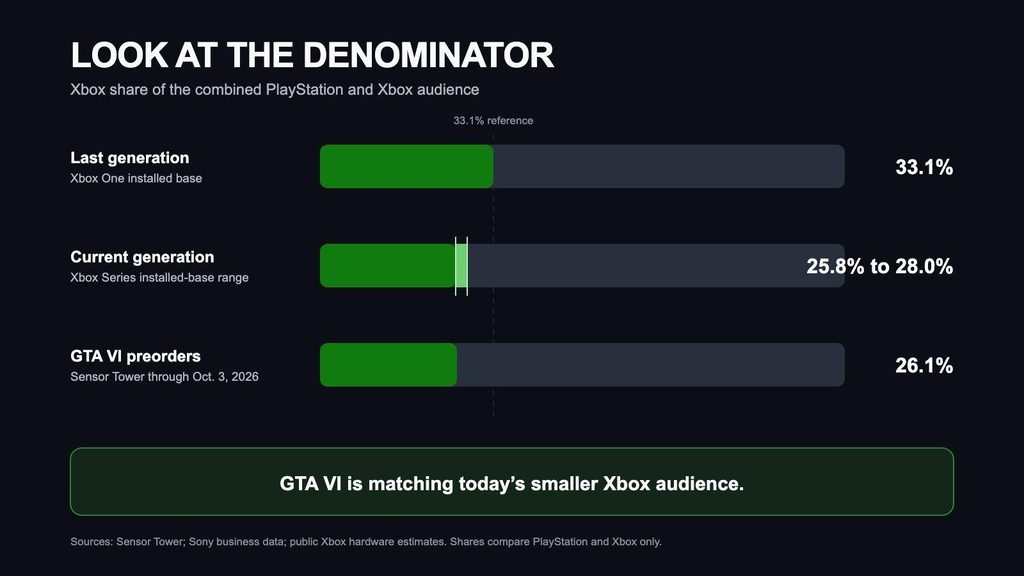
At 26.1%, Xbox is roughly where its current footprint says it should be. The figure sits inside public estimates of Xbox’s installed-base share. It is also above Sensor Tower’s separate estimate of its recent share of PlayStation-plus-Xbox action-game revenue.
But let’s not get hypnotized by the decimal. Sensor Tower materially revised the split on October 5. Its tracker and Video Game Insights are related estimates, not independent confirmation, and neither is Take-Two’s ledger.
Ball also did not say which denominator he meant: boxes sold, active devices, active users, or addressable GTA customers. Depending on the answer, the comparison changes materially. So, let’s not manufacture precision the data cannot bear.
The trend is hard to miss. Xbox represented roughly one-third of the combined PlayStation-and-Xbox base last generation. Public estimates put it closer to one-quarter today. GTA VI is tracing that smaller audience.
If the biggest game of the generation sells in proportion to that shrunken audience, the preorder campaign has not created a new Xbox problem. It has measured the damage already done.
The casual audience moved
Grand Theft Auto gives us the snapshot. My friends at Alinea Analytics gave me a way to look backward: worldwide cumulative paid-copy estimates for Red Dead Redemption 2 and six consecutive FIFA/EA Sports FC releases. The series excludes subscriptions, free weekends, and other unpaid promotions. Alinea counts a sale when the game is activated on the platform, so it catches physical and digital purchases across the past two console generations.
Red Dead Redemption 2 is the cleanest Rockstar benchmark. Xbox represented 41.0% of its combined Xbox-and-PlayStation copies on launch day, 44.8% after 14 days, and 44.9% after 29 days. It is not a like-for-like comparison with a GTA VI preorder snapshot, obviously, but the last major Rockstar launch was far less tilted toward PlayStation.
Then look at FIFA/FC. At roughly the first month represented in each series, Xbox’s share falls from 35.8% for FIFA 22 to 29.4% for FIFA 23, 25.0% for FC 24, 22.5% for FC 25, 22.9% for FC 26, and 16.7% for FC 27 through October 22. Alinea’s Rhys Elliott checked the math and agreed with the interpretation. Do not over-read the exact day: Alinea says its estimates get better after the first week, and the older series do not share one tidy day-zero convention. These are rounded, roughly first-month checkpoints and not stopwatch comparisons. Even so, the slope is not subtle.
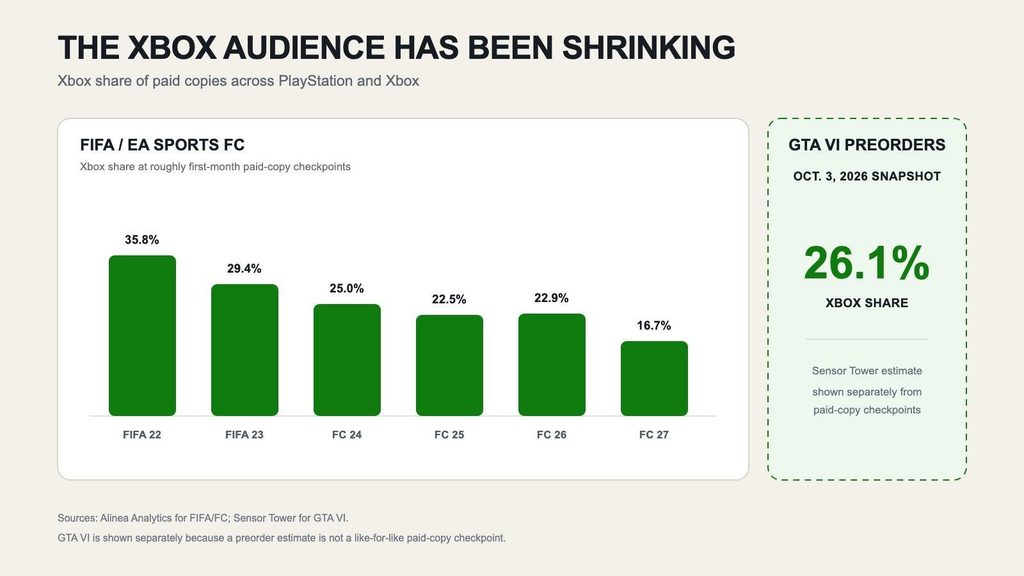
Why use football as the comparison? Because the audience overlaps. In Alinea’s public FC 27 analysis, Rhys reports that 81% of FC 26 players on Xbox One had previously played GTA V. That does not prove they switched platforms (it doesn’t). It does tell us the erosion is happening among the broad console audience GTA VI is supposed to reach, rather than in some convenient niche.
Which brings us back to Ball. At 26.1% in the latest Sensor Tower snapshot, GTA VI does not look uniquely weak on Xbox. Against FC 27, it may be over-indexing current Xbox purchase behavior.
Instead, the indictment is historical: Xbox once captured close to half of Red Dead Redemption 2’s two-console launch audience and more than a third of FIFA 22’s early sales. The newest FC is below one in five.
What is the lost audience worth?
This is where Microsoft Gaming and the Xbox platform stop being synonyms. Alinea’s title-level data does not validate a marketwide dollar estimate, but it gives us a concrete example of the economics moving.
Thirty-seven days after launch, Alinea estimated $758.0 million in FC 27 gross revenue on PlayStation and $141.9 million on Xbox. Against FC 26 at the same checkpoint, PlayStation was up 47.5%; Xbox was up 6.2%. Put differently, nearly 97% of the two-console growth happened on PlayStation. Xbox’s share slid from 23.2% for FC 25 to 20.6% for FC 26 and 15.8% for FC 27. One annual sports release, especially one selling editions as high as $150, cannot stand in for the entire premium market. But it makes the mechanism painfully concrete: the franchise returned to growth and Xbox captured almost none of the upside.
Sensor Tower’s latest premium-market estimate puts Xbox at about 26.5% of PlayStation-and-Xbox consumer spending. If Xbox still held the roughly one-third share it had in the Xbox One generation, about $1.2 billion more premium spending would flow through its ecosystem each year.
Before anyone turns that into a headline: $1.2 billion is not lost Microsoft revenue. Some of the spending is physical, some is first-party, store commissions vary, and subscription economics are different again. Converting the gap into platform value requires an assumption.
I used an effective platform-capture range of 15% to 25%, deliberately below the familiar 30% store fee. That produces roughly $180 million to $300 million a year of platform economics, or about $700 million to $1.2 billion in present value if the gap persists for five years (discounted at 10%).
This is a sensitivity, not a reported Microsoft result. It assumes premium spending would rise with hardware share, and it omits hardware contribution, Game Pass, add-ons, advertising, engagement, developer priority, and network effects. IMHO the useful conclusion is the order of magnitude, not the third decimal place.
The tax is not theoretical. It is the difference between owning content and owning the customer.
Microsoft owns Call of Duty. When somebody buys it on PlayStation, Microsoft still gets the publisher economics. Sony owns the storefront, takes the platform toll, controls discovery, sees the transaction, and keeps the player inside the PlayStation relationship.
Microsoft has not lost the copy. Xbox has ceded the store fee and everything around it: identity, checkout, entitlements, discovery, community, and the next transaction.
This distinction was at the center of my last two pieces. I was there when we built the original Xbox; the point was never merely to sell another box. The box earned Microsoft a customer relationship and a place at the platform table. Microsoft can now own one of the industry’s strongest content portfolios while the Xbox platform underneath it continues to shrink. Those two things are not contradictory.
This is a test we can grade
The advantage of publishing this before November 19 is that we can write down the test before we know the answer.
We will compare Xbox’s paid-copy share with PlayStation at day 7 and day 14, using the same source and definitions.
If Xbox lands between 24% and 28%, Ball’s narrow claim holds. GTA VI will have converted the audience Xbox has about as well as PlayStation converted its audience. The story will be accumulated platform loss, not a GTA-specific failure.
If Xbox falls below 22%, the problem is worse. That would suggest GTA VI is under-indexing even against Xbox’s smaller installed base. We would then need to test active users, Series S and Series X performance, geography, marketing, digital conversion, and platform trust before assigning a cause.
If Xbox exceeds 29%, the strongest version of this thesis weakens. GTA VI would be over-indexing the estimated hardware base. We should say so plainly and ask what let one extraordinary game activate Xbox customers more effectively than the rest of the premium market.
The space between those thresholds is gray, not an invitation to round toward whichever answer makes the better headline. These are editorial guardrails, not statistical confidence intervals. If Alinea or Sensor Tower supplies model-error guidance, we will adjust them.
Matching share is not a growth strategy
Matthew Ball was answering a tactical accusation: GTA VI preorders were somehow failing on Xbox. On the current evidence, he answered it.
But Xbox says it is rebuilding the console business and restoring the platform. For that job, “we matched our present share” is hardly a victory condition.
The KPI is not whether Xbox captured 26% of one game’s sales. It is whether Xbox can make the denominator grow: more active customers, more third-party spending, more developers treating the platform as essential, and more players choosing to build their libraries and communities there.
GTA VI seems destined to become the largest videogame launch in history. It cannot rebuild Xbox’s installed base for Microsoft. It can only sell to the audience Microsoft has assembled.
Right now, GTA VI appears to be doing exactly that. And no more.
Congratulations can wait for the December data.
Jon Kimmich is CEO of Software Illuminati, a games consultancy. He worked at Microsoft for 16 years, including during the conception and launch of Xbox.
Editor’s note: The opinions in this story are those of the author and not necessarily those of GamesBeat.