
This history was crafted by Twin Galaxies
On November 10, 1981, Walter Day and John Bloch opened an arcade at 226 East Main Street in Ottumwa, Iowa. Inspired by a dream of the cosmos, Day named their business venture Twin Galaxies.
In many ways, Twin Galaxies started like any small town arcade in the early ‘80s, marking the moment that the computer age finally traded in its lab coats and vacuum tubes for curious teenagers and 8-bit microprocessors. Built on foundations established by penny arcades and pool halls, Day and Bloch plugged into the “video craze” with its promise of dizzying profits while having fun along the way.
And like the thousands of arcades that came and went, the story could have ended there, leaving us with “remember when” memories to swap with each other at gaming festivals or on social media as the world picked up and moved on.
But that wasn’t going to be the story of Twin Galaxies.
In February 1982 it published the Twin Galaxies National Scoreboard, the first attempt to keep a single, consistent record of the best scores in the country. Later that year Life magazine came to Ottumwa to photograph 16 of the best players in North America on Main Street, and the town was declared the Video Game Capital of the World.
On January 8 and 9, 1983, Twin Galaxies crowned the first video game world champion, Ben Gold, in a competition broadcast on ABC’s That’s Incredible. Guinness World Records still lists that moment today.
Twin Galaxies went on to serve as the official supplier of video game records to Guinness World Records.
Today the Twin Galaxies database holds more than 200,000 verified records across more than 16,000 games, spanning every platform in gaming history.
The celebration
Twin Galaxies turned 45 on November 10, and the company marked the date the way it has marked every chapter since 1981: with a competition. This is the first of a number activities planned throughout the next year.
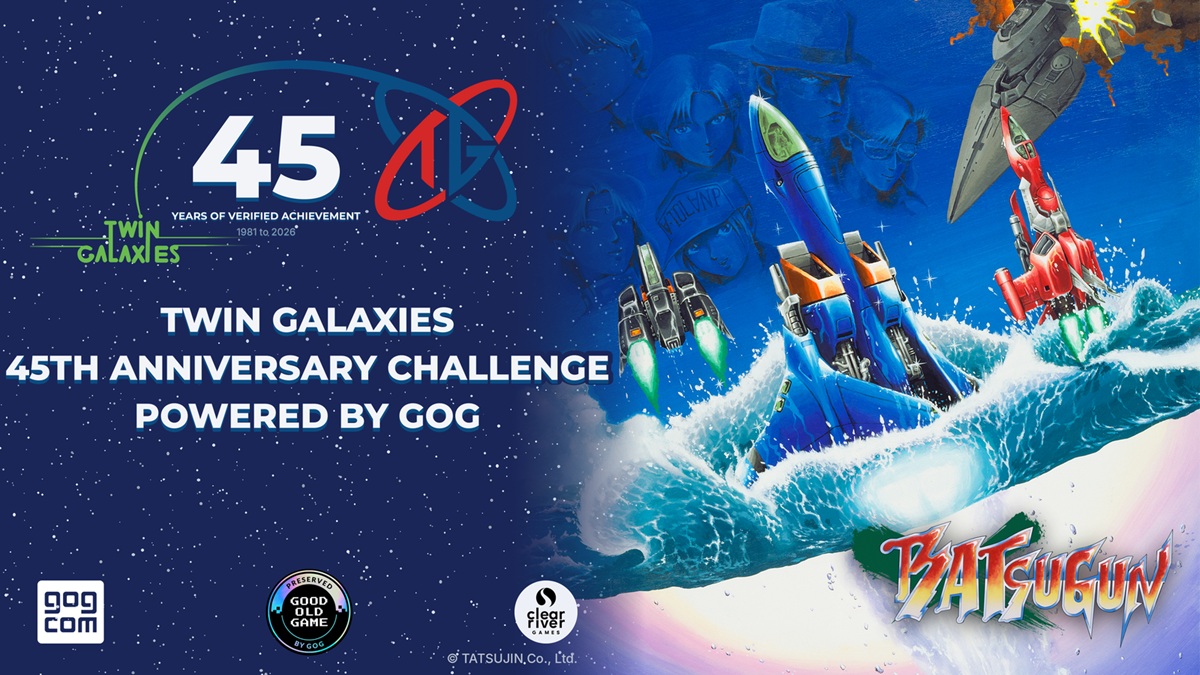
The Twin Galaxies 45th Anniversary Challenge, powered by GOG, features Batsugun, Toaplan’s final arcade shooter, in the Special Version released on PC by Bitwave Games and Tatsujin and published by Clear River Games. GOG and Clear River Games are the launch partners. The company just went live yesterday.
Key facts
- Announced Tuesday, November 10, 2026, 45 years to the day since Twin Galaxies opened in Ottumwa, Iowa
- Competition goes live Thursday, November 19 and closes Sunday, December 6
- Winners announced in December
- Batsugun is 40% off at GOG from now through December 6, so players can buy and practice before the competition opens
- The competition opens November 19 and will be promoted by Twin Galaxies, GOG and Clear River Games on their own channels
The challenge
One credit. Start at Stage 1 and post the highest score you can by the end of Stage 3, or at Game Over if that comes first. Run out of lives in Stage 1 and the score still counts, so a newcomer has something on the board from the first attempt and a veteran has three stages of routing to perfect. Every run is submitted on video and verified before it stands.
Batsugun was released by Toaplan in 1993 and is widely regarded as the bridge between the classic vertical shooter and the bullet hell genre that followed. Special Version is the brighter, slightly more forgiving cut of the game included in the PC release. Prizes will include game keys from Clear River Games and SWAG from Twin Galaxies.
The chapters
Like anything that has been around for 45 years, Twin Galaxies has had its chapters.
After a hiatus, Twin Galaxies joined the Internet age with the launch of its very first website in March 1997. Three years later, Twin Galaxies joined the new millenium with its first searchable, on-line database of video game achievements. For the next 14 years, TG operated on the basis of volunteer referees who reviewed gaming submissions mailed to them on video tape and DVD.
Given the logistical challenges of this model, TG made the next big leap forward in 2015 with the launch of an on-line submission process that maintains a full video archive of gaming achievements, which are peer reviewed by community members, known as the Twin Galaxies Submission and Adjudication Process (TGSAP).
The chapter that matters is the one being written today. Under Jace Hall, Twin Galaxies has been rebuilt around the same promise it started with in 1981: humans achieve, peers verify, and Twin Galaxies keeps the permanent record.
The verification system is the heart of it. Every submission is a video of real play by a real person. It is reviewed by human judges drawn from a community of tens of thousands of members around the world, through blind review so no judge knows who else is looking at a submission, with a dispute process that lets any result be challenged and re-examined. The system was designed with game mechanics: judges earn standing by being right, and the record is only as strong as the scrutiny behind it.
That design has turned out to matter more in 2026 than it did in 2016. Jace Hall siad, “When we built the verification system, the problem we were solving was trust between players. The problem it solves now is bigger. Anyone can generate a clip. A Twin Galaxies record means a human did it, other humans checked it, and the proof is permanent.”
The business of verified achievement
Over the past two years Twin Galaxies has turned verified human achievement into a product, for game makers and for brands outside gaming alike.
On an increasingly synthetic internet, a verified human accomplishment is the scarcest thing a brand can buy. A Twin Galaxies competition gives a brand or a game a reason to be in front of players beyond “buy my product.” The brand that makes the competition happen is the hero of the moment, not the interruption to it.
That is no longer a theory. Twin Galaxies has run competition programs with Warner Bros. Games around Mortal Kombat, including the first competition to tie a game and a film release into a single activation, around Mortal Kombat 1 and the Mortal Kombat II film.
Warner Bros. Games measured a verified 14 percent lift in concurrent Mortal Kombat players during the promoted competition, in its own first-party data against a matched control. Twin Galaxies has also run programs with Logitech G and is the co-creator and producer of the Atari World Championships.
Suggested quote, Zack Rozga of Twin Galaxies said in a statement, “Every one of those programs was a managed service. We designed the competition, wrote the rules, ran the verification and delivered the report. What the market kept asking us for was a way to do it themselves. That is what we built.”
The self-serve platform
Twin Galaxies is now opening that engine up. The new self-serve competition platform is entering beta, and the 45th Anniversary Challenge with GOG and Clear River Games is its first public competition.
Game makers can now do it all themselves – build and run their own official, verified Twin Galaxies competitions. No code changes, no SDK, no engineering time. The game maker sets the challenge in its own game, players submit video of their runs, the Twin Galaxies community verifies every entry, and the game maker owns the leaderboard. The platform facilitates prize fulfillment and delivers the same reporting Twin Galaxies has provided as a managed service.
Twin Galaxies is selecting a limited number of beta customers during beta. Several are already in. Game makers can apply at business.twingalaxies.com/beta.
Why GOG, why now
GOG preserves the game. Twin Galaxies preserves what humans accomplished in the game.
GOG has spent years keeping classic games alive and playable, and its community loves it for that.
A preserved game is a game you can still play. A competition is what makes it a game people are playing right now. Old games normally go quiet over time. A current challenge, a record chase, a historic player returning or a new player doing something nobody has done before can make a decades-old title culturally active again without anyone changing a line of the game. GOG keeps the software alive. Twin Galaxies keeps the achievements alive. The 45th anniversary is the moment to put the two together: a classic from the GOG catalog, an official Twin Galaxies challenge, and a new reason for players everywhere to play, compete and be remembered.
What’s next
When the competition goes live on November 19, the platform is officially open for business.
The Batsugun challenge is the first act of a year-long 45th anniversary program that Twin Galaxies will run from its archive through November 2027. Game makers who want to run their own can start at business.twingalaxies.com/beta