

Vivrato, a games industry consultancy headed by Adam Boyes, released the Vivrato AI Adoption (VAIA) Report 2026, saying AI is being used widely in game production but in a fairly shallow way so far.
Of the 101 studio leaders Vivrato interviewed, 94% use AI in at least one of nine production stages, but 52% rate how deeply it is built into their full production pipeline at three or lower out of 10. This finding is at odds with what many executives say publicly.
In an interview with GamesBeat, Boyes said the report draws on confidential interviews with senior studio leaders and decision makers, conducted from April to September 2026 by VAIA Games AI Research & Advisory, Vivrato’s AI research vertical. The interviewees were primarily in the North America and Europe, with a focus on PC and console development.
Key Findings
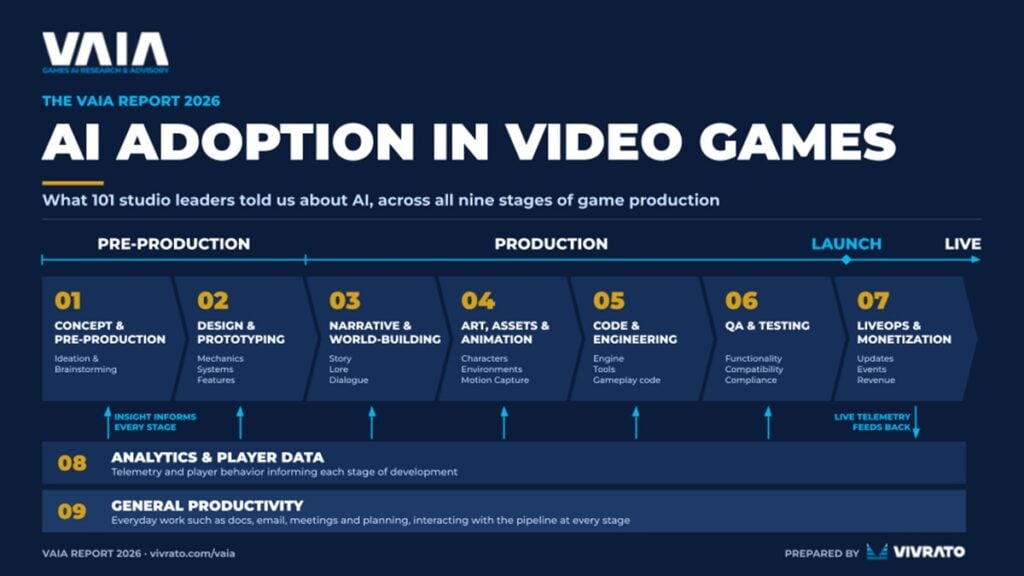
AI is already part of the development process for the majority of the studios Vivrato spoke with, but over half have yet to deeply embed it into their production pipelines:
● 101 confidential, one-to-one interviews with senior studio leaders and decision makers, conducted April to September 2026.
● 97% have used AI in some form.
● 94% use AI in at least one of nine production stages.
● Three out of 10 is the median rating for how deeply AI is built into the whole production pipeline. 52% rate it three or lower.
Boyes, founder and CEO of Vivrato, said, “We’ve noticed this year, public discourse and definitions about AI in games usually defaults to generative AI: chatbots, image generation and synthetic voices. However, we know that studios use AI in a variety of ways, from machine learning that predicts player churn to rules-based automation in testing, with very different results. That makes now the right moment to set a clear baseline, so we created VAIA, a dedicated research vertical within Vivrato to track and measure what is actually happening
behind closed doors.
Boyes added, “The interesting question isn’t around which game studios are using AI anymore. Most of the 101 leaders we spoke with declared that they have adopted some form of AI within their development pipelines. The focus is now where they’re using it, what is changing, what’s actually helping, and where teams are still running into challenges. Vivrato is in a unique position to have these candid conversations and surface real-world workflows, highlight where
approaches differ, and then help studios make better decisions about where it may or may not make sense for them.”
The report is available now in the form of the 2026 VAIA Snapshot at this web site.
The full VAIA Report 2026 is available in two editions. The Studio Report benchmarks a studio against its size cohort (1 to 24, 25 to 100, or 101+ people). The Enterprise Report includes the complete report and data annex, plus new interviews inside the client’s own organization and a bespoke, in-person session with the Vivrato VAIA research team to explore the findings in depth.
“One of the biggest things is just our position and what we think people should be doing. I think is really important. And after talking to everyone, our stance is kind of simple. It’s being thoughtful about how you use these tools,” Boyes said. “It’s measuring everything that’s occurring, keeping humans in a loop and creativity at the forefront of what you do. And then talking about it openly with your team and your players. I think those are the four things that we are concluding in the best practices. It’s just so fascinating to see how different people are using it in different ways.”
What led to the survey

Boyes started handed out a deck of cards that listed all of the major problems of the industry. But he found that with AI, people pointed to a lot of problems but then talked about it privately.
“I started to talk to people privately, and they started telling me how they’re using tools and where they’re using tools. And then I would go to these conferences, and no one would say anything,” Boyes said.
It reminded him of the early days of virtual reality, when people were getting nauseous and throwing up because of motion sickness with the VR headsets. To deal with it, the VR games industry banded together to share best practices, he said.
“Right now, I think a lot of players just, when they think about AI, think chatbots and AI slop and stuff like that,” Boyes said.
So he sought to find out how studios were actually doing the research with AI tools, and to talk to them about it.
Doing things in secret

Execs have this cautious curiosity about how AI can help, but they’re hampered from talking about it because of negative public feedback. And rather than send out online surveys, Boyes thought the best way to get to the root of opinions was to sit down in conversations and ask the questions.
“To me, what that means is that people are still dabbling and they’re still trying to figure things out,” he said.
He focused on North America and Europe because different regions outside of North America and Europe have different proclivities and are more enthusiastic. He also felt that the hesitancy about AI was focused on the PC and console space. The vast majority of respondents were CEOs, studio heads and general managers, he said. It took six months to do the report, and the respondents answered 44 questions and spent a lot of time on open-ended feedback.
“We we dug in and asked them where they’re using AI and how they’re using it, what’s working, what isn’t, fears, inhibitions. That was really fascinating,” Boyes said. “But we also wanted to quantify what AI means, as a lot of people think it’s just ChatGPT.”
About 72% of all the respondents were CEOs or founders or presidents or GMs or studio heads, and then 15% were chief technical officers, CPOs, creative or tech directors, and then we had the rest were VPs, directors, leads, and specialists. About 43% of the studios were about 24 people or so. Another 31% were above that and less than 100, and then 26% were larger companies.
One of the problems was reticence about diving in because the AI models change so frequently.
Some talked about how people in the team don’t like AI or don’t want it. There’s a lot of juxtaposition on teams of the pull-push pressure of leadership wanting it sometimes and team members not, and then of course the player sentiment, he said.
“Some find this utopia and they’re excited about what’s possible,” he said.
When it comes to generative AI, staff will use it to create prototypes or concepts. they can quickly refine that and move faster. Communicating ideas to different people through AI tools is very powerful, but most did not want to see AI creations in the final product. Use in narrative world building was very low and that was not surprising, Boyes said.
“People are just not relying on AI for writing stories and building stories,” he said.
As far as what is holding back, that includes player sentiment, staff feelings, budget, the tools themselves, concern about job losses, fear and lack of time.
One interesting finding: Europe is moving into AI faster than North America.
“To me, this is this is super fascinating. We’re digging a lot more into why the motivating factors are,” he said.
The report didn’t look at Asia, but the impression is that the Asian game companies are moving faster on AI than the West, he said.
The need for open conversation

Boyes said the report came from going to conferences and having “incredibly compelling conversations privately over dinner, and then as soon as someone else joins the conversation, people just zip up.”
He added, “It just felt like we are in this weird place as an industry where we’ve always been frontier people. We’ve always been pioneers, we’ve always been cutting edge, and right now I feel like we’re like” being slow and deliberate.
On the other side, consumers have valid concerns and they’re frustrated where the industry is going with AI, he said.
“You take all the change and tumult that’s happening in the industry, and then you also inject this new technological innovation. It’s our job, and I think my job too, to to uncover that, so that the studios don’t have to be the villains. I’d rather us talk about the trends, the best practices, and create a safe space for us to be looking first, versus everyone having to do it in secret underground lairs.”
Methodology
VAIA is a structured interview study, not an online survey. Between April and September 2026, Vivrato held 101 confidential conversations with senior studio leaders, primarily at studios headquartered in North America and Europe. Each conversation followed the same 44-question guide and covered the same nine production stages. Answers are anonymized and reported only in aggregate. No individual or company is identified. The research was reviewed by independent games-research analysts.
The surveyors asked about six types of AI, including generative AI with LLMs, image and audion generation; classical machine learning: prediction, classification, clustering; rules-based automation: scripted logic, decision trees; RAG: retrieval-augmented systems; fine-tuned or custom-trained models: models adapted on a studio’s own data; and agentic systems: autonomous AI workflows.