
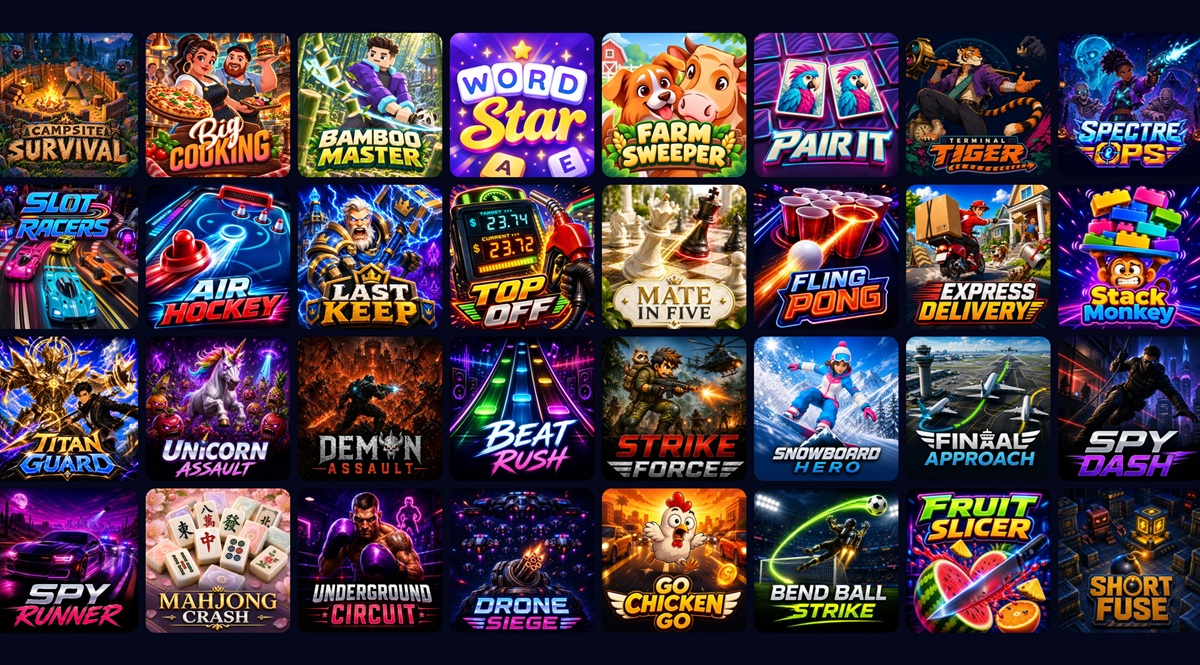
Astrocade is one of a number of game companies focused on creating platforms for players to engage with AI-produced games.
In the past four months, Astrocade has seen its monthly active user base grow from five million players to ten million players. And those players are playing 220 million gameplay sessions a month across more than 100,000 “playable” casual games made by third-party creators.
That growth has happened before Astrocade’s first deliberate U.S. push, with millions of people already using an endless feed where the content is played rather than watched, said Amir Sadeghian, Astrocade CEO, in an interview with GamesBeat.
“We have crazy numbers there, and we basically have hundreds of thousands of creators now across 99% of the countries in the world, or 191 of 193 United Nations countries,” he said. “The two countries that we don’t is North Korea and Tavulu.”

Now the company is prepping for its launch on iOS for its user-generated playable experiences, which Sadeghian calls “playables” rather than games. He believes Astrocade is evolving from an AI creation product into a consumer entertainment platform at meaningful scale.
He said, “The whole the reason we exist as a platform is the AI creation tools, which enables everyone to create. And I think the the advantage of Astrocade is we have a lot of data to be able to train our models and improve our models. To be able to basically train models that are built for generating fun stuff for the audience because we have the end-to-end signal all the way to fun. We have the distribution, we have the creation, we have recommendation, and I think that is the biggest advantage for Astrocade.”
The distinction between playables and games is intentional. Astrocade sees the opportunity extending beyond conventional gaming into a broader category of short-form interactive content. Early experiences include games, AI companions, educational content and interactive simulations, with creators beginning to experiment with formats that do not fit neatly into existing gaming categories.

The company is focused on growth for now, and monetization and profits will be a priority in the future. For now, the Palo Alto, California-based company is doing pretty good since it raised $56 million in funding in May from investors including Sequoia Capital, Sea, Google AI Futures Fund, Nvidia and others.
Sadeghian started the company in 2022 with his brother Ali Sadeghian and researcher Fei-Fei Li, who just sold her AI research lab to AMD for $8.2 billion. Amir Sadeghian holds a doctorate from Stanford, where he researched artificial intelligence. Before starting Astrocade, Sadeghian was founding director of AI/R&D at Aibee.
With players creating their own games, Sadeghian believes that advances in AI could dramatically lower the technical barrier to creating interactive content, which historically required coding expertise, artwork, assets and development teams.
Astrocade is making a consumer platform where people can create, publish, discover and play
interactive content. Rather than requiring traditional game-development skills, Astrocade allows creators to turn ideas into playable experiences using natural-language AI tools and immediately distribute them through the same platform.
While AI has proven controversial in hardcore gamer circles, Sadeghian said his audience doesn’t really care how the content was created as long as it is fun.
“The technology has become so good on our creation side that it’s very hard to also know that these are made with AI,” he said. “AI is now like writing code better than a lot of engineers. So that part is actually better. And even some of these 3D assets are getting to a point that it’s like very hard to distinguish.”
Asked if the company sees itself as a new kind of Roblox, Sadeghian replied that he thinks its more like a new kind of YouTube. The UGC creators are paid based on how much their games are played.
“We are focusing on user growth right now. We are at 10 million monthly users, and I think sometime next year we’re going to start prioritizing the revenue.”

Now there are hundreds of thousand of playables published monthly. The firm itself has a few dozen employees.
For more than a decade, major consumer feeds have largely been built around content people
watch, read or listen to. Astrocade is exploring a different behavior: a feed where the content is
something people play and interact with. AI lowers the barrier to creating the content, while Astrocade’s feed and recommendation systems provide distribution and discovery.
Astrocade is also investing heavily in recommendation technology designed specifically around
interactive content. Traditional recommendation systems largely optimize around what someone wants to watch. Astrocade is trying to understand what an individual wants to play and interact with.
The audience is 50-50 male and female, with ages ranging from 18 to 45 or older. Astrocade’s content is stretching beyond games to include other entertainment. For instance, you can create companions who are your friends.
At first, the company started out with Unity. The team spent time converting to Javascript/HTML, and now all the games are web-based. The move away from Unity was based on an assessment that AI model performance wasn’t as good as on Javascript, Sadeghian said.
“It was just too heavy of an engine for our use,” he said. “This is one of the best transitions we’ve done as a company.”