
Brad Wardell started Stardock 33 years ago in 1993 and he has been responsible for making big titles like Galactic Civilizations, Sins of a Solar Empire, the Political Machine, Ashes of the Singularity 2 and more. Now his team has created Clairvoyance, an AI productivity tool for game developers and more.
In an exclusive interview with GamesBeat, Wardell said that Clairvoyance could become the company’s top-selling product.
“There’s a pretty good chance that this is going to be by far biggest source of revenue,” Wardell said. “It’s exploding.”
Clairvoyance runs directly on your own computer, so your AI staff can open your real projects, build them, run them, and hand back finished work, rather than living in a browser tab that can only describe what to do.
Clairvoyance started as an internal tool, built to get more out of AI for Stardock’s own game development and live operations. Wardell said the team created it to automate repetitive software and game-development operations. It was used to orchestrate cloud-code terminals, store generated data consistently, and import art assets into custom engines.
Then it expanded to asset imports, document-to-CSV conversion, localization workflows, crash analysis, build monitoring, Jira task creation, and advertising fraud detection.
The company used and refined Clairvoyance daily for two years before Stardock decided to sell it externally.
Spreading out the reach
Clairvoyance runs directly on your own computer, so your AI staff can open your real projects, build them, run them, and hand back finished work, rather than living in a browser tab that can only describe what to do. It’s free on Windows, macOS, and Linux, and works alongside the AI tools people already pay for: Claude Code, Codex, Cursor, Grok, and Copilot.
Persistent, named AI staff can take on real work. A developer hands off a bug and gets back a tested fix, compiled, run, and submitted through Perforce or GitHub. A video editor drops in raw footage and a script and gets back a cut assembled against their actual media at full resolution.
An operations team hands over an export or a P&L and gets back a working dashboard. Staff also run on standing schedules: watching a support forum every three hours, reading overnight logs before anyone’s at their desk, or screening an inbox against a press list, work that continues without anyone sitting in front of a chat window.
The platform addresses repetitive work that may consume most of a specialist’s time; the discussion cited level designers spending roughly 10% on creative work and 90% on implementation and troubleshooting.
Clairvoyance is used a lot by non-game companies, which means its general-purpose nature makes the tool a lot more valuable to more companies than just game studios.
“It’s kind of funny because we all thought AI was going to come for the writers and the artists and the engineers. Like, it’s that’s not what clairvoyance is mostly about taking care of the grunt work that’s in between all those three groups,” Wardell.
Last winter, Stardock started making it available to the public on an invite-only basis. Then it began reaching out to wider audiences. It has gone viral, and the company announced a partnership with Qualcomm. It’s not about AI generation. It manages AI workflow.
How Clairvoyance can help game companies
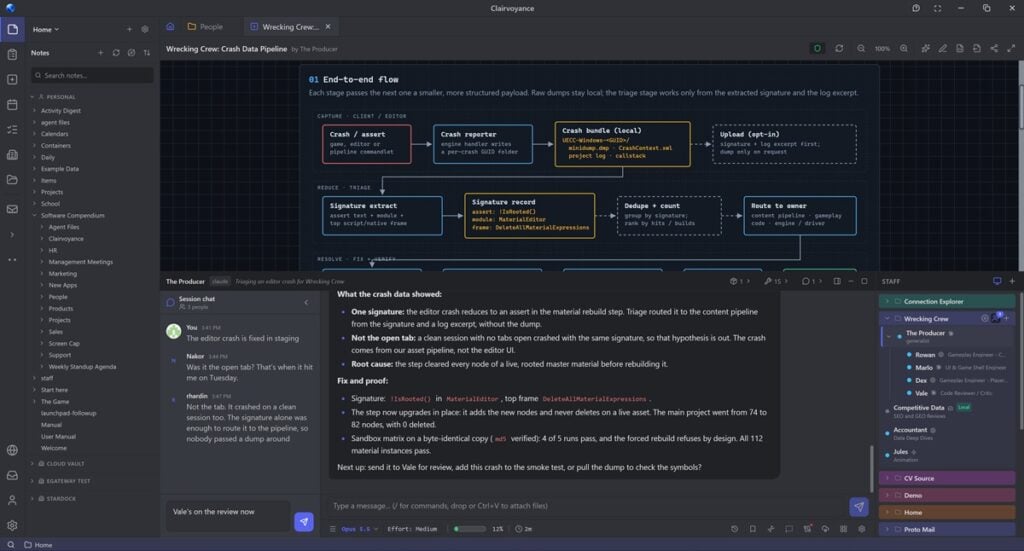
Wardell said that Clairvoyance targets workflow friction rather than replacing creative work. It can import human-created art into custom engines, convert writers’ Microsoft Word files into CSV data, analyze crash logs, pinpoint code failures, and create and assign Jira tasks.
Clairvoyance’s agents can monitor build machines, servers, driver-related crash spikes, and configuration problems, including sending phone alerts. They can also detect abnormal advertising traffic, such as bot-driven clicks concentrated in one country.
The Labor Day build alert. During a recent Steam publisher sale, a creator working on the sale hit a build error. An agent monitoring the workspace caught it and pushed an alert to Wardell’s phone the same day, on a holiday, without anyone asking it to.
The story isn’t that monitoring exists. It’s that Brad found out the moment it happened rather than the next morning. Now the Clairvoyance agent will look at the crash report and figure out the problem and then edit the line and fix the problem.
The bot farm catch. During a separate campaign, a bot farm was burning through Stardock’s ad budget at an unusual rate-per-click. An agent watching the campaign caught the pattern and paused it that same morning, before a human had opened the dashboard.
Stardock is running Clairvoyance on its own live operations, including sale weekends, not demoing it as a concept.
The base app is free. A “plus” version lets you sync your data to the cloud so you can use multiple machines more easily for a few bucks a month. Then the pro version costs $20 a month, and it comes with additional tools, token allowances, Jira and to-do-list management, and other features.
“We originally made it for ourselves, and there was a lot of consternation about making it available to the public. But we think there’s a huge opportunity,” Wardell said.
He added, “We needed tools to help automate all kinds of work, everything from crash logs, detecting and routing them to people. At its most basic level, it was started out orchestrating a bunch of cloud code terminals. That’s how it started.”
Then the team wanted to store data in a consistent way and automate that process. The team doesn’t use the Unreal and Unity game engines. Rather, it uses its own custom engines. It’s always a challenge to get assets like art into a game. Now it uses Clairvoyance for that job of mass importation. Over time, Clairvoyance got more and more powerful as a tool.
Origins
As a college student, Wardell founded Stardock in 1993 and built its name on two parallel tracks: PC strategy games and Windows desktop customization.
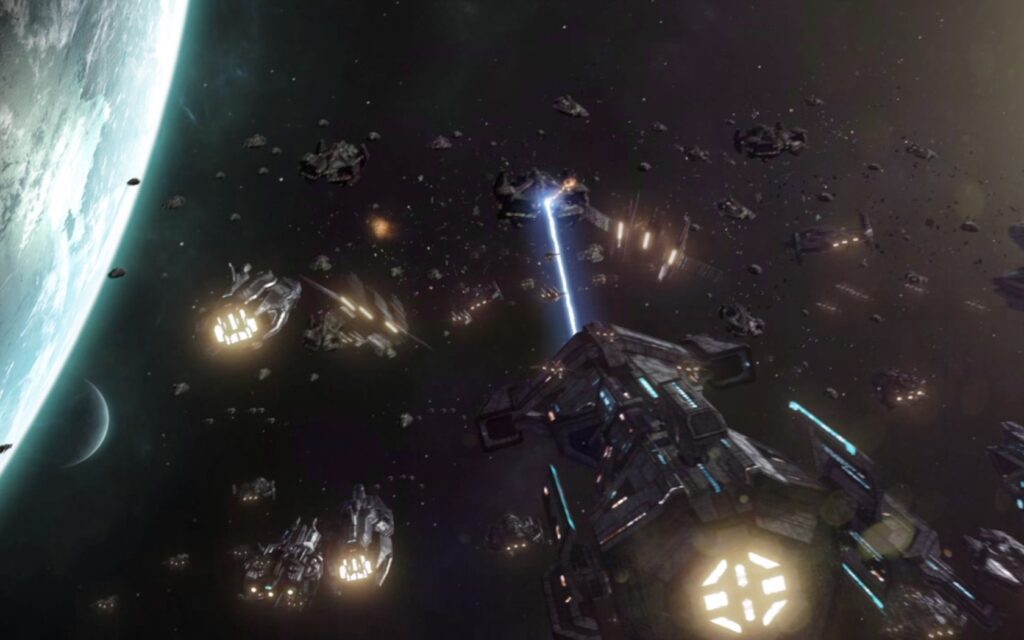
On the games side, he was the designer or executive producer behind Galactic Civilizations, Galactic Civilizations II (GameSpy’s Game of the Year), Sins of a Solar Empire, Demigod, The Political Machine, and Elemental.
He had an ill-fated move into software for IBM’s OS/2 operating system in the mid-1990s but pivoted to Windows. On the utilities side, Stardock built Object Desktop, WindowBlinds, and Fences, and Brad co-founded WinCustomize, one of the earliest hubs for PC skinning and themes.
Stardock was also an early pioneer of digital distribution, well before it was standard practice, building the Impulse platform to sell and deliver games directly to players. That instinct (build the infrastructure yourself rather than wait for someone else to build it) is the same one behind Clairvoyance.
“A lot of people forget that Stardock was doing digital distribution long before Steam existed,” he said. “At the time, people thought that it was crazy to put your credit card on the internet.”
He said, “Someday you’re going to be purchasing and downloading all your software over using some sort of app that will manage your downloads and your updates and stuff for you. And so, similarly, if not Clairvoyance, it’ll be something like Clairvoyance that we all have on our machines for managing a group of AI stuff.”
Stardock’s future
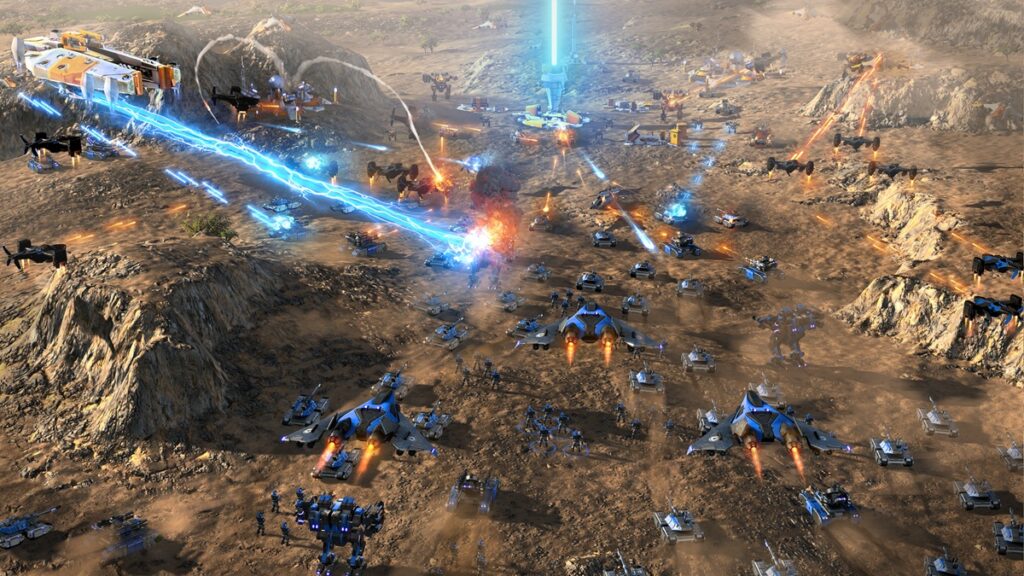
Stardock will continue to make games.
Wardell’s specialty within game design has long been AI, the kind where he programs the computer-controlled opponents in Stardock’s turn-based strategy games, which is a big part of why he speaks fluently about AI.
But Wardell believes Clairvoyance will help small game studios take on the triple-A game studios.
Brad believes within 18 months, tiny teams using AI will release titles that exceed the quality and depth of what previously took hundreds of developers years to build, and it won’t read as “AI slop” because the people driving it will have real expertise.
Brad frames output as Capability × AI Productivity, where both factors are unevenly distributed and compound exponentially (cognitive ability, conscientiousness, industriousness, stress resistance, domain knowledge).
He cites the Ringelmann Effect, Brooks’s Law, and Price’s Law for why big teams lose efficiency as headcount grows, and models a 250-person triple-A team against a nine-person founding team. Without AI, the 250-person team wins on raw output, 747 to 239 in his model. With AI multiplying each person’s capability, the nine-person team overtakes them.
Attention is the new currency

Wardell’s companion argument to the Nine Person Game Studio piece: the real threat to AAA isn’t AI-generated “slop,” it’s a supply-versus-attention mismatch. The math: roughly the square root of the total number of games determines how many can realistically capture attention, everyone else fights over what’s left.
The trend line: 1,700 games released on Steam in 2014 (top 2.5% captured most attention), 21,000 in 2025 (top 0.70%), with AI likely pushing that toward 40,000+ a year. New titles now also compete against roughly 100,000 games already on Steam, so only the top 0.3% will realistically get noticed going forward.
Cites Xbox CEO Asha Sharma’s July 6 disclosure that Xbox saw only $36 back for every $100 invested, as evidence the old triple-A economics are already breaking.
Wardell’s prediction: big IP holders start licensing established, already-attention-having titles (classic and back-catalog games) to small AI-native teams to remake and modernize, rather than betting on brand-new concepts. He’s candid that this isn’t a comfortable trend for someone who has built new IP for a career, but expects it regardless.
Hivemind (upcoming release)
Clairvoyance AI will introduce Hivemind, which lets your AI agent take a job to a more powerful computer, do the work there, and hand it back finished.
With other tools, the remote machine answers your questions. With Hivemind, your agent does the job there and hands it back finished. When a machine is idle, its owner can also make its GPU or NPU available to contacts or domain users they choose. Installed on a server, Clairvoyance shows up to other machines as one more AI provider their AI Staff can use.
HiveMind lets users share unused GPU capacity with friends for AI workloads.
And what about the anti-AI arguments?

Clairvoyance doesn’t replace game developers or artists or writers. It helps those people and programmers use more of their time to get to work on the creative port.
“Sometimes creators only spend 10% of their time creating,” he said. “We clear out the laborious stuff.”
“A lot of game developers who are now learning about advertising, and they can lose their entire advertising budget on Reddit because a bot farm will eat up all their clicks, and you have to stay on top of it,” he said. “You have to adapt and turn off the ad before the budget is gone. With Clairvoyance, I can have it monitor the the clicks, and it will ping me if if I’m suddenly getting a bunch of clicks from a particular country.”
While this is a good use of AI, Wardell doesn’t believe generative art should be a substitute for human creativity. But he feels differently about writing code.
“It’s not that I’m against AI for generation personally. I just don’t think it produces good results because you end up homogenizing the art, especially the art and writing, ” he said. “I want every game to have its own voice, and I don’t think AI is even close to being able to replace that.”
Wardell is a programming buff and he once used to write in assembly language. Then compilers came along and he realized that it could elevate the programmer to a higher level of abstraction.
“Now, you don’t even have to be a programmer. You can just write and see and and have the compiler do it and make the real code. But art and writing are an expression of individuality whereas coding is not quite as much. I don’t feel I have written some really neat algorithms I’m proud of, but the bulk of what I’ve written over the years is pretty repetitive.”
Now AI is taking the coding part off of the programmer’s hands.
Wardell doesn’t think AI is the answer for everything.
I asked him about using generative AI for art. He said, “I think that generative AI currently ends up creating homogenous-looking slop, and so I don’t really like seeing it or using it. I’m only interested in the result, and the result — I don’t find pleasing enough on the general art. Ironically, the AI art and writing is it’s still pretty weak. Here we thought that artists and writers were doomed, and they’re like, ‘No, no, no. It’s going to be the the poor guy doing tedious programming junk.”