
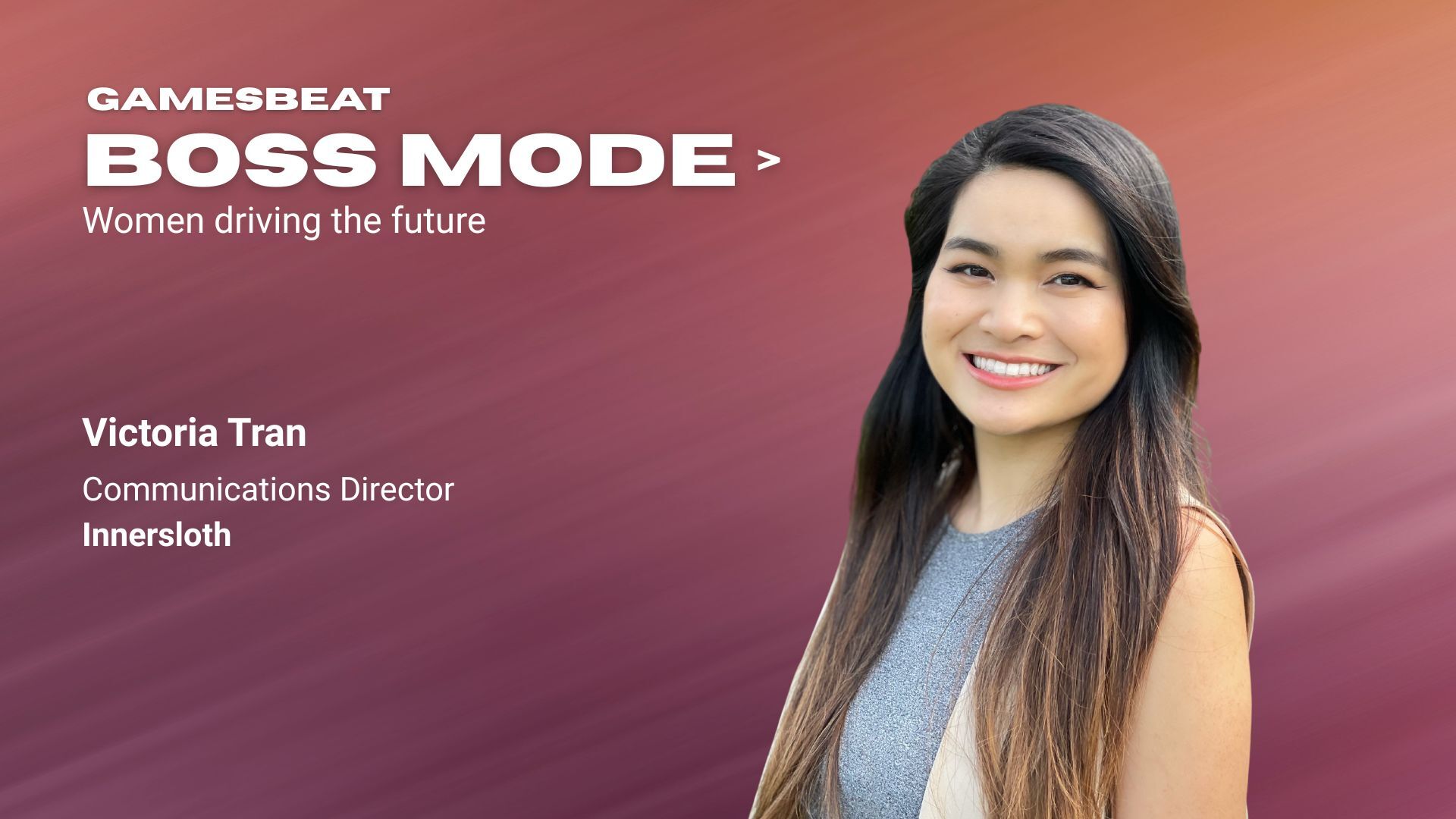
BOSS Mode: Women Driving the Future is a groundbreaking new series by GamesBeat, led by Rachel Kaser, that finally puts the spotlight where it belongs—on the women transforming the business of games, entertainment, and tech, and the industries it touches. It’s the B2B POV, where women leaders will provide critical business insights you need to make more informed decisions, and an inside look into how women leaders driving the future are navigating their business strategy.
From tech to healthcare, entertainment to retail, gaming is no longer a silo—it’s the connective tissue of the modern economy. And women are driving that evolution. In this ongoing series, we go beyond titles to showcase women whose influence is shaping the future of gaming and the industries orbiting it.
This isn’t a moment. This is a movement.
New chapter. New era. Welcome to BOSS Mode.
When I started BOSS Mode, one of my guiding principles was that I wanted to seek out the women who’ve helped guide the industry and its culture, no matter who and where they are. The women who’ve had the biggest impact on gaming aren’t always the C-suite executives or the highest women in the org chart.
Sometimes it’s the woman who repped for the games industry as a whole during the pandemic-era fundraising event on The Tonight Show: Victoria Tran, Innersloth’s communications director.
If you don’t know Victoria Tran’s name, then you probably know her by reputation if you’re at all interested in the hit indie game Among Us. She’s the person behind the Among Us community, including social media, collaborations, external partnerships, events and community-facing projects.
Tran has written one of the books on community management: “Mastering Community Management: Chaos, Compassion, and Connections in Games.” She’s also worked on titles such as Unpacking, Boyfriend Dungeon and Dwarf Fortress, the latter two during her time at Kitfox Games.
When I contacted her for her BOSS Mode interview, it was with the intention of understanding an under-sung part of game development from someone who literally wrote the book on the topic. Below is an edited transcript of our interview.
GamesBeat: I know you from your work on Among Us, but I don’t know a lot about your background. Can you tell me more about how you got into the games industry?
Victoria Tran: Technically, I wasn’t supposed to go into the games industry at the onset. In university, I was a sociology major, double minor communications and social studies and medicine. I wanted to do healthcare PR stuff, but then I graduated.
I ended up in games because I had always loved games. I played so many MMO games growing up, and I think communication and how that happens online, I found that super-fascinating.
I got my first job with a game outsourcing company, but I was there less than a year. It did give me some sort of insight into how games marketing worked, and that’s when I started working as the community manager for Kitfox Games. I was there for four-and-a-half years, doing various things like Kickstarters and helping publish their games like Boyfriend Dungeon and Dwarf Fortress.
I’ve always been in the indie space, and I wrote a lot about games community stuff online because at the time I wasn’t finding anything. I started writing stuff because I wanted a place to put it down and talk to people about it. Then, in early 2020, when Among Us was blowing up, the first thing they needed was someone to help them with the community. They actually reached out to me to ask if I’d be interested in working with them on it.
GamesBeat: Speaking of Among Us, can you tell me about what it was like working on the game and with Innersloth during the pandemic years? I think that’s something that should be studied and I’d love to get your thoughts on it.
Tran: It’s hard to talk about it, because people will say, “Oh my god, that must have been amazing! You’re blowing up! It must have been a lot of fun!” And it was a lot of fun. But when you’re on the ground floor, you’re just trying to get through the day. There’s so much happening every day, so much to keep up with. But I think it’s one of those things where it’s truly impactful and cool after you’ve had a little bit more time to process it.
Working on Among Us during the 2020 pandemic feels like a winning lottery ticket. But it also feels like building a plane while trying to fly it
It’s going to blow my mind, in 10 years, when an adult tells me, “I loved Among Us when I was a kid.” Or, “I loved Among Us during 2020, and it made my days better during a hard time.” Those stories are really impactful, especially because people had a hard time during 2020, and being a part of the way people stay connected is kind of crazy. We’ve had wedding invites from people who met playing together.
Working on Among Us during the 2020 pandemic feels like a winning lottery ticket. But it also feels like building a plane while trying to fly it. It was so many different emotions at once, and it think it’s cool that the impact of it is still being felt now. We can still continue doing cool things like with Outersloth and the TV show and the upcoming game we have that makes it still feel special.
GamesBeat: How do you think about the impact you’ve made? How do you approach that with mindfulness and conscientiousness?
Tran: I think it’s two different things. The first, which I touch on in my book, is that it feels like getting to be a role model, an influencer for a studio’s brand. I’m not representing myself, but I’m representing my entire team as they wish to be represented, hopefully making their lives better and easier.
It’s helpful to know that it’s not ever a solo project. Games are beautiful because they’re shared experiences, and remembering that is an important factor when it comes to leadership in the space itself.
Games are beautiful because they’re shared experiences, and remembering that is an important factor when it comes to leadership in the space itself.
Second is a little bit of absurdity. I think, at the end of the day, the industry is fun at its core. I think being able to remember that and remember how absurd and fun it is is really nice and really important when it comes to this.
GamesBeat: Among Us has broken containment and spread beyond gaming. It was in Glass Onion, for goodness sake. What do you think other industries could learn from gaming? You unlatched the cage!
Tran: It’s true, it’s true. I can think of one of the things that other industries are trying to learn, maybe. One of the things that has made Among Us, and a lot of beloved indie games, continue to have success is sometimes you make decisions that aren’t about the bottom line profit of it all.
Even when I think of games Slay the Spire II or Stardew Valley or Among Us, I think the creators sometimes make decisions that aren’t maximizing the dollar. Sometimes they’re so the players enjoy the game more, or because it’s a great way to bring people together, or it would just bring a lot of joy.
Sometimes you might even take a little bit of a hit, and that’s a very privileged position that you can take when you’re a success, of course. But I think there’s a sort of humanity that a lot of indie games — and triple-A games still have, for sure — that makes that kind of fan base that I’ve seen a lot of industries chase.
GamesBeat: What do you consider to be a win in your job?
Tran: I think a win at the job is multi-faceted. There’s a win for the team or the studio. Like I said, you’re not doing this in a vacuum. Sometimes, a win in the team/studio space is, “Oh, this update that we were all really nervous for went really well!” The messaging behind it that I worked on helped turn the tide a bit for how people would take it, in tandem with the hard work that the team did themselves.
Then there are personal wins. A personal win for me is my book. I never want to make a book again! That was so hard! But a career win for me is that. I think a personal win for me involves sharing knowledge. I think I’ve only gotten as far as I had because a lot of people were very generous with their knowledge to me. When I hear people got the book and it was helpful to them, I’m really happy about that!
Then there are player wins. That can go from the response to an update going really well, fixing someone’s problem really easily, or just seeing really cool fan art. I think that always hits.
GamesBeat: Community management, to this day, feels like an unsung aspect of game development. Why do you wish people understood about the role, both within and without the games industry?
Tran: I wish people understood that your game community is one of the most valuable assets you can have. It’s easy to copy a game’s art style or design. It’s easy to copy many different aspects of a game. But when it comes to your players and the people that are passionate about our game, the ones that are following you throughout development and whatnot, following you into your next game — when you think of long-term success as a studio, community is where that really matters.
When you are making a hire, or when you’re trying to find someone to work with your community, it’s not just a one-off. It’s not an intern who will figure it out because they can post funny TikToks once in a while. You need someone who’s thinking ahead, thinking about the players. It’s a slow build, and not necessarily a marketing campaign push. It’s that long game, and that’s the kind of thing that I think is missing from the conversation.
When it comes to your players and the people that are passionate about our game, the ones that are following you throughout development and whatnot, following you into your next game — when you think of long-term success as a studio, community is where that really matters.
I get it, because it can be really difficult to think about that when you’re very much focused on just shipping your first projects. But long-term, if you want to be a studio that maintains its player base in future games (and also your sanity when it comes to players) sometimes having a community manager can be very helpful.
GamesBeat: One thing that I’ve gleaned from talking to developers, especially indie developers, is the importance of building community. The way they describe it, it’s more of an edge puzzle piece than people think. [Context: I build puzzles edge-first.] It’s not something you can fill in after the fact. How can game developers approach community with more of a pre-production mindset?
Tran: You don’t even need to necessarily hire a community manager at the onset of pre-production. I know it can be a difficult thing, hiring someone when you don’t have the budget. One of the things that I usually tell game developers if they want to keep community management in mind when they’re designing a game is actively try to be part of that space for a little bit.
Whether that’s being part of the Reddit, or playing games yourself and then noting down what you liked or didn’t like, then reading the reviews and seeing what people say — just putting in the time and effort understand what the pain points are in competitor games and what people really love about them can be very helpful.
When you are designing, keep in mind what kind of person you are designing for. How would a beginning who hasn’t played a game like this handle it, or someone who’s just casually scrolling Steam? What will they think of this key art compared to all of the others? Sometimes you can get tunnel vision when you develop a game. Being able to keep a sense of what is going on around you and how other people are reacting to games around yours will help you keep community in mind without having to hire someone.
GamesBeat: What do you consider to be your Boss Move, the decision that defined your career?
Tran: Past-Victoria was so bold, but I think the fact that I started to write about all the stuff that I was doing on my blogs and shared it publicly, back when it didn’t feel like there was much out there felt like a Boss Move. I think that was genuinely part of the reason the Innersloth team hired me is because they saw me writing about my work and the ways I thought about it.
People love talking about the wins, and no one really talks about when you lose or how embarrassing it can feel.
Back then, I was so ready for someone to say, “Wow, she’s not doing this right at all.” I thought someone with more seniority could very much write about how I wasn’t doing it right or something like that.
I think that sort of bravery, putting yourself out there and being open to people correcting you, or being open to learning more and knowing you don’t know everything, that was especially good for younger Victoria when she was learning what community management was. People love talking about the wins, and no one really talks about when you lose or how embarrassing it can feel.
I think that’s when I learned the most, and that’s why I have the confidence that I do now to do my work. I screwed up so many times in the past, and I was able to bounce back from that. I think that has been my career-defining move.
GamesBeat: What is your Boss Music? What is the song that gets you hyped up?
Tran: The boss music I listen to when I’m working is probably going to be “Megalovania” from Undertale. But if I was talking about pop-y music, I really love “Von Dutch” by Charli XCX.