
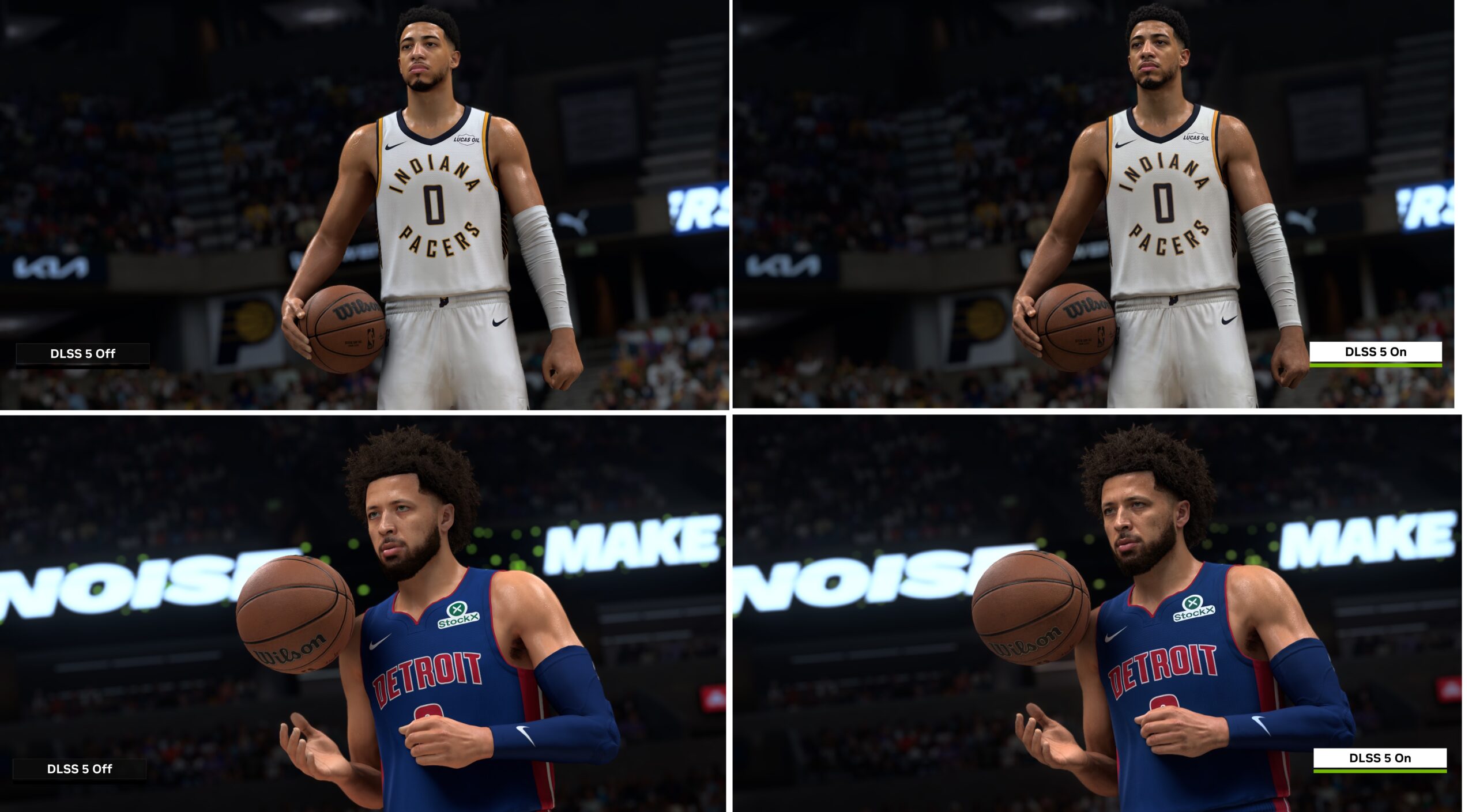
Nvidia showed off its latest progress with the DLSS 5 tech for enhancing 3D images in games, and it showed off photorealistic content in NBA 2K27.
Behind closed doors at Gamescom 2026 last week, I saw demos of the technology in action, and the imagery looked much better than it did when Nvidia showed it off six months ago and ran into an anti-AI buzz saw from gamers.
The tech is controversial in part because it uses generative AI to fill in details that aren’t otherwise present in the images being enhanced with the tech. However, Nvidia said its approach to DLSS 5 puts the final decision on how to use it inside games — either dialed up or dialed down or not at all — in the hands of developers and artists.
I think it looks better, but I’ll leave it for you to decide. But I do think the final impression should really be made only after you see it working inside a game that aspires to be as realistic as possible. We know it’s controversial because some details leaked out over the weekend and anti-Nvidia commenters and meme creators had a field day.

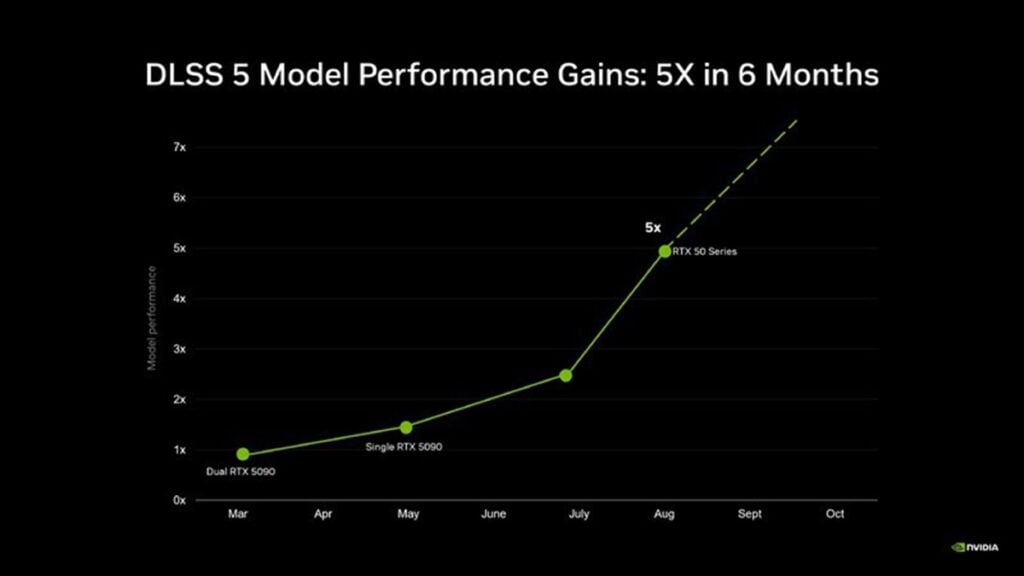
Edward Liu, director and distinguished research scientist at Nvidia, said in my briefing that DLSS 5 aims to achieve high-fidelity, real-time graphics by leveraging AI and graphics advancements. Nvidia’s first attempt to show off the tech in March got a bad reception, but the company has been able to optimize its results since that time, with seven times better performance compared to just six months ago, Liu said.
On top of that, Liu said it can now run on a single graphics card, rather than two. It can run NBA 2K27 at 370 frames per second on an Nvidia GeForce RTX 5090 at 4K resolution. Thta’s the first game that will integrate DLSS 5, available next week. And Liu reiterated that developers/artists can control the level of enhancement for different scenes and characters, and that the images retain the original underlying polygons in the 3D graphics.
DLSS 5 can enhance images by simulating complex visual cues like light interaction with hair and skin, improving reflections, contact shadows, and subsurface scattering. The system operates on render frames, preserving original content while adding realistic details. It’s basically a filter where you can dial up or dial down the effect, and it’s likely people are reacting poorly to images that are dialed up so much that they no longer resemble the original image.
NBA 2K27 is set to launch with DLSS 5, offering enhanced photorealism and visual quality on PCs with Nvidia GeForce RTX 50 series graphics processing units (GPUs). Visual Concepts and Nvidia collaborated to improve lighting, material detail, and shadowing, particularly noticeable in player and crowd renderings.
The technology allows for precise control over visual elements, maintaining player likeness while enhancing realism. Demonstrations showed significant improvements in visual fidelity, running at 4K with 370 FPS on a 5090, and 120 FPS on a 5060 laptop. NBA player Tyrese Halliburton praised the detailed in-game representation of himself in a video, highlighting the technology’s impact on player likeness and overall game immersion.
Liu said the motivation to build DLSS 5 was to achieve photorealism in real time.
“Since 2018, we’ve tried,” he said. “We [beieved] that we have to achieve this from both advancing graphics and AI. Even though right now we’re benefiting from AI, … we’re still orders of magnitudes off in terms of compute that we have, especially for some of the most challenging visual cues that might trick your brain.”
Li pointed to a real person in the room, noting that the light bouncing off the person’s hair would be really hard to simulate, as light bounces off multiple hairs and modelers would have to simulate how the light interacts with each individual hair. That light could bounce off hair and other objects hundreds of times before reaching the human eye.

“That’s how the traditional graphics work. The traditional graphics is based on first principle simulation, where you model the scene, you simulate the light bouncing inside of it, and you’re framing a shot with your camera. The thing about simulating the world is that you need to simulate the infinitesimal details of the world,” he said. “So examples such as hair, such as skin subsurface scattering, those things are really really compute extensive. When you’re thinking about doing that type of thing in real time, it’s not even close by borders of magnitude.”
So Nvidia needed something different to really achieve photorealism and realism.
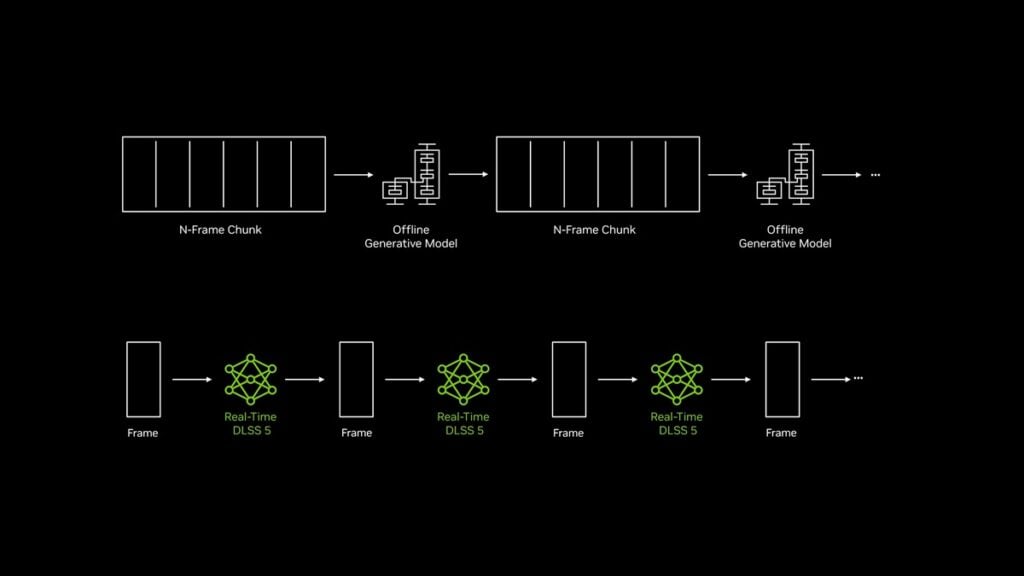
“In the last few years, a new way of synthesizing photoreal images emerged, and it’s maturing,” he said. “These generative models don’t really have to generate images by simulating the physics. Instead, they just watch and learn from the real world images. And when they’ve seen enough of these images from the real world, when asked, ‘Hey, I need a character that’s lit on the side with long hair,’ they will just directly know the hair should probably glow in a certain way that matches your visual expectations.”
Liu said he was proud to say that Nvidia’s research team has made tremendous progress in solving challenges enough to a point where “we’re happy that we can ship a product out of it.”
Liu said the scene doesn’t have to do a global edit. Rather, it can do a very local and semantic-aware edit.

“We know that we have to make sure the generation stays true to the original content. It cannot just generate a realistic image. It has to generate the same character, the same world, the same lighting, the same story, with the original artistic content. DLSS 5 will change the image, but it has to change it in a way that it does not change the story. That’s really a hardcore requirement that we knew early on, and the way that we solve it is that during training we leverage some of the internal buffer from a renderer, which is very positive, surface textures, lightings, and normals. We make sure whatever the image that the model generates, these buffers are staying consistent with the original input.”
Gabriele Leone, director of content technology at Nvidia, has a background as a game developer. Leone said her team helps bridge the game between the tech creators and the game developers.
“When you generate a game, it’s always a compromise between artistic vision and performance, right? And if you let the artist do whatever they would like to do, they will probably do things that would make the you know game less performant,” Leone said.
You can add more lights and add more complexity. When the team turns on DLSS 5, you can see more visual cues come to life. The result is better reflections, better contact shadows and better subsurface scattering.
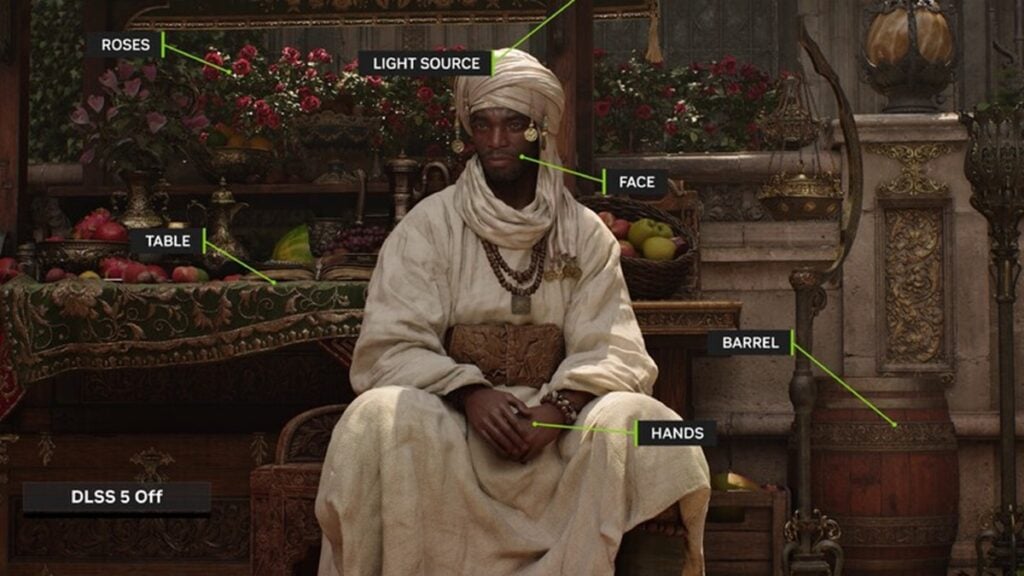
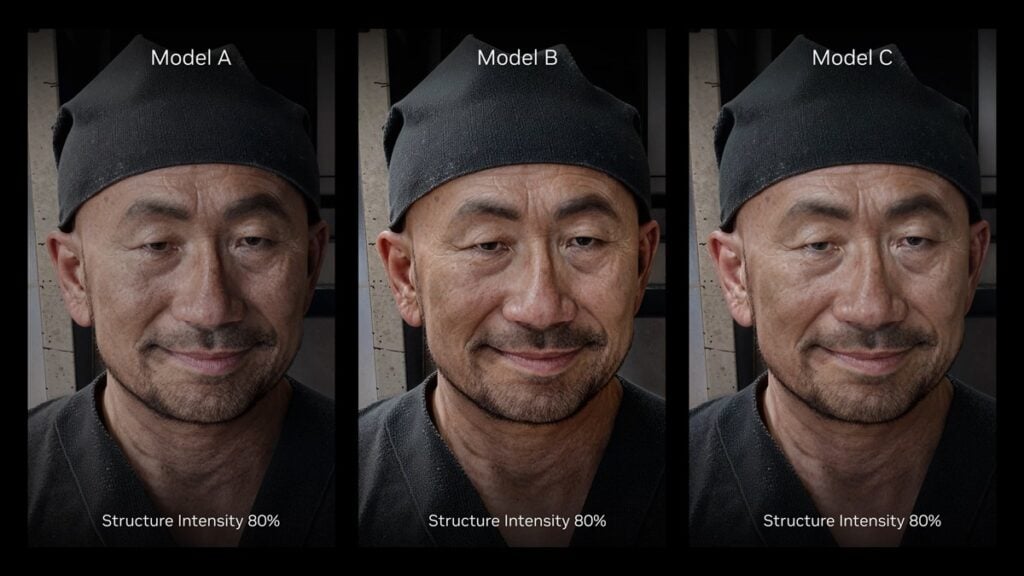
In this picture of the older Asian man, I noticed the shadowy seam between the man’s hat and his skin. The model can present an artist with a few different options. The artist can choose one model for one scene, and another model for another scene. The dev keeps granular control of the image. Leone said the gradations can mean better occlusion, better subsurface scattering and tone intensity.
I asked what was different with the DLSS 5 model compared to March, when a lot of people criticized it.
Leone said, “When the public saw it in March, it was a research model that was not as as good or as fast as this one, and it also didn’t have all the controls that were built into this one. It was still a pixel accurate enhancement. That means that when you turned the DLSS 5 on in March, it was still actually complete. It was not changing geometry and the shape.”
He added, “It was still adding things like ambient occlusion, reflection, and all these things that we spoke about. But it was adding them in a bit of a different way compared to this model, which is much better right now but inherently right when you have better lighting or even just simply different lighting.”

He recalled people looking at the character Grace from Resident Evil Requiem, and she look different as a person from when DLSS 5 was turned on or off. That’s like using a flash light to shine on someone’s face.
“If I take different lighting scenarios of your face, your face will look completely different,” Leone said. “There are other factors including camera lens and whatnot, but your face could look totally different. I think it was a combination of the model being again not as good as this one, not tuned with the controls. He also noted that a given character could look different from the original after DLSS 5 because there was detail in the image but it was not drawn out because the computing power applied to it wasn’t sufficient. This means wrinkles can appear, and light underneath the skin, subsurface scattering, can appear different.”
Before Leone worked at Nvidia, he worked in the movies, first at Pixar and he also was part of an Oscar-winning team on the Life of Pi. He worked on games like Metal Gear Solid 5 and Horiizon: Zero Dawn.
“DLSS 5 is basically adding the information that you don’t have because of performance reasons,” Leone said. “I would argue that when you work on a character. Every time we worked on a game, it’s like a compromise of what you’re trying to do as an artist and the performance that is not there, right? On every single game we worked on, there was never a time when a character artist that was doing the character for the game said, ‘This is perfect.’ The same is true for Grace if the scene was fully path traced.”
Lone said, “This is ultimately why we give the control to developers now.”
I noted that the word “generative” in “generative AI” makes the public think that the AI is making something up. But from the Nvidia point of view, it means making the image more accurate.
“Obviously, technically, it is an approximation still,” Leone said. “It’s not like we can claim it is 100% physically accurate. It is the best approximation possible. But then again, if I want to be really technical, a path tracing is also an approximation, right?”
Leone added, “This is why Ed was saying that the the what is the ground truth is very subjective to what renderer you use, the setting you use. Of course, we cannot technically claim that this is completely accurate.”
But he added, “The model itself is smaller and more efficient, and it’s also more realistic and controllable compared to what we showed at GTC.”
“Every once a few years, there will be a revolutionary tech that take the next leap in image realism. We believe this is it. This is that next leap,” and it will be public available next week. It’ll be you guys get to take a look at it in the next room after this.” Liu said.
The look of NBA 2K27

Peter Kavic, senior producer at Visual Concepts, said in a video message he was excited NBA 2K27 will be the first title to use DLSS 5 3D-guided rendering. The game launched into early access last week, and Kavic relayed a message from the dev team.
“NBA 2K has been delivering the most authentic sports experience in gaming for over 25 years. We have deep admiration for the NBA and WNBA, and really want to bring the best of that experience into our players’ hands,” Kavic said. “For a game like NBA 2K27, photorealism is very important. Our goal has always been to make the in-game experience feel as close as possible to watching a real NBA or WNBA broadcast.”
Kavic said DLSS 5 makes images look genuine and real, boosting the quality of the objects and lighting, bringing a real jump to photorealism across the game.
“You can see how clothes would naturally layer on top of the skin, or the detail that hair gets as it catches the light and shadow in a room. The crowd and the wider in arena atmosphere get that same lighting, shadowing, and detail boost, even during fast motion,” Kavic said.
In the past, rendering tens of thousands of people in a crowd was labor intensive.
“What’s great is the level of control this gives us. We can set the overall tone and style to match our existing art direction, and then really get precise where it matters most, using a per-pixel uplift control mask to fine-tune detail on characters, given that we want to respect their likeness with the utmost care,” Kavic said. “Having a tool like DLSS 5 on our side is really just empowering our teams to bring so much more forward. We’re able to make sure that we’re not taking anything away from the identity of the players and being true to the visual concepts and NBA 2K spirit with how we want to treat these representations.”
Kavic added, “I love the idea of what it’s going to be like for you as a PC player when you first get your hands on it and see the change. What you really see at the end of the day is it builds a greater sense of immersion than you’ve ever seen before.”
The NBA 2K27 demo was running on a 5090 desktop running at max settings at 4K resolution. When he turned on the DLSS 5, you could see the hair get natural light transmission from the arena lighting. I could see more shadows on the basketball. You can freeze the scene at any time and see the wire frame and notice there are no artifacts, Kavic said. The game ran at 370 frames per second while a nearby laptop ran at 120FPS on a 5060 graphics card at 1200p.
I noticed that when you turn on the DLSS 5, it can fill in the player’s details like wrinkles, and that can make the player look older. But it will also make them look more real. I could also see in the crowd that the objects like cameras and water bottles had a lot more detail.
Overall, DLSS 5 made a lot of visual improvements from my point of view. Having seen it, I would suggest to anyone who hasn’t seen a demo yet to look at it up close and personal.
The tech details
Some folks said that turning on DLSS 5 could cause a 50% to 60% performance hit across a variety of games. But Nvidia offered a concrete comparison, showing that DLSS 5 On can work. At 4K with the Ultra preset and ray tracing on an RTX 5090, it shows an average of 227 FPS with DLSS Off and 370 FPS with DLSS On.
DLSS On is the full DLSS suite enabled: 3D-Guided Neural Rendering, Super Resolution in Performance mode, and Multi Frame Generation at 6x.
Performance is an important part of the experience, but so is image quality. DLSS 5 is an optional visual-quality feature, like ray tracing, that adds lifelike lighting and material enhancements such as subsurface skin scattering and micro-shadows. Combined with Super Resolution and Frame Generation, it introduces a new image-quality tier while preserving high frame rates.
For additional context, a photoreal Hollywood VFX frame can take hours or even days to render, while a game needs to produce 60 or more frames every second for smooth gameplay. DLSS 5 is designed to help bridge that gap by bringing complex lighting and material effects into a real-time rendering pipeline.
Disclosure: Gamescom paid my way to Germany for the event. The content of this story is solely the responsibility of GamesBeat.