

I don’t know many game developers who are politicians. So it was a pleasure to interview Marc Bosch, a game developer who has unsuccessfully run for mayor twice in his town of Neufahrn bei Freising, a small town of 22,000 people near Munich, Germany.
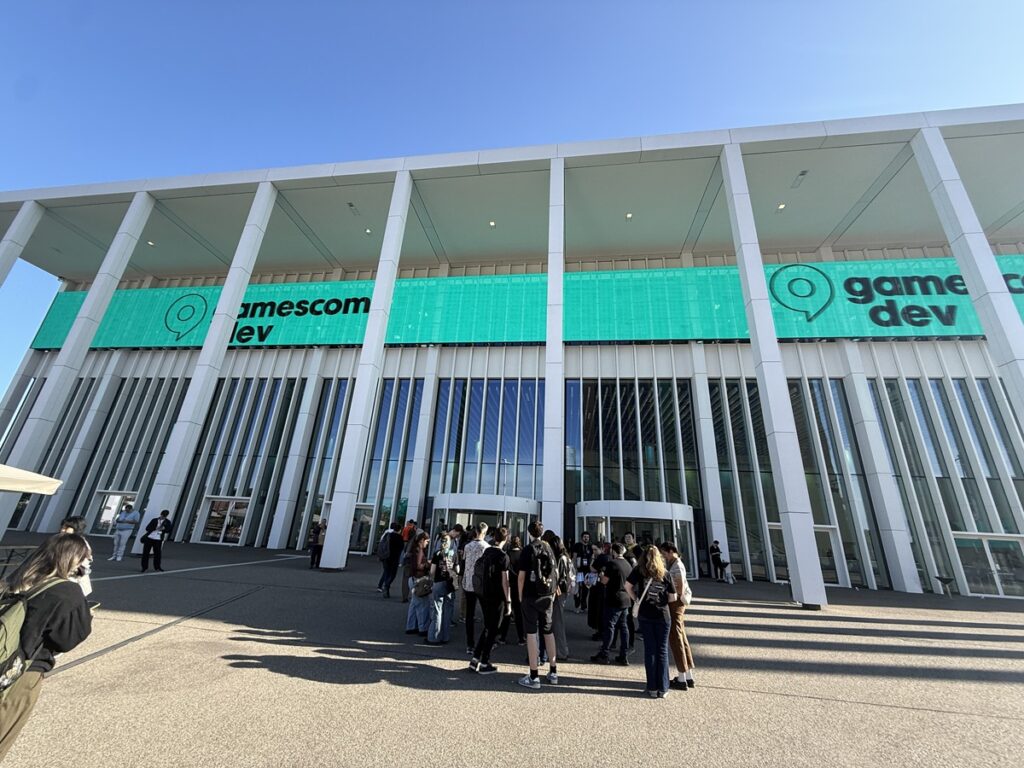
I talked with Bosch at Gamescom Dev, the 6,000+ game developer event at Gamescom in Cologne, Germany. There were more than 500 politicians there, including the president of Germany. But I was interested in Bosch because I wanted to know more about the crossover of politics and games, and what gamers and game devs should know about politics. And, vice versa, I wanted to know what politicians should know about games.
In terms of his game background, Bosch said the first game he worked on was quailty assurance and programming for the original Far Cry from Crytek. More recently, he worked on Ambulance Life and Legend of Khiimori. His favorite game is an Xbox Original called Black and on the racing side, the original Le Mans 24 hours on Dreamcast.
Earlier this year, Bosch got about 8.8% of the vote in the face for mayor, finishing fourth. We’ll see if he runs again. Meanwhile, you can see what issues he cars about and what he knows about AI below.
Here’s an edited transcript of our interview.
GamesBeat: What do you think of this notion of games literacy for politicians? What do they need to know?
Marc Bosch: In terms of games, do you think about politicians all around the globe, or just German politicians?
GamesBeat: Those that are concerned with the industrial base, jobs, economic development. Industry-specific issues or regulations.
Bosch: I do think, in the run of AI for the last two years, everybody was afraid that nobody in the creative industries could survive. But honestly, for politicians, I highly recommend looking into handcrafted games. Because handcrafted games will be like handcrafted music and handcrafted art. They’re the very few things that will survive and that will be of value. As we’ve seen in the music industry, as soon as music was taken over by AI, music is not worth anything anymore. You can just imagine something, put it into ChatGPT or Suno or whatever, and a song comes out in 30 seconds. The song that you think you care about at that very moment. Then you just get rid of it and you’ll never hear it again, because you don’t care, because it’s free. It’s not worth anything.
Honestly, I do think that when you have a handcrafted game, we should have a label for that. Not only for things that are AI. We should have handcrafted, human-made labels that tell you that this was done by a human. This can be valued, because it was done by somebody. Like Patrick Swayze in Ghost. He formed that clay. That’s what game designers do. They think about what another human could be influenced by. What could another human be emotionally touched by? That’s handcrafted stuff. Stuff that comes from your heart, from your soul, from your hands, from your capabilities, from your experiences.
AI just does whatever you tell it to do. Of course you can prompt it to make you a GTA VII, but then you just get an AI slop third-person adventure that only uses old references to create something out of them. But nobody will be surprised by it. Surprises or jokes can only happen when someone understands the human mind, human feelings, human emotions. That’s what I’d like to tell politicians. Take a look at exactly where you’re putting your funding. Put it into handcrafted things. In the next five years, not a lot will survive.
GamesBeat: It sounds like AI is at the top of the list as far as relevance for politicians. But is that too big an ask for politicians? Is there some way to frame it so they can take the trouble to learn, or so they can grasp it more easily?
Bosch: Political systems all around the globe–especially in Germany, we have so much bureaucracy. We love our bureaucracy. Sometimes it can help, but only sometimes. It can help to be very structured. I do honestly think that AI will overtake politicians within the next two or three years, probably. People will have AI companions or assistants that will just play out whatever political system you bring to them. If you want to build a house, you can ask your AI assistant to build the perfect house for you within regulations, so the local council can’t say no to your house. Politicians and local governments will be played out by AI.
Only a few–I think less than one percent of politicians will even be able to grasp what’s coming, because they’re forced into their political system and how it works to ask if someone allows something, if the law works in a certain way and so on. On my part, as a member of a city council, I see that we’re trying to implement AI, but we haven’t done it yet. I think as soon as we have implemented AI, AI will take over most of our job as the city council. AI overlooks state law, federal law, local restrictions. Bureaucracy is basically a game. As we said in the last interview, fighting bureaucracy from a games perspective–AI will solve that. Politicians will not be a thing of the past, but they will live in peril.
GamesBeat: There’s a couple of glaring contrasts about dealing with AI and dealing with regulation. The United States has mostly let capitalism win, let capitalists work it out. Private companies are dealing with these problems. Places like Europe are much more interested in regulatory decisions that provide a framework for everyone to proceed. What do you think about that contrast? Do you think one or the other may work better when it comes to AI?
Bosch: That’s exactly what politicians think about AI and how they perceive AI. They think that if they make another regulation, they can regulate AI. I’m absolutely not for giving capitalists a go and just letting them do whatever they want. At some point–I’ve talked to so many technology drivers in the market already over the last few months. They have been telling me about local AI, AI in the machine, AI on a chip. That means, in a few years, you’ll have basic AI functions in your pocket. Therefore you’re completely independent. That also means that when you choose the AI you want, whether from China or the U.S. or someplace in Europe, even if the government wants to regulate AI, you have your pocket AI to help you through your day, through your life. Nobody can regulate you.
It’s very difficult to be a politician right now and say, “Yes, as Europe we will regulate AI so it’s good for everyone.” The genie is already out of the lamp. You can’t regulate a mathematical equation or algorithm. It’s already here.
GamesBeat: What about something that’s more familiar to politicians? How do you protect jobs in the era of AI? How do you encourage more economic development to happen because of AI?
Bosch: In terms of jobs, as in the U.S., I see on YouTube and Instagram and TikTok that many people are against building data centers. Those data centers can be bad for the economy, as I’ve heard and read. They only employ a handful of people, because they’re just servers. They need water cooling and power, but that’s it. They don’t need too many employees. We need to think of this as an industrial revolution that will shift jobs to generate intellectual wealth, instead of saying, “You worked in the car industry? Your job is now taken over by an AI robot. Let’s find something else for you that’s similar.” No. There will be 70% or 80% jobs lost. You can’t just ignore the industrial revolution. That will cost the economy and the country more than if they invest it into making people more creative, more self-sustaining.
Imagine if people don’t need companies to build houses anymore, because they have two robots at home that build them a house. What about being self-sustaining? They have a robot that plants a garden to grow food. Nowadays you can grow food even without any soil, with hydroponics, in your living room. How much can you eat that a robot can produce within your 80 square meters of living space, right around the walls? We should think about this from a political perspective as shifting into a higher intellectual wealth with people, instead of saying, “Let’s just do this so you can have a similar job.” Most of those jobs will be killed by robotics and AI. It would be stupid to just make up jobs.
GamesBeat: What about the arguments people make about advancing AI? Some will say that if we don’t invest in this now, someone else will, and they’ll get to whatever benefits first. They’ll out-compete and wipe us out.
Bosch: Do you mean different countries with different AI competing?
GamesBeat: If we don’t build all those data centers and China does, will they gain some big advantage? And not just data centers, but investing in models and so on.
Bosch: Looking at how AI has scaled over the last four years, and looking at how–look at the Will Smith meme, eating spaghetti. Compare it now to three or four years ago. It’s so fast. Building data centers is building buildings. It’s laying bricks. It’s pouring concrete. Scaling is an IT business. Scaling means you just need more power. More power means you need a better infrastructure to support the power needs you have for data centers, or for AI happening in people’s homes.
I don’t think there’s a race for the best AI. What is the goal of AI? The positive goals will be more efficiency, less work, less hassle, less complication. The chores you have to do on a daily basis – filling out your taxes, going through forms applying for school, applying for loans and so on – that’s all now being done, or very shortly will be done, by AI. AI can free us from so many things.
The question is, what would be the next step for politicians trying to leverage AI instead of war? If you’re self-sustaining, if you create power for yourself through solar and so on–I think AI can be used for the better. I don’t see why AI should make us the worst version of ourselves. You can say, “China will take over,” or “the U.S. will take over,” but I think AI warfare is already over when you think it through. It’s like the nuclear threat among all these countries. Everyone has it, but as soon as someone uses it, everyone loses. If you work it out, yes, we’ll have many models. Every country will have more or less advanced models, but it will all be for the better of the people who live there.
If you did have AI warfare, what would be the consequence? What if the U.S. targeted another state with their AI? What do they win? If they kill that infrastructure, they have to build that infrastructure again. Then another AI comes and kills their infrastructure. It’s like the nuclear race. It doesn’t go anywhere except to create a threat.
GamesBeat: As far as politicians using AI to do their jobs better, what comes to mind when you think about that?
Bosch: You mean if AI could solve the question of whether we need politicians?
GamesBeat: Well, in a scenario where we don’t eliminate their jobs, but we provide tools for them to do their jobs better.
Bosch: I absolutely agree that we should give politicians a lot of AI, even very high levels of AI, to do their jobs better. At the moment it’s a very hard job to please the people on the one hand and negotiate deals on the other hand. From “am I allowed to build a house here in the style I want?” up to “how do we make the economy grow faster?” or “how do we sustain the economy?” We have a problem with sustaining the economy in Germany right now. If we use AI to understand what is coming next, instead of trying to please people–for example, what kind of age range do you have in places like Germany or Japan? Populations are getting older and older. There are ideas that if you survive the next five to 10 years, you might be able to live forever, because diseases will be cracked, more medications will be available, because AI can brute force through the possibilities.
GamesBeat: How are politicians to believe that these great things are going to come from AI, when today we look at AI output and just find that it’s full of errors? We’ve learned not to trust AI results, because it hallucinates.
Bosch: Yeah, absolutely. That’s where the human part comes in. You’ll have an assistant that you partly trust. If you have an assistant that you give a task to, and you say, “Okay, I expect this or that as a result,” but the result is far off somewhere else, then you should be aware and understand that you should look into this before you blurt it out, before you just copy and paste it. Common sense is very human. It can be an error. Everybody knows that common sense is absolutely subjective.
GamesBeat: There’s a source of ground truth as well.
Bosch: Yes. Still, people should use AI to solve for complex things, and then break them down and make them understandable for every human. That’s still a different kind of politician than we have nowadays. Nowadays politicians are people pleasers. They want votes. Every four years, every six years, they want votes. But those votes–from my own experience, you get those votes by shaking hands, by drinking beers, by handing out toys and sweets, by being nice to people. There will be a shift, I think, to politicians who are more true to being negotiators and trying to solve things instead of pleasing people and then not doing what they expect from you for the next four or six years.
I think AI can really solve making politicians more honest and less ideological. Ideology is not something an AI looks at and says, “We should go a bit to the left,” or, “No, we should go a bit to the right.” AI always focuses on the mathematically perfect solution. That doesn’t mean the mathematically perfect solution is to get rid of all humans so the earth can survive. We’re not thinking in Terminator terms.
GamesBeat: Do you think we’ll wind up with left-facing AI policies or politics and right-facing AI politics?
Bosch: I think it will balance itself out. AI itself will focus on what’s good for people. If there are things that come from parties that are good for people, preserving traditions for example–we’re here now in Cologne. They’ve been making beer here for hundreds of years, exactly like this. Why shouldn’t we drink exactly the same beer 200 years from now, or even on Mars? Why shouldn’t we do that? Why is that bad? But while also having a universal basic income, which is a very left-wing idea, but which is true to the reality in two or three years when nobody has a job anymore.
In the last six months, even, I’ve personally seen a shift from AI being a bad thing, because it costs jobs, to AI being AI. Using it as a tool. Making things more efficient. But then handcrafted things that come from humans are valued so much more. In the last six months I’ve personally seen a spike on social media around meeting people, going to concerts, experiencing real life things that can’t be AI. People are refocusing away from AI-made stuff to, “Let’s use AI to understand why my plants aren’t growing.” “Why can’t I apply for a loan?” “How can I limit my spending?” AI can be used for so many good things. I’ve seen the shift already in the last six months. People use it for good things. People use it for a lot of slop, but the slop will run out in the coming months and years. People are just sick of it.
GamesBeat: What gives you confidence that this is really going to work in the way the optimistic scenario suggests?
Bosch: My optimistic scenario is that if we use AI and understand AI as a tool, keeping our personal freedoms–I think one of the Scandinavian countries already put it in writing, in their law, that you as yourself, your voice, your appearance, is yours. It’s your IP, basically. As long as you keep it like that and people are not being copied or have the fear of being copied, being used–I think it’s basically a bad Hollywood movie. If you have a set of rules, three or four or five basic laws that say you own your own IP, you are your own IP, and nobody can take that way – you can flag it with social media and when it comes out the platform has a problem – and also ground rules like, if something is made by a human and only by a human, it can be labeled as human made.
We can leave it as what it is. It’s a wrench in a toolbox. Then all the positive things that come from AI are only things that we could have achieved over a much longer time if we thought about it hard enough. Figuring out a disease or bringing out a new drug or helping people use the right drugs. This is what we should use AI for. I’m very optimistic that it will make humanity better and bureaucracy less. People will have less of a need to be bad, to think bad things, because AI solves problems for them.
GamesBeat: How do you come around to solving some of the political differences in gaming itself around AI? Consumers don’t want AI slop. They reject a lot of what people would consider to be AI advances. Game developers as well, they don’t trust AI yet. They’re suspicious of their jobs being replaced by AI. How should the game industry resolve this kind of dispute?
Bosch: People that have very specific skills, like artists, should stay within their branch and stay specific. They should probably even go deeper on being an artist that makes the best art they can. If you stop working because you think you’ll be replaced by AI, you’ve stopped learning. I think we’ll overcome that tipping point where AI slop is not accepted by anyone anymore. As I said earlier, people want human-made things. Any artist, musician, animator–look at animation in 3DS Max, in Maya or whatever. There have always been tools. They’ve never been called AI, but now we’re using AI to make it better, to overcome the uncanny valley in graphics, to do so many things.
As long as we keep it a tool, but still stay specialized in what we love doing, be it music, art, animation, or game design–where are the AI games that could change the market? I don’t see them. You can tell ChatGPT to make you a great game, but what comes out? Just mediocre slop. A copy or a mix. But it’s totally human to come together and create something new. There will be humans here at Gamescom, at Tokyo Game Show, at GDC that sit together and form new and creative ways, finding something new, the next big product. And people doing less work means they have more free time to spend on more amazing games made by humans.
Disclosure: Gamescom paid my way to Germany for the event. The content of this story is solely the responsibility of GamesBeat.