
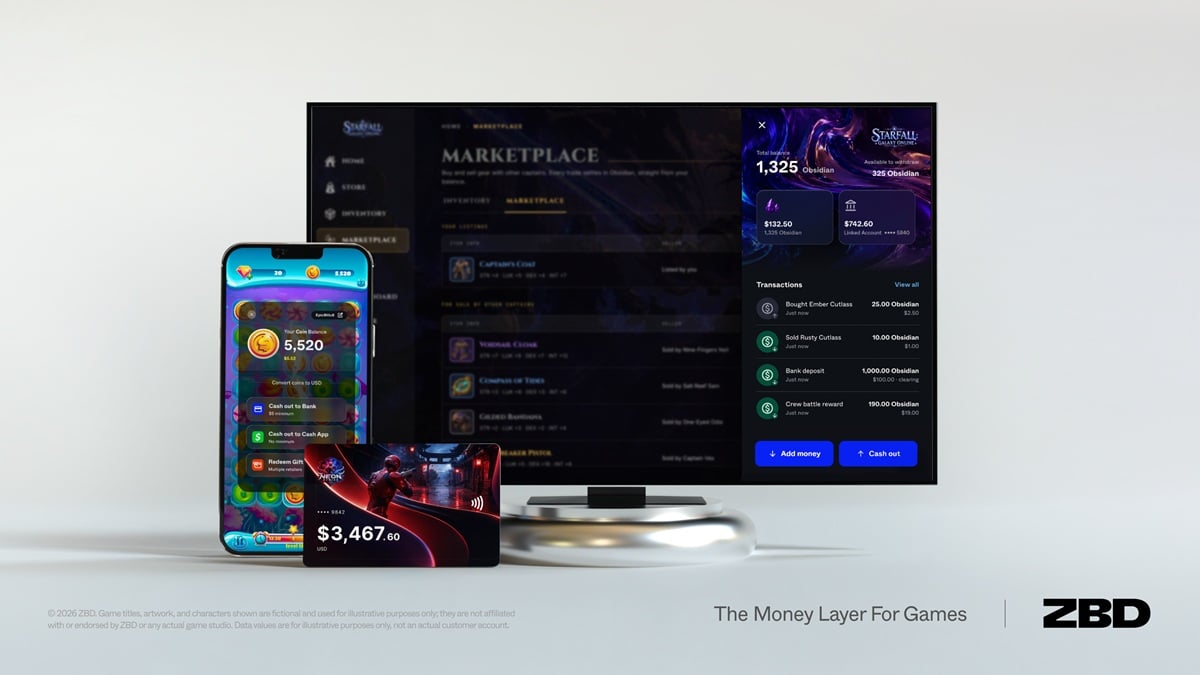
ZBD launched embedded financial infrastructure that powers the money lifecycle in games: money in, money through, and money out.
The tech enables money to flow into games, move through them as users earn and transact, and be paid out to players and creators in exchange for the value they create, equipping ZBD to cater fully to PC and console titles following its success in mobile games.
The Hoboken, New Jersey-based company has snared some PC gaming customers such as 1047 Games, publisher of Empulse and Splitgate.
The financial infrastructure around games is fragmented and unsuited to the way play has evolved. Game economies now routinely need to serve creators, player-to-player commerce, and support esports prizes inside the game, the company said.
However, existing payment stacks are often retrofitted from other industries, meaning they aren’t built to cater to gaming’s unique use cases and only facilitate one-way transactions. The ability to build a new two-way financial relationship with players means money movement in games evolves from being a cost center to a driver of engagement, revenue, and loyalty.
ZBD has been working to address this problem since 2019 when it set out to develop the tech and secure the licenses to power a complete, embedded payment stack for games. ZBD has raised $90 million from investors including Raine, Square Enix, and Lakestar, and is a licensed payment provider in a majority of US states and across the European Economic Area (EEA).
Currently, ZBD has over 65 employees. It’s a fully remote company spanning the US, Canada, Brazil, UK, Netherlands, and many other countries. This allows it to hire the best talent, give employees flexibility, and still gather for regular full-team offsites.
Its rewards and payments technology has been extensively proven in the mobile games industry, where millions of players have engaged with ZBD tech in hundreds of games including Idle Bank from TapNation. Now, the launch of its complete payment product suite means it can cater to the entire games industry end-to-end.
The ZBD platform encompasses:
- Embedded Accounts: ZBD’s programmable financial infrastructure layer for studios and publishers integrates licensed embedded accounts for players directly inside a game. Primarily for PC and console platforms, Embedded Accounts enables direct pay-in deposits, real-money P2P marketplaces that reduce gray-market demand, creator economies, and compliant cash-out through licensed payment rails. ZBD Embedded Accounts is an end-to-end financial layer natively integrated into the game. The integration provides publishers with full control over their real-money economy and the financial relationships with players, allowing them to drive deeper player engagement and monetization while enabling new business models never before possible.
- Embedded Payouts: Purpose-built for game publishers that need to pay players, creators, and esports competitors at the speed and scale of modern gaming. ZBD Embedded Payouts enables instant, embedded, and compliant cash-out through modern rails including bank accounts, Cash App, gift cards, and push-to-card. It is a single integration layer embedded directly in-game, meaning from KYC to cash out, players never need to leave the game for a third-party payout platform, giving studios the flexibility to build stronger engagement programs for both players and creators.
- Embedded Rewards: The next evolution of rewarded play, lifting retention and lifetime value by integrating real-money rewards natively into core gameplay, progression milestones, and LiveOps events. ZBD Embedded Rewards keeps the entire reward journey and cash-out within the game experience, allowing studios to fully own player loyalty for every user. The reward infrastructure layers on top of the game’s existing economy and monetization mechanics, with full compliance and fraud protection handled end-to-end.
- Branded Debit Cards: Built for studios who want to extend player loyalty beyond the game ecosystem, ZBD powers fully configurable white-label debit cards with “cash-back” like rewards that enable players to earn in-game currency or other in-game benefits, such as discounted subscriptions, through real-world purchases. This turns everyday spending on gas and groceries into a continuous loyalty loop that drives player engagement and repeat in-game spending. ZBD fully manages card infrastructure, virtual currency conversion, and compliance.
Gordon Thornton, CCO at ZBD, said, in a statement, “Money has been part of the video games experience for as long as I can remember, but the big shift is that consumers now expect two-way financial relationships with publishers. Studios can now evolve their financial interactions with players, turning a one-way relationship into a two-way loop that drives engagement, revenue, and loyalty.”
Thornton added, “Ultimately, I see our role as enabling studios to implement strategies they’ve always wanted to, but simply haven’t had the tech or licenses available before. This launch is the culmination of a seven-year mission to build this capability for the industry, and we’re thrilled to already see a lot of pent-up demand from studios and publishers.”
Game developers worldwide have already adopted ZBD’s new embedded technology. 1047 Games, developer of Splitgate and Empulse, is using ZBD’s Embedded Payout technology to power their real-money referral feature and reward players for community-driven growth, while cross-platform publisher Joygame has recently introduced ZBD Embedded Rewards.
They join a growing roster of game publishers including TapNation, Udo Games, and Turborilla actively partnering with ZBD to create a two-way value exchange to drive further user retention and loyalty.
John Wright, CEO at Turborilla, said in a statement, “Retention is critical for games to succeed today, and game publishers need to start looking beyond legacy growth playbooks to boost LTV and long-term profitability. ZBD is one of the few companies building for that future by weaving together payments and player engagement. We’re excited to be working with them to bring new loyalty mechanics inside our game, giving our whole player base real value for logging in every day.”
Unlike traditional payment solutions, ZBD powers the financial infrastructure at the speed and scale games require: on-demand processing, micro-payouts at fractions of a cent, with built-in compliance and fraud protections. ZBD is the only fintech company that combines gaming-native infrastructure, programmable money flows, and compliance rigor into a single licensed layer. The company will be at Gamescom.
The company positioned itself not long ago as a Web3 gaming company. ZBD uses the Lightning Network to power real-money embedded payments at scale, creating a frictionless, compliant money movement layer. The company already processes more than 120 million transactions annually and has doubled the number of games integrated with its SDK over the past 12 months, driven by adoption from developers including TapNation, Fumb Games and PlayEmber. These partners use ZBD’s infrastructure at scale to deliver tens of millions in fiat currencies, bitcoin, and gift card rewards to gamers, Thornton said.
Written Q&A

I asked how developers like 1047 are using the products. In a written interview, Thornton said there are a variety of straightforward use cases, but once a developer partners with ZBD, it really opens up nearly endless possibilities.
“ZBD provides the back-end tech and compliance capabilities for payments, enabling publishers to get creative about how money can flow natively through their games and build features they once thought were impossible,” Thornton said. “For 1047, they’ve used ZBD Embedded Payouts to power a referral program directly within their game. The feature helped drive community-led growth.”
Players earn $5 for each new player they bring to Empulse who engages and qualifies. Payouts are on demand, and players can initiate a cash-out to their preferred payout method. Crucially, all of this takes place within the game itself. These products are natively embedded within games and feel like a natural extension of a game’s brand, monetization mechanics, and user experience.
“We are also in advanced discussions with several PC/console publishers to power their P2P marketplaces and launch branded debit cards for their games. This new product suite will help us achieve our long-term goal of enabling studios to build closer, deeper financial relationships with their players,” Thornton said.
Asked about the value proposition for game devs, Thornton said, first and foremost, it’s all about turning a legacy one-way transactional relationship with players into a two-way loop that drives incremental engagement, revenue, and loyalty.
“When players get value back, often in the form of payouts, they’ll be more engaged, which can lead to stronger retention and in-game spending,” Thornton said.
Likewise, the current status quo of payments tech is often fragile, expensive to operate, and can require a patchwork of infrastructure partners spanning money movement in, through, and out of a game (the money lifecycle). ZBD is providing end-to-end infrastructure that is embedded directly into the game.
“This means we operate in the background as part of the native gameplay experience rather than being bolted-on like most merchants of record or payment partners,” Thornton said. “Developers retain their direct relationship with players in-game without needing to push them to external third party services. This reduces friction for players and developers, and enables functionality at the speed and scale games require. “
This also means optimal flexibility, recognizing that players want the freedom to choose when, how, and the amount they want to transact and cash out while remaining engaged inside the game.
In terms of how ZBD makes money for game companies, Thornton said, “By fully owning the entire financial relationship with their players, publishers are equipped to craft a new playbook for game growth in the face of current industry headwinds. Deeper player loyalty, new monetization features, and creator-powered economies all flow through to revenue creation.”
In terms of individual products, Embedded Accounts delivers revenue from every in-game transaction: trading, tipping, payouts, and more. And it can also enable studios to power a first-party P2P marketplace within the game, recapturing revenue from gray markets.
Embedded Rewards and Branded Debit Cards boost player loyalty, which in turn drives incremental revenue. It’s a powerful flywheel effect: the more players earn back, the more they play and spend in the game.
Embedded Payouts is woven into the functionality of others, but as a standalone product it also helps publishers bring the whole experience under their domain. This includes simplifying onboarding and payout processes, and ultimately driving stronger payout economics and operational savings while bolstering player and creator-led programs.
ZBD was founded in 2019 by CEO Simon Cowell, CTO André Neves, and the head of Gaming R&D Christian Moss, all of whom are still with the company.
The idea came at the intersection of three pillars: gaming, money, and tech. The cofounders realized that gamers intuitively understand digital value (points, items, rewards), but the systems that manage value in a game are either siloed or proprietary.
At the same time, traditional financial rails aren’t built for how play is evolving. There are plenty of webshops, merchants of record, payment providers, and other legacy tools that drive standard transactions. However, consumers now want two-way financial relationships with publishers and platforms. Game economies routinely need to serve creators, marketplaces, player-to-player commerce, and tournament prize structures.
Basically, no one had invested in the e-money license that the games industry – both platform and publisher groups – had shied away from previously. No one was building embedded payments tech specifically for gaming to drive incremental revenue from increased player engagement, and that was the problem they spent six years solving.
ZBD’s origins
ZBD has spent six years building the tech to power a complete payments stack for games, and accruing the licenses required to operate it in key markets including the EU and a number of US states. Along the way, the company developed a successful consumer rewards app, launched the original version of our Embedded Rewards SDK to establish a foothold in mobile gaming, and have now expanded with purpose into PC/console gaming so we serve the whole industry.
The vision of ZBD has always been clear but, like many startups aiming to innovate, timing is everything. The specific use cases and go-to-market strategy depend on market conditions and, in ZBD’s case, the state of the games industry.
“While we’ve historically spanned B2C to B2B product offerings, we’re now doubling down on serving game developers to evolve their financial relationship with players,” said Thornton. “Our core focus is being the money layer for games, delivering gaming-native financial infrastructure, programmable money flows, and compliance rigor in one licensed layer.”
Like most startups, ZBD was scrappy at the start.
“We’ve retained our passion and ability to move fast, but now we’re one of the most rigorously licensed and disruptive fintechs in the world – and the only one built for gaming,” Thornton said.
A couple of the earliest customers were Square Enix with their title Ludo Zenith, which experienced an 82% increase in ARPDAU from integrating our early rewards product, and British mobile studio Fumb Games.
ZBD-powered in-game rewards turned one of Fumb’s titles from a stagnant game to a thriving one, helping fuel Fumb’s transformation into an established and still rapidly growing mobile publisher, recently ranking as the No. 13 Top UK game maker. TapNation has also been a longstanding rewards partner.
With a foundation in blockchain, ZBD built its original tech on something called the Lightning Network because it was more effective for gaming than existing payments rails.
Some of the products still use Lightning in the back-end, but users and developers don’t interact with it, and the products have expanded to include traditional banking rails.
ZBD has never been involved with Web3/NFTs or proprietary crypto tokens.