
Liftoff reported its first quarterly earnings as a publicly traded company today, noting that revenue was up 35% from a year ago and adjusted profit margins were 60%.
That was the 11th consecutive quarter of revenue growth and it reinforced the patter that better advertising performance gives customers reason to increase their spend with Liftoff, said Jeremy Bondy, CEO of Liftoff, in an analyst call.
Half of demand comes from mobile gaming apps and half comes from non-gaming mobile apps. Liftoff generates revenue by helping advertisers acquire ROI-positive users and by helping publishers monetize their user base.
Cortex, powered by machine learning with continued self-learning and discrete model improvements, contributed to better performance this quarter, he said. In after-hours trading, Liftoff’s stock is down about 6% to $23.80 a share, presumably because of less optimistic Q3 guidance. Liftoff went public in June at $28.45 a share at a $3.83 billion valuation. It raised $437 million in the IPO, which was a pay day for private equity investors.
The company has about $305 million in cash and $1.44 billion in debt, compared with $201 million in cash and $1.85 billion in debt in the previous quarter.
In Q3, Liftoff predicts revenue of $217 million to $222 million, and adjusted EBITDA is expected to be $124 million to $128 million, with the adjusted EBITDA margin hitting 57% to 58%. For the full year, revenue is expected to be $870 million to $880 million, with adjusted EBITDA of $510 million to $518 million.
“Our integrated advertising platform, powered by Cortex machine learning, is designed to serve all verticals in the app economy, and we believe we’re still in the early innings of our growth story in a large, expanding, and structurally under-monetized market,” he said. ”
Overall, revenue was $220 million, up 35% from $162 million a year earlier. Net loss was $4 million, compared with a loss of $24 million a year earlier. Adjusted EBITDA was $132 million, up 55% from $85 million a year ago and up 10% from $120 million in the first quarter.
Liftoff’s first earnings call
“Q2 was a strong quarter,” said Bondy, in a call with analysts today.
Bondy said the Cortex platform learns from advertiser outcomes and supply signals, helping Liftoff value each ad opportunity more effectively. Improvements in the model for Cortex helped with better performance during the quarter.
“Several of the app categories we serve converge around major cultural moments and global sporting events. For example, we saw increased demand during the World Cup in Q2, particularly across sports betting, live scoring apps, and prediction markets,” Bondy said. “This activity contributed to our second quarter performance. The global sports calendar is one source of high attention moments across the broader app economy. As focus shifts from the World Cup to the NFL season, for example, our platform helps customers scale efficiently.”
He added, “We bring the same capability to cultural moments of all kinds across every vertical we serve worldwide, enabling customers to drive profitable user acquisition over time.”
Bondy said that, starting with the marketplace, the mobile app economy is massive and growing. More than 5 billion people around the world use smartphones, and they spend an average of about three hours a day inside apps.
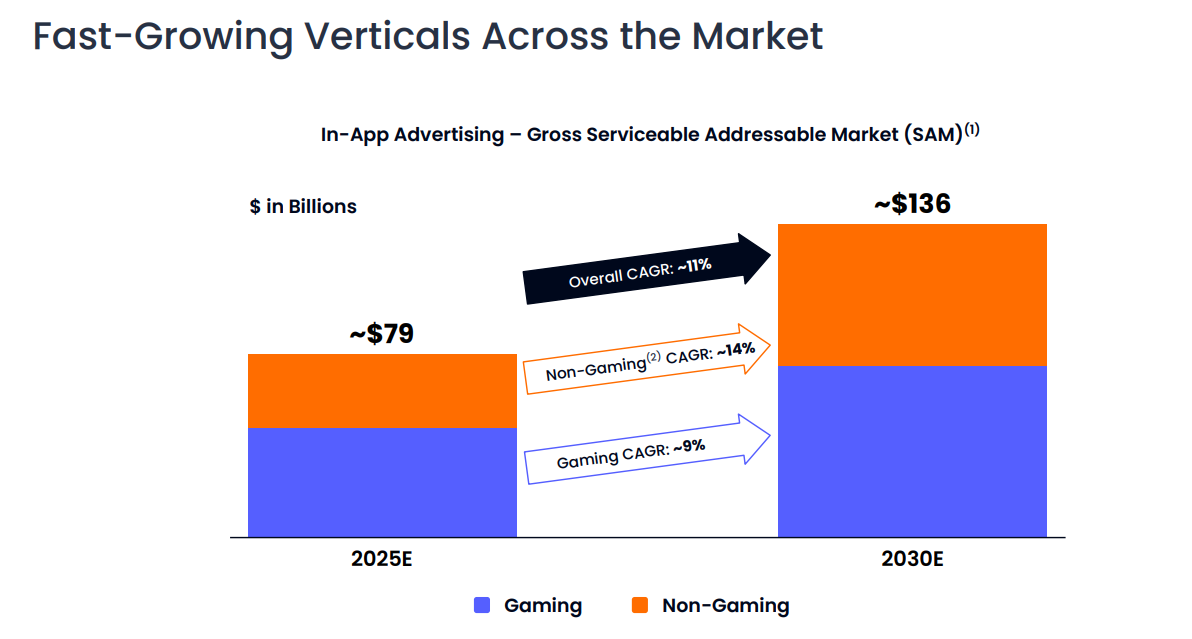
Lyftoff operates in a third-party in-app advertising market, which is projected to grow at an 11% compound annual growth rate (CAGR) to $136 billion by 2030. Within that market, non-gaming verticals are expanding even faster at 14%, while gaming is expected to grow 9% a year.
“This is a marketplace that is structurally under monetized, with third-party in-app advertising spend estimated at roughly a sixth of TV on a per-user hour basis. Perhaps put more simply, attention has already moved into apps, ad dollars are still catching up,” said Bondy. “In a large, growing, and fragmented app economy, our role is clear: help advertisers acquire customers and help app publishers monetize their audiences.”
He said the role is simple to describe but complex to execute at global scale.
“We built a fully integrated advertising platform to serve both sides across every vertical, from gaming and shopping to finance and productivity tools. On the demand side, we help businesses find new users for their apps with our demand side platform,” he said. “Our DSP is designed to find the right users at the right time and the right price to provide high ROI at scale. On the supply side, our SSP or supply side platform helps apps monetize their user base with ads via our software development kit or SDK, which is integrated into close to 170,000 apps globally.”
He said a fully distributed SDK network takes years to build and is difficult to replicate, given that publishers integrate only a limited number of SDKs into their apps, which makes comparable reach difficult to achieve.
“Our unified DSP and SSP provide direct user reach, data symmetry, and economics that are more effective than either would be alone. At the center of the platform is Cortex, our proprietary AI-powered prediction engine,” he said. “For each ad auction, Cortex estimates the probability of converting the user or device associated with that opportunity, and what the conversion would be worth in return on ad spend. Cortex runs automatically, with over one billion predictions every second. Cortex is self-learning.”
He said that to give you a sense of the pace of improvement, since Cortex launched in late 2023, the learning phase, which is the time it takes a new campaign to reach optimized performance, has gone from about two weeks to under one day.
“Self-learning sits at the heart of our business. The process starts with the outcome and advertiser values, whether that’s a purchase or another measurable action. For each ad opportunity, Cortex evaluates the data signals available to liftoff from both sides of the platform and estimates whether to bid and at what price,” Bondy said. “We compare those estimates with the outcomes we observe, retrain the models, and apply what we learn to future decisions. Faster learning can improve performance. When performance improves, advertisers often increase spend with us, giving Cortex more outcomes to learn from. “
Bondy said Cortex machine learning helps differentiate the company from others.
“Cortex’s prediction models allow us to price and target effectively across billions of auctions,” Bondy said. “Our models are continually improving, which we believe enables us to deliver better performance for our customers, expanding our market opportunity and strengthening our role in the app economy.”
More details
Core Advertising Daily Average Revenue (DAR) increased by 6% quarter-over-quarter.
The net loss in the quarter was $4 million and it included $45 million of non-cash expenses related to the IPO and other capital markets activities. Trailing 12-month Net Cash from Operating Activities was $237 million, an increase of 90% from the corresponding period of the prior year.
The company’s trailing 12-month free cash flow was $184 million, an increase of 142% from the corresponding period of the prior year.