

What if the graphics we have today isn’t the most efficient or powerful? Is it possible that graphics processing units (GPUs) need a new kind of rendering infrastructure?
Gacriva Technologies has been asking those questions, and the company thinks that it has stumbled onto something very interesting.
The company is a small game studio based in Baia Mare, a city on a river surrounded by mountains in Romania. Cristian Gajda, CEO of Gacriva Technologies, told me about how the company is working on a new kind of rendering tech that could yield higher visual fidelity in games with hardware that isn’t as bulky or costly as the top of the line graphics today.
Gajda started Gacriva Studio in 2019 as a game studio making original indie games. The team made a few games, but they weren’t hits.
“We started to work on a more ambitious project,” Gajda said in an exclusive interview with GamesBeat.
You could say that.
Gajda said that Earth Renderer is a next-generation rendering technology built around what the company calls “hopfions,” a new mathematical representation designed to replace conventional pixels and polygon meshes.
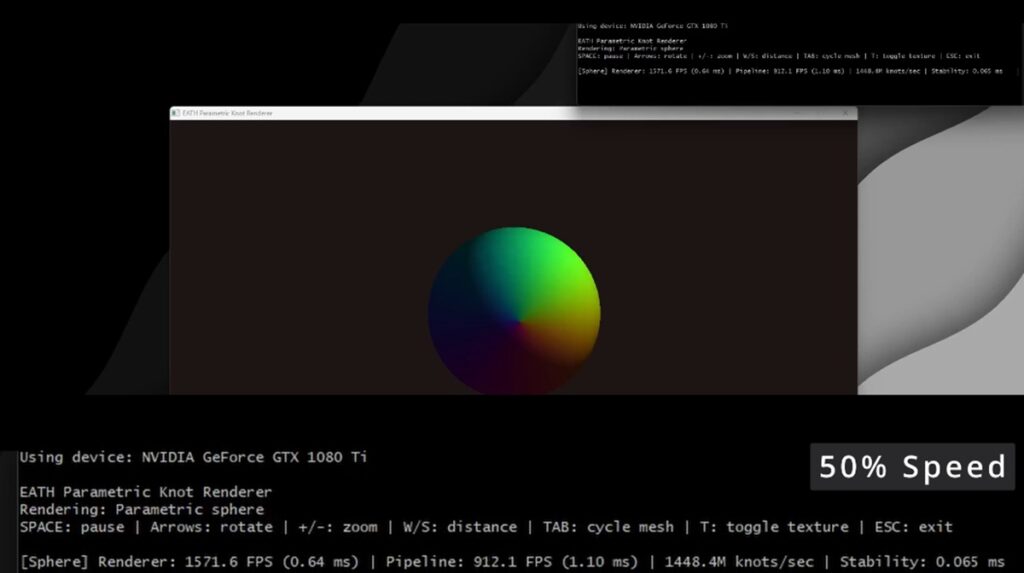
Instead of constructing scenes from millions of triangles and processing every pixel independently like today’s graphics cards, Earth Renderer represents visual information through continuous mathematical structures. This enables highly detailed 3D objects and extreme zoom without visible pixelation. It also enables real-time lighting and shadows without traditional triangle-based calculations, and large-scale collision processing at exceptional speeds.
Earth Renderer is not an AI-generated graphics system. It is a fundamentally different rendering architecture intended to reduce computational complexity, bandwidth requirements and data size while enabling new approaches to real-time graphics, Gajda said.
He said the technology can be developed into a standalone professional renderer, an integrated mesh and geometry editor for game engines, a rendering layer for CAD and 3D creation software, or an infrastructure component for cloud rendering, digital twins, simulation and streamed interactive environments.
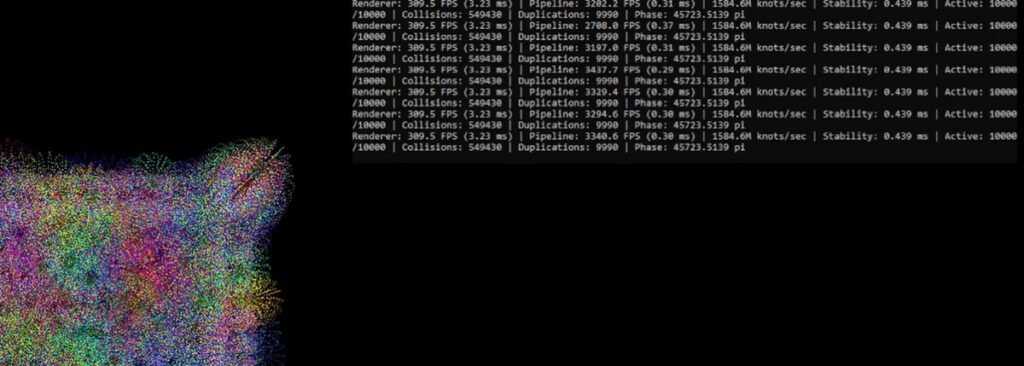
The claimed performance is pretty unbelievable. Games usually run at 30 frames per second (FPS) to 60 FPS. Virtual reality requires 120 FPS. That includes a ton of sub processes. Gajda said demonstrations show Earth Renderer can deliver rendering performance exceeding 3,000 frames per second and processing pipelines operating at several thousand frames per second under specific test conditions.
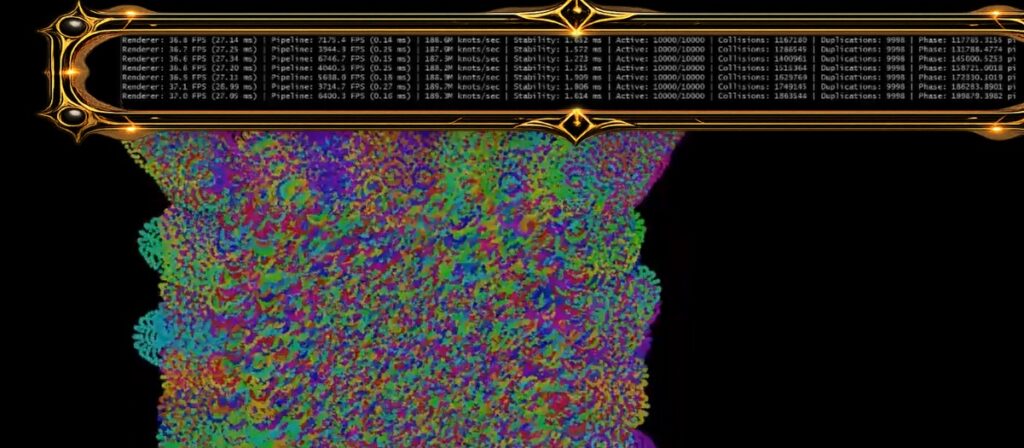
Other demonstrations show millions of collision events accumulated during the simulation; approximately 10,000 simultaneously active 3D entities; high-volume object spawning, updating and despawning; and continuous collision processing during real-time rendering, he said.
These figures demonstrate the architectural potential of the technology, but they should not be interpreted as the expected frame rate for every complete commercial application, Gajda said.
Still, Gajda hopes to raised money to develop and commercialize the high-efficiency rendering technology. He isn’t describing the math formulas behind the renderer yet, but he said they are the key to success. Gacriva uses these formulas to create 3D entities called hopfions. Unlike traditional pixel-based or triangle-based rendering, these toroidal shapes are computationally cheaper to process.
Gajda said these results show what’s possible.
- Performance metrics: The system achieved over 800 frames per second in rendering and over 1,000 frames per second in the pipeline using a nine-year-old computer.
- Data efficiency: For 4K video streaming, the technology requires only 16 to 24 kilobytes per frame, compared to the standard approximately 24.9 megabytes.
- Physics-based rendering: The system naturally handles lighting and shadows through its inherent geometry without requiring explicit shadow-casting code.
The significance of this work
We cannot yet prove whether this works or what Gajda said is true. But this is an interesting moment for this kind of work, as graphics processing is being held back by the rising cost of memory chips and bottlenecks in the system.
Gajda said Earth Renderer demonstrations show visual information represented at sizes up to 1,000 times smaller than conventional alternatives used in the tested comparison. A reduction of this scale could directly affect storage requirements; network bandwidth; cloud delivery costs; content distribution; streaming infrastructure; application download sizes; device memory usage; data-center energy consumption; and remote visualization performance.
This does not mean that every asset, video, scene or application will automatically become 1,000 times smaller. Compression and representation gains depend on the source material, visual complexity, required fidelity, target platform and existing comparison method.
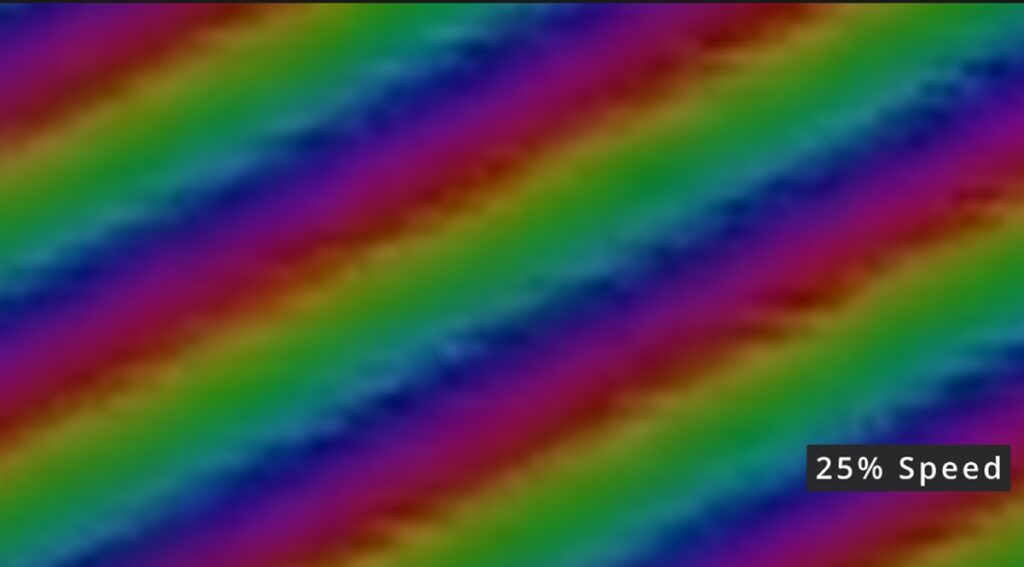
The correct commercial claim is that Earth Renderer has demonstrated the potential for dramatic reductions and that every target use case must be independently validated through a pilot test. But, so far, demonstrations show objects and recorded visual information being enlarged without revealing the conventional square pixel structure associated with raster images, Gajda said.
Because the underlying representation is mathematical rather than a fixed grid of stored pixels, zooming is not restricted in the same way as conventional bitmap enlargement.
The collision demonstrations show Earth Renderer processing more than 500,000 collision operations within microsecond-level execution windows under the tested conditions.
This capability is especially relevant for simulations containing very large numbers of
simultaneously active entities.
Potential applications include large-scale physics simulations; particle and fluid-like systems; destruction systems; crowd simulations; industrial process simulation; scientific modelling; digital twins; interactive training environments; and games containing large numbers of dynamic objects.
Traditional collision systems frequently simplify geometry, reduce active objects or divide scenes into smaller spatial regions to maintain performance. Earth Renderer may enable a much larger number of interactions while maintaining real-time responsiveness.
The exact result will vary by processor, GPU, memory architecture, entity complexity, collision rules and implementation. Pilot tests must compare identical workloads on controlled hardware.
The demonstration does not claim infinite detail for zooming where no source information exists. It demonstrates that the representation and reconstruction method is not inherently constrained by a conventional visible pixel grid.
More visual complexity typically means more GPU demand, more storage, larger downloads, heavier data transfers, and greater network bandwidth, Gajda said. Cloud rendering can move computation away from the user’s device, but it introduces another problem: the rendered result still has to reach the user efficiently and responsively.
Gacriva is developing software intended to address this problem at the architecture level. Rather than treating rendering, compression, and streaming as isolated technologies, Gacriva is building them as parts of a unified system, Gajda said.
At the center of this work is what he calls the Earth Technology Platform: a next-generation rendering and delivery architecture designed around three closely connected capabilities: remote rendering, adaptive low-bandwidth streaming, and Neural Texture Compression.
I’ve interviewed Gajda and I think his claims are worth checking out by qualified experts, as even partial success could advance the cause of graphics and gamers.
Earth Renderer demonstrates ray traced lighting and illuminated 3D forms without
depending on a conventional triangle mesh, Gajda said.
Traditional real-time rendering calculates light interaction across polygonal surfaces. As
geometry and scene complexity increase, the system must process more triangles,
intersections, materials and samples.
Earth Renderer explores a different method in which light interacts with the mathematical representation of the object itself.
Potential advantages include:
● Reduced dependence on polygon density
● More efficient light–geometry intersection calculations
● Lower geometry-processing overhead
● Simplified representation of curved surfaces
● New approaches to real-time shadows
● More consistent rendering across different detail levels
The current demonstration focuses on lighting and object representation. More extensive validation is required for complex materials, multiple light sources, reflections, refractions, global illumination and production-scale scenes.
Running circles around today’s graphics
“I’m coming with 3D objects that are cheaper than 2D pixels. We need to go with pilot programs to prove that. This is real. It’s not magic,” he said. “Where we really shine is when you scale it. So when you’re getting into millions of pixels, then you can see the big difference between us and what’s out there.”
One possible partner was interested in the ability to do neural texture compression, which is a new tech for games running 4K or 8K textures.
“We’ve discovered that our renderer can do that better than what’s out there,” he said. “Once we have this working software,” the team can move on.
“If we make a chip architecture using these algorithms, then definitely the speed will probably increase even more,” Gajda said.
Going beyond the traditional rendering pipeline
Most modern graphics systems are built around a familiar assumption: the device displaying a 3D world must either render that world locally or receive a conventional video stream generated somewhere else.
Both models have significant limitations, Gajda believes. Local rendering requires sufficient hardware on the end-user device. Complex scenes demand capable GPUs, memory, storage, and increasingly large asset packages.
Remote rendering shifts the workload to another machine or data center, but conventional video delivery can consume substantial bandwidth and may become difficult to scale across large numbers of users.
Gacriva is approaching the problem differently. The company is developing a system in which the renderer, the streaming architecture, and advanced compression mechanisms are designed to work together as one pipeline.
The objective is not simply to compress a video after it has been rendered. The aim is to reconsider how complex visual information is generated, represented, compressed, transmitted, and reconstructed across the entire system, Gajda said.
This does not mean that existing content pipelines must immediately be abandoned.
Earth Renderer can be developed as a standalone environment or integrated
progressively into existing engines, rendering pipelines and professional software.
The commercial opportunity is not limited to replacing an entire renderer. The
technology can initially improve one costly part of an existing pipeline and expand after
validation.
The Earth Renderer
The Earth Renderer is the rendering foundation of the platform.
The team is developing it for scenarios where complex visual environments may be generated remotely and delivered to another device through a streaming architecture. This changes the role of the client device.
Instead of assuming that every user needs powerful local hardware capable of processing the complete scene, the computationally demanding work can be performed elsewhere. The result can then be delivered through a system designed specifically around efficient visual transmission.
This architecture has implications far beyond conventional cloud gaming.
Potential application areas include: interactive 3D environments; large-scale simulations; digital twins; XR and spatial computing; architectural visualization; industrial platforms; remote scientific visualization; complex geographic environments; training and educational systems; and cloud-based creative software
The common problem across these fields is similar: how do you make increasingly complex visual environments accessible without forcing every endpoint to reproduce the full computational infrastructure locally?
That is one of the central problems the Earth platform is being designed to address.
Ultra-low-bandwidth streaming
Remote rendering alone does not solve the infrastructure problem.
A remote GPU can generate an extraordinarily complex image, but that image still has to travel across a network. At scale, bandwidth becomes one of the defining constraints.
Gacriva Technologies is developing the streaming layer as a core part of the system rather than an afterthought. The platform is focused on reducing the amount of information that must be transmitted while preserving the visual result required by the application.
This is particularly important for use cases where conventional high-bandwidth video streaming becomes expensive, inefficient, or operationally difficult. For example, a highly detailed 3D application may run successfully on powerful remote hardware, yet remain impractical if every active user requires a heavy continuous stream, Gajda said.
The problem becomes even more significant when considering: mobile networks; geographically distributed users; large concurrent audiences; remote industrial locations; bandwidth-constrained environments; XR devices; edge computing; and emerging markets with inconsistent connectivity.
Gacriva Technologies’s work is based on the idea that the future of remote graphics depends not only on how quickly images can be rendered, but on how intelligently visual information can move through the network.
Neural Texture Compression
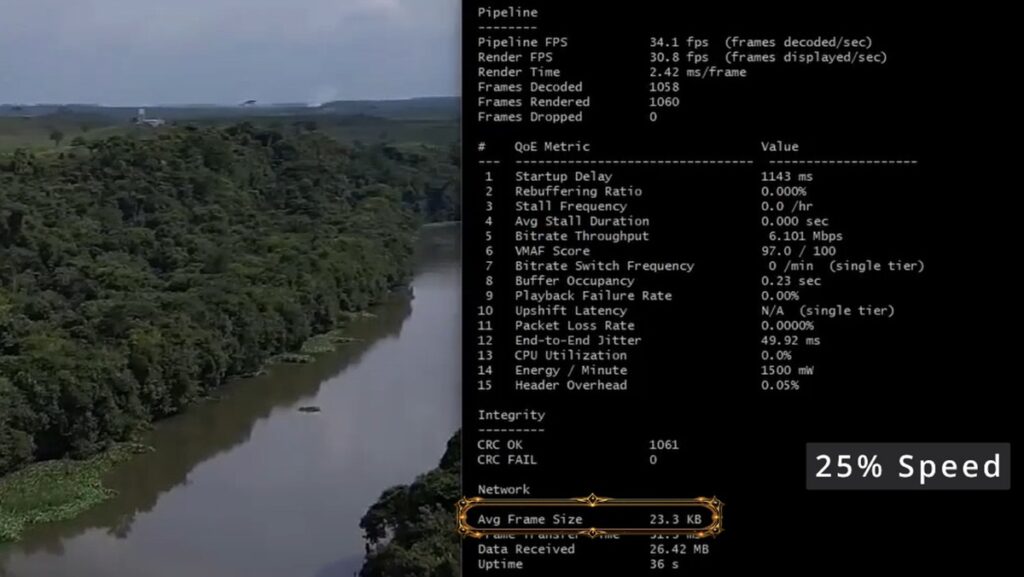
A major component of the technology is Neural Texture Compression, or NTC.
Textures represent a substantial part of the storage and memory footprint of modern visual applications. As graphical fidelity increases, texture datasets can become extremely large.
Traditional compression methods have helped the industry for decades, but the continued growth of high-resolution assets is forcing developers to look at new approaches.
Gacriva Technologies is developing its own work in this area through BRAID-NTC, a Neural Texture Compression technology intended to become part of the wider Earth architecture.
The important distinction is architectural. BRAID-NTC is not just an unrelated compression experiment attached to a renderer. Within the broader platform vision, neural compression can become one component of a system designed around the complete journey of visual data.
That includes creation, representation, rendering, compression, transmission and reconstruction. By considering these stages together, Gacriva Technologies is exploring a software architecture where optimization can happen across the pipeline rather than at a single isolated point.
At the same time, the Neural Texture Compression component has the potential to exist as a standalone technology for applications that require compression without adopting the complete remote-rendering platform.
One system. Not a collection of unrelated tools

This is an important aspect of Gacriva Technologies’ development strategy, Gajda said.
The company is not simply building three unrelated products: a renderer, a streaming tool, and a compression system. The broader objective is a unified technology platform.
The Earth Technology Platform combines Earth Renderer, the rendering layer responsible for generating complex visual output; and the Earth Streaming Platform. The delivery architecture responsible for moving that visual result efficiently between remote computation and the end user.
BRAID-NTC
The neural compression technology focused on reducing the data burden associated with complex visual assets. Each component may have independent value, but the larger technical proposition comes from their integration.
This makes the technology relevant to a wider question facing the software industry.
What happens when visual complexity continues to increase faster than storage, bandwidth, and endpoint hardware can economically scale?
Gacriva Technologies is building its answer around a different relationship between compute, visual data, and delivery.
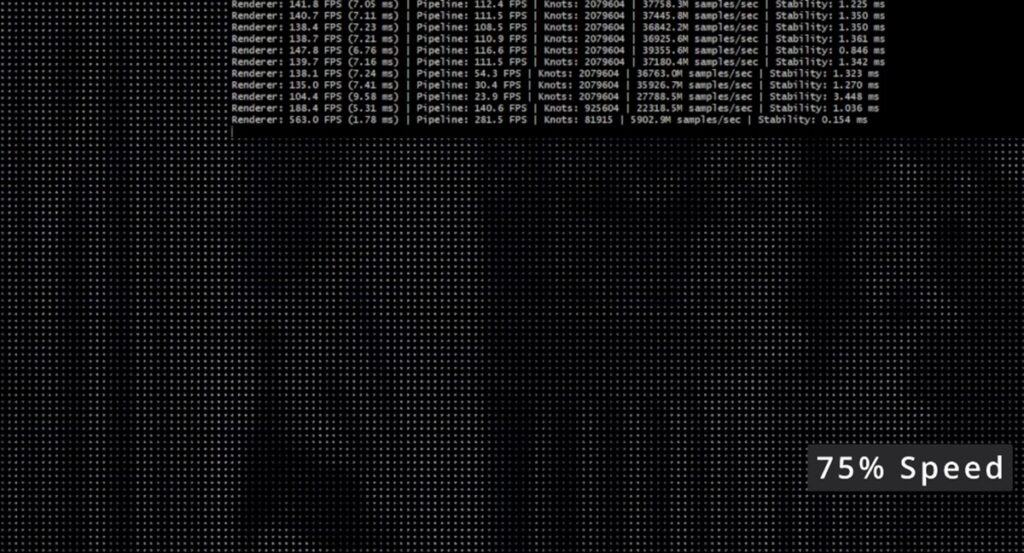
In the current demonstration, Earth Renderer reconstructs and displays high-resolution visual output using a single resolution sample rather than relying on conventional multi-sample reconstruction.
The demonstration presents a 4K output at 4096 × 2160 resolution while requiring only one sample for the represented information.
Potential benefits include:
● Lower sampling requirements
● Reduced processing per rendered output
● Lower memory and storage pressure
● Faster reconstruction of visual information
● More efficient high-resolution rendering
● Reduced data requirements for transmission and playback
The exact improvement will depend on the customer’s existing renderer, sampling method, target quality and hardware configuration. The relevant comparison must therefore be performed through a customer-specific pilot using the customer’s own content and infrastructure.
From games to a much larger market
The technology has roots in problems encountered through game development. That is not accidental.
Games are among the most demanding real-time software systems in existence. They combine rendering, networking, user interaction, simulation, massive asset libraries, strict latency requirements, and unpredictable real-time behavior.
A technology capable of addressing these constraints may naturally have applications beyond entertainment. The same fundamental challenges appear in other industries. A digital twin of a factory must represent enormous amounts of visual and operational information.
A scientific visualization platform may need to display datasets too complex for ordinary client hardware. An architectural environment may contain highly detailed geometry and materials.
An XR system must balance visual fidelity against device weight, heat, battery life, and computational limits. A geographically distributed engineering team may need access to sophisticated 3D software without identical high-end workstations at every location.
A large interactive world may be too heavy to distribute efficiently through conventional asset pipelines. These are different industries, but they share an infrastructure problem.
Complex visual information is expensive to compute, store, move, and reproduce. Gacriva Technologies is developing software around that shared constraint.
Reducing the dependence on the endpoint
One of the most significant long-term consequences of this architecture could be a reduced dependence on powerful local hardware.
Today, access to advanced 3D applications is often determined by the device in front of the user. A sufficiently powerful workstation can run the application. A weak device cannot.
Remote rendering changes that equation by separating the location of computation from the location of interaction.
But for this model to become broadly practical, the network itself must not become the new bottleneck.
This is why Gacriva Technologies’s combination of rendering, compression, and low-bandwidth streaming matters.
The long-term goal is a system in which high computational complexity can exist remotely while the endpoint receives only the information necessary to experience and interact with the result.
In practical terms, this could contribute to a future where the complexity of an application is less tightly coupled to the power of the device displaying it.
A different view of compression
Compression is often treated as a final step. A system creates data, and then another system attempts to make that data smaller.
Gacriva Technologies is investigating a broader model. When the renderer, the compression architecture, and the streaming system are developed together, compression can potentially become part of the design logic of the full platform.
This is a fundamentally different perspective. Instead of asking only: “How do we compress the final output?”
The more ambitious question becomes: “How should visual information be represented from the beginning if we know that it must eventually be transmitted efficiently?”
That shift in perspective is central to the direction of the technology, Gajda said.
Why this matters now
The timing of this problem is significant. The software industry is moving toward larger real-time environments, cloud-hosted applications, AI-generated visual content, spatial computing, industrial digital twins, remote collaboration, persistent virtual environments, increasingly detailed simulations, higher-resolution assets and distributed GPU infrastructure.
Every one of these trends increases pressure somewhere in the system. This requires more compute. More memory. More storage. More bandwidth. The traditional response has often been to increase infrastructure capacity.
More powerful GPUs. Larger servers. Faster networks. And bigger storage systems.
Gacriva Technologies is exploring another route: reducing the amount of infrastructure required to deliver the experience in the first place.
Building infrastructure for the next generation of visual computing
Gacriva Technologies is still developing the platform, and the significance of the work will ultimately depend on technical validation, integration, and real-world deployment.
But the direction is clear. The company is not approaching rendering as an isolated graphics problem, Gajda said. It is treating visual computing as a complete systems problem involving: computation, representation, compression, networking, and delivery.
The Earth Technology Platform reflects that philosophy. By combining remote rendering, ultra-low-bandwidth streaming, and Neural Texture Compression within a unified architecture, Gacriva Technologies is working toward a future where increasingly complex digital worlds do not automatically require increasingly expensive infrastructure at every endpoint.
The technology began with problems visible in game development. The potential market is much larger.
Because in the next generation of computing, the central challenge may no longer be whether computers can create extraordinarily complex digital environments. It may be whether Gacriva can deliver them efficiently enough for the world to actually use them.
What if the biggest technological breakthroughs didn’t start in labs, but in games? Gajda wants to prove the tech in games and then license the tech for broader applications. He’s looking for partners.
Origins of the graphics technology
The team was studying graphics, looking at models for how objects in the background of a scene disappear behind other objects in the foreground.
“The stuff behind you disappears and spawns in front of you and gives you the illusion that you’re walking around the planet or something like that,” Gajda said. “We didn’t have the model to copy or take inspiration from, and we wanted to do something else. So we started to look into research papers. We looked at a lot of research papers, and then one designer on the team just had an Eureka moment.”
That took place in November. The programmers and developers didn’t know how to solve a big issue. But they were lucky enough to have a mathematician in the community, Gajda said. The mathematician validated the formulas, and a low-level programmer put the formulas into practice. By December, the programmer did the work. And by January, there were demos.
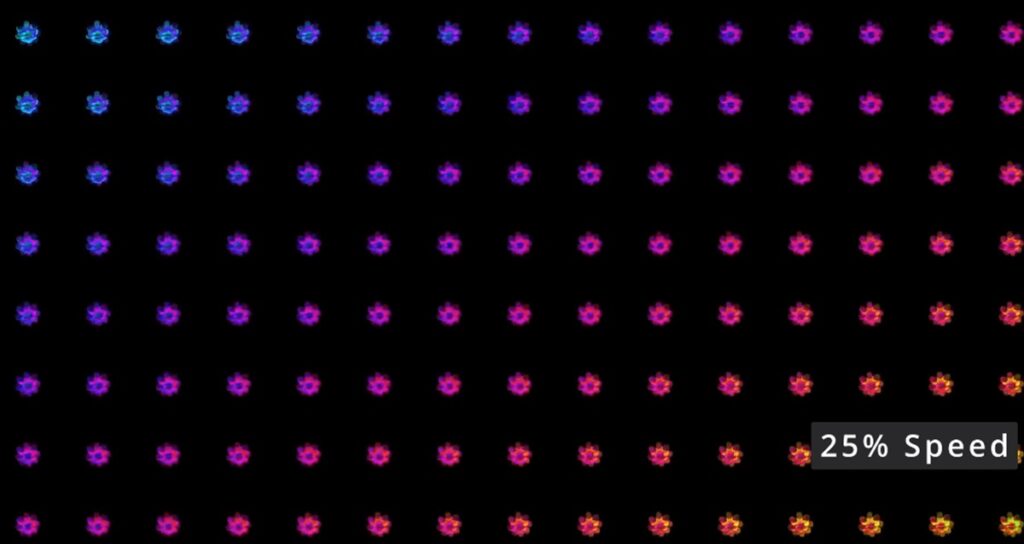
First, the graphics appeared on the screen based on those formulas in the shape of a doughnut, or a toroidal shape made out of what looked like squares. That might appear to a technical person to be vectors, but there were no vectors in that 3D representation.
“We saw that it barely used any computer resources. Instead of trying to pinpoint what it was using on the computer, we put as many objects as we could on the screen to see where it collapses. The programmer wasn’t very comfortable because he said that he might burn something, either his GPU or his CPU.
So he said, “But don’t worry, I have a nine-year-old computer, and we will use that computer as a test dummy.”
So he managed to put 11 billion of those things on the screen at very high frame rate,” Gajda said. “We had over 100 frames per second, and there were 3D entities spinning, giving light and color to the screen. And at that point, we we realized that basically we had a rendering tool that was able to render over 32K of an image. We didn’t find the limit. It would be able to render on a nine-year-old computer in record time.”
Then they tried to render a movie, as it is just 24 images in one second.
“We e started to render a movie, so also great results, great numbers. There, we said, ‘OK, let’s see if we can stream this movie. How well it will work? And at that point, we actually got to a point we were 80% better than anything else,” he said.
They got some images off the internet and then recorded it.
“Basically, when you zoom in into this movie, you don’t see pixels. At one point, you will start to see these 3D donut-looking things. We call them hopfions, which are way faster than pixels,” Gajda said.
It seemed crazy, but the 3D object was cheaper and easier to render than a square.
“Because we were game developers at the end of the day, and this came out of trying to make a planet for a game, and we didn’t have a network in the movie industry or streaming industry or whatnot. We said let’s see if we can put them together and try to make a 3D object out of it,” Gajda said. “So we crammed these things together and we made the ball. the The programmer suggested to use ray tracing light because that’s the most expensive light that you have in games today.”
The programmer wanted to see how big of an impact it would have if that light was hit.
“So the moment that the demo started, we were asking the programmer, why did you code in shadows? Because that a nightmare to code, especially to a new system that you are building from scratch. And he basically showed us the code. There were no shadows cast. There were no shadows written in the code,” Gajda said.
Normally, you have a 3D object, and they calculate a flat shape on the surface based on the angle of the light, and then you have the shadows in games. The shadows were not pre-programmed. They just appeared. They had to use a debugging tool to see what was happening.
“We didn’t code anything to do that those shadows. At that point, we realized that we had something that’s basically a renderer. We can call it physics-based renderer because it behaves as physics behaves in real life,” Gajda said. “The response time was in the microseconds at that point. The speed on the rendering was around 800 frames per second. So that would mean in game engine terms we could add a ton more objects there without feeling almost any impact. And on the pipeline side, we had over 1,000 frames per second.”
He said it was sampling billions of samples per second.
“That’s unheard of, especially on a nine-year-old computer. Now you might be able to have similar results on a supercomputer that’s extremely costly, but definitely not on a nine-year-old desktop PC, Gajda said.
Why is this possible? What comes next?
I asked Gajda why it was possible. He said it was due to the formula that generates the hopfions.
“They’re like donuts. If you look at them, if you want to visualize them, it’s something like the magnetic field of the Earth,” he said. “In the math of creating that shape, that gives all these powerful results.”
Gajda said the team could patent products that are based on this discovery, and it could license the tech to big partners. It could be both hardware and software. The tech could make an impact on movies, images, 3D objects and more — with millions of collisions per second and thousands of frames per second on the pipeline, he said.
“We can reduce the costs of streaming — for the entire pipeline of streaming,” he said. “We’ve refined it in the last months to a point that now it outperforms” other renderers.
Pilot first commercialization
Earth Renderer will be introduced through focused pilot programs. Each pilot begins with the partner’s actual problem, existing architecture and measurable operating baseline. We then adapt and integrate the relevant Earth Renderer components into a controlled use case.
A typical pilot includes: technical and commercial qualification; selection of the target workload; definition of existing baseline metrics; infrastructure and architecture assessment; customer-specific implementation; controlled benchmark testing; joint validation of results; production and licensing roadmap; limited deployment and expansion across additional workloads or markets.
Gajda said This approach ensures that claims are supported by evidence from the partner’s own environment.
If the pilot produces meaningful results, the technology can scale through annual licensing, SDK access, enterprise integration, infrastructure deployment, support agreements or joint product development.
His call to action? To find partners in each of these segments who can help turn the tech into products.
“We are looking for partners of every size from independent developers and specialized engineering teams to game-engine companies, streaming platforms, cloud providers, hardware manufacturers and global technology organizations,” Gajda said. “You do not need to replace your complete infrastructure to work with us. We can begin with one object, one scene, one workload, one bottleneck or one measurable cost.”
Gajda added, “Bring us the problem that your current technology handles inefficiently. We will build the pilot around your content, your infrastructure and your success criteria. If the technology proves its value, we scale it together. Start small. Prove the advantage. Scale together. Earth Renderer is ready for partners who want to help shape (not simply adopt) the next generation of rendering technology.”
Gajda said the company does not claim that Earth Renderer currently beats every renderer, every engine or every metric across the entire industry. Different technologies are optimized for different purposes, he said. A system may lead in visual fidelity, another in compatibility, another in latency and another in production maturity.
“Our position is simpler and commercially more relevant,” he said. “Earth Renderer is designed to make rendering, computation and visual-data delivery more efficient and less expensive. We do not need to win every possible benchmark to create substantial value. If Earth Renderer can reduce a customer’s bandwidth, infrastructure, processing or production costs while maintaining or improving the required output, the technology has achieved its commercial purpose.”