
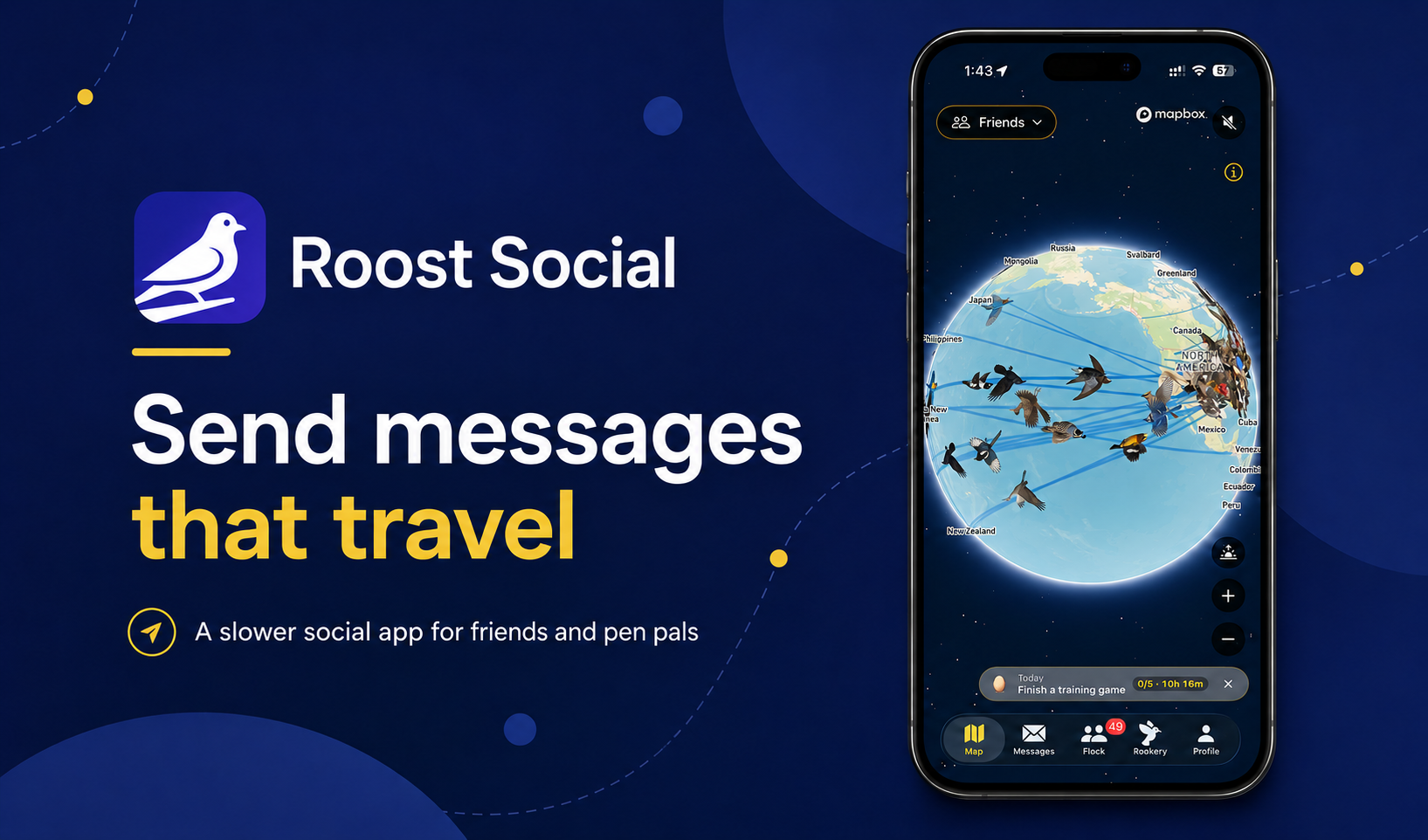
In an era of instant messaging and endless notifications Roost Social is asking users to slow down — by sending messages via virtual carrier pigeons. Since launching in April, the app has racked up more than 250,000 downloads.
Published on April 28 by founder Logan Mendelsohn, Roost Social translates the old-school practice of using trained birds for distance communication into a modern digital experience. Users can select from a range of over 1,000 virtual birds — as well as other animals like turtles, snails, and bats — each with unique speed statistics based on the real-life birds’ behavior. Using their animal of choice, users can send messages back and forth with friends, with notes taking between minutes and days to arrive based on the speed of the bird and the distance between the friends. Users can also collect birds and use them to play casual games within the app, like a bullet hell game or a Flappy Bird clone.
“I call it a social media app; other people call it a game,” Mendelsohn said in an interview with GamesBeat. “I don’t know what to call it, honestly.”
Categorization notwithstanding, Roost Social appears to be meeting a real need among people who want to put a relaxing and ornithological spin on their conversations with friends. Roost Social currently boasts over 250,000 users, with over 100,000 active conversations every day. There’s an unofficial subreddit discussing the app, as well as numerous TikToks and social posts from influencers and creators. All of this marketing was organic, with Mendelsohn spending a grand total of zero dollars on advertising or paid user acquisition.
Mendelsohn grew up around birds and in a family of birdwatchers, describing his parents’ 38-year-old African gray parrot, Bingo, as his “older brother.” He works full-time as a product manager and started Roost as a side project with a friend in May 2025 — first as a proof-of-concept TikTok that went viral, then as an app that he didn’t initially intend for public release.
“I thought it would just be a fun thing people would enjoy — ‘oh, this is a cool little project’ — but it actually touched on something that a lot of people are feeling right now,” he said.
Roost Social is already monetizing its offering, both through purchases of individual birds on a rotating item store, with prices ranging between $0.99 and $10, and through a recently-launched subscription service that gives premium users benefits like profile badges and early access to new features. So far, the majority of paying users have sprung for Roost Social’s lifetime subscription tier, which sells for $50. Mendelsohn told GamesBeat that he’s sold between 60 and 70 of these subscriptions so far.
Roost Social’s user base continues to grow steadily, and Mendelsohn has his eyes set on future growth for the so-called “slow-cial media” app. In the coming year, he hopes to staff up, with plans to hire a game developer to help step up the mobile gaming aspects of the app. He also acknowledged that he will likely delve into marketing and paid user acquisition as Roost Social continues to scale. Mendelsohn is not currently looking to scale Roost Social through investment; instead, he plans to self-fund the app through its built-in revenue streams.
“I will have to cross that bridge at some point — of doing paid acquisition and marketing,” Mendelsohn said. “I don’t know when, but I think it will come sooner than later for me.”
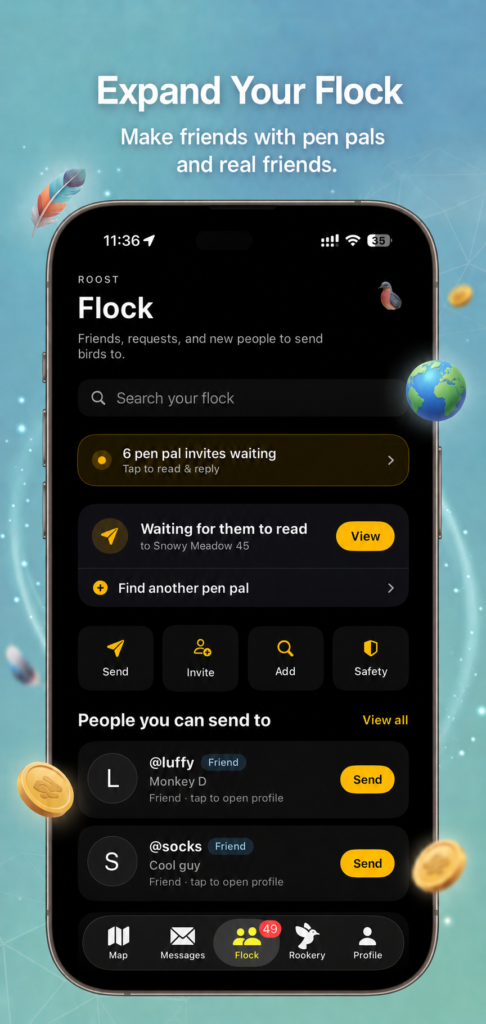
In addition to the relaxing and fun nature of Roost Social, Mendelsohn said he believes the added trust and safety that comes with slower communication is a potential selling point for kids and their parents interested in the app.
“The way I designed the pen pal feature is, we put people into age cohorts, and you can only match and communicate with people in your age groups,” he said. “I really want to create a more wholesome and positive internet experience for kids and for adults.”