
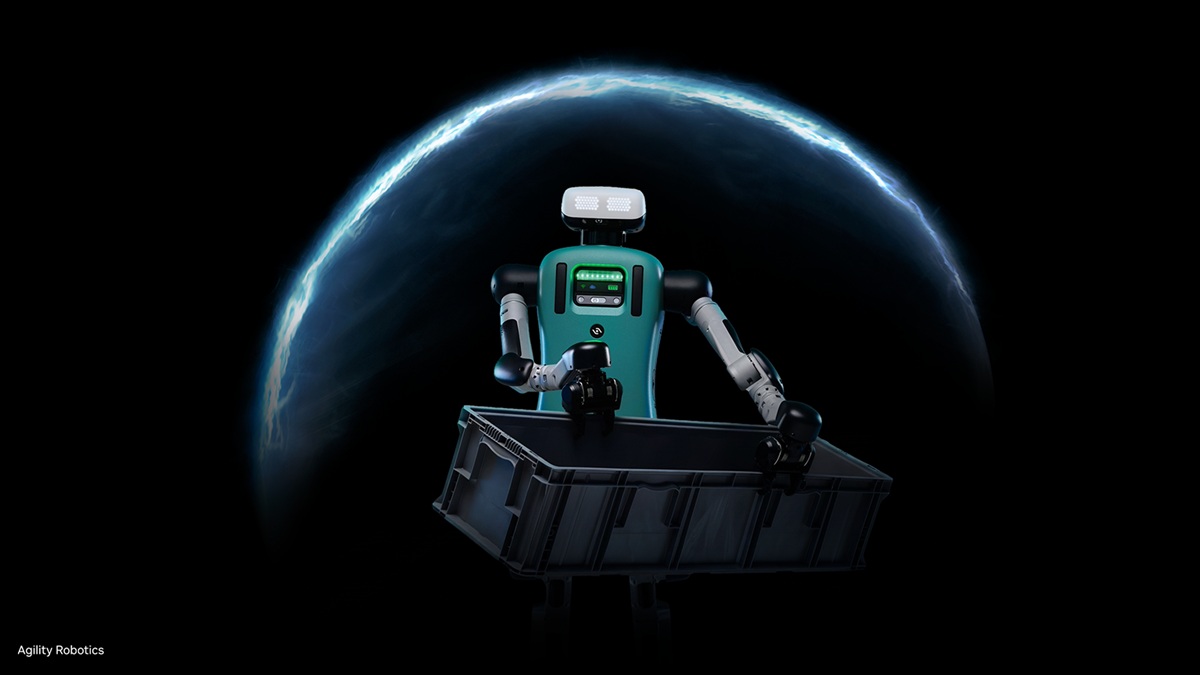
Nvidia announced Nvidia Halos for Robotics, a full-stack, comprehensive safety system for robotics and physical AI that unifies AI compute and safety.
Agility, a leading humanoid robotics and physical AI company, is the first to use Nvidia Halos
for Robotics to build safety into its humanoids working in factories, warehouses and logistics
operations for customers including Amazon, GXO, Schaeffler and Toyota Motor Manufacturing
Canada.
The next generation of autonomous robots will operate in dynamic environments alongside
humans, using AI foundation models, accelerated compute and distributed sensors. Scaling
these systems requires a full-stack safety architecture.
Nvidia Halos enables companies to rely on a standardized, unified safety architecture that
connects AI compute, system software, sensor data, safety applications and inspection for
robotic systems.
“Physical AI is transforming how factories, warehouses and logistics operations work, and
robotics teams need a unified safety architecture to scale autonomous systems into these
environments,” said Deepu Talla, vice president of robotics and edge AI at Nvidia, in a statement. “With Nvidia Halos for Robotics, developers and system builders can harness Nvidia’s proven autonomous vehicle safety foundation to develop safer robots faster and bring them into industrial operations alongside workers with greater confidence.”
A Full-Stack Foundation for Robot Safety
Drawing on 18,600+ engineering years of autonomous vehicle safety development, Nvidia
Halos for Robotics provides developers with a common safety architecture for building,
validating and deploying physical AI systems.
The system spans the key layers needed for robot safety:
● NNvidia IGX Thor and Nvidia Holoscan Sensor Bridge provide industrial-grade AI compute, built-in safety and sensor connectivity for real-time robotics and safety workloads.
● Nvidia Halos OS provides the software stack for robotics safety, including Halos Core to support safety-related operating functions and safety applications built with the Nvidia Halos Outside-In Safety Blueprint, which extends robot perception using external cameras and AI agents to dynamically control robot behavior in industrial settings.
● The Nvidia Halos AI Systems Inspection Lab is the world’s first ANSI National Accreditation Board (ANAB)-accredited program for physical AI functional and AI safety, helping partners prepare Halos integrations for third-party certification by leading certification bodies including TÜV Rheinland, UL Solutions, TÜV SÜD, exida, SGS and CertX.
“As AI-enabled robotics moves into industrial environments, the industry needs standardized,
internationally recognized frameworks to assess safety across increasingly complex systems,”
said Laurie E. Locascio, CEO of Ansi, in a statement. “The Nvidia Halos AI Systems Inspection Lab, accredited by ANAB, gives companies a structured path to validate their robotic AI systems before third-party certification, setting a new benchmark for how physical AI safety is evaluated.”
Agility Incorporates Halos for Industrial Humanoids
Humanoid robots are designed to operate in dynamic environments alongside workers,
equipment and other robots that are constantly in motion. That requires safety engineered for
every layer of the stack.
Agility is extending its leadership in humanoid safety by teaming with Nvidia to integrate Nvidia IGX Thor and Halos Core into its proprietary safe human detection system for its humanoid robot Digit, which is designed for industrial work in logistics, manufacturing and warehouse operations. For Digit, Nvidia IGX Thor delivers industrial-grade AI compute with built-in safety capabilities, while Halos Core supports the software layer for safety-related operating functions.
Agility will also participate in the Nvidia Halos AI Systems Inspection Lab. Together, Agility and
NVIDIA will use the lab to ensure Digit’s safety-related software, AI components and cybersecurity protections meet rigorous standards such as IEC 61508, ISO 13849 and ISO/IEC
TR 5469 before final third-party certification.
“For humanoids to deliver value at scale, safety has to be built into the robot and validated
across the entire system,” said Peggy Johnson, CEO of Agility, in a statement. “Partnering with Nvidia to implement and optimize the Halos for Robotics system extends our leadership in responsible automation, which is a non-negotiable requirement for bringing humanoids safely into industrial workflows. This collaboration unlocks true human-robot teamwork, driving the long-term returns that will power next-generation manufacturing and logistics operations.”
A Robotics Safety Ecosystem Built for Scale
The NVIDIA Halos for Robotics ecosystem brings together partners across , software, systems,
sensors and silicon, industrial applications and certification bodies to support safety from
development through deployment:
● Software: Acontis, Amazon FreeRTOS and QNX support the real-time operating
environment, safety communications and embedded software layers needed for
functional safety development.
● Embedded systems: Advantech and NexCobot deliver safety-designed IGX-based
systems for robotics deployments.
● Sensors and silicon: Infineon, NXP, SICK, STMicroelectronics and Texas Instruments contribute sensor, safety microcontroller and semiconductor technologies.
● Industrial applications: FORT Robotics, Inventec, KION Group and Neurealm are developing functional safety agents using the Nvidia Halos Outside-In Safety Blueprint.
● Certification Bodies: TÜV Rheinland is inspecting Nvidia IGX Thor, Halos OS and Holoscan Sensor Bridge for functional safety certification readiness, building on TUV SuD’s inspection of Thor SoC and certification of Halos Core for ISO 26262.
The Nvidia Halos AI Systems Inspection Lab includes more than 40 companies across manufacturers, certification bodies and safety vendors working to move safe physical AI systems from design to real-world deployment. TÜV Rheinland, TÜV SÜD, UL Solutions, exida,
SGS, and CertX all recognize the Nvidia Halos AI Systems Inspection Lab as part of their
certification process.
Availability
Nvidia Halos Core for Nvidia IGX is available in early access for registered developers in
Linux and Linux plus QNX configurations. The open source Nvidia Halos Outside-In Safety
Blueprint, part of the Halos Applications layer of Halos OS, is now available in early access on
GitHub.