
Mellow, a contractor management platform for the game development industry, found in a survey of 2,000 game dev freelancers that 95% reported a better life after going independent.
The State of Freelancing in Game Development 2025 report examines the work of the 150-plus game companies with over 2,000 freelancers, and combines it with the new study — the 2026 Survey of Freelancers, covering more than 1,000 active game development freelancers from the U.S. and United Kingdom. The results are cross-referenced signals of what’s happening with the freelance class in the industry today.
The headline finding: 95% of game-dev freelancers say their quality of life improved after leaving full-time employment — and most are not coming back. What’s more, 50.8% are moving toward some form of independent ownership rather than returning to employment: 36.5% plan to launch their own studio or agency within five years, and 14.3% are working toward releasing their own game.
Alex Norovyatkin, vice president of growth at Mellow, said in an interview with GamesBeat that Mellow helps game development companies work with contractors who operate as part of a flexible workforce. The company has done that for over 10 years and it has more than 200 customers in game development — mostly mid-sized game studios. Because of all of the layoffs, the team decided to do a survey in the U.S. and U.K. to understand the market.
Norovyatkin said that the survey found that 43% of those surveyed felt they transitioned gradually, and they started freelancing alongside with a full-time job, and then they made it to jump.
Mellow believed that many knew layoffs were coming and they made this choice on their own.
“The most important thing I hear is that people are actually making this choice not because of the fear, but because this is how they want to pursue their future and their business,” Norovyatkin said. “It’s not just ‘I have been laid off, and that’s why I have to become a freelancer.’ It’s ‘I want to become a freelancer, because it gives me more flexibility, more freedom, and more money at the end of the day.'”
“Freelancing is also just step one toward building something on their own. Only around 10% of those who participated in our survey told us that they wanted to return to full-time employment,” Norovyatkin said.
Freelancing helps them build skills, develop a client base, and create their own business.
Quality of life is the real driver
95% of respondents say their quality of life improved after leaving full-time employment. 64% say it improved significantly. The top reasons: higher income (65.6%), freedom to choose projects (62.5%), flexible schedule (53.1%), and the ability to work from anywhere (45.3%). Money matters — but autonomy and ownership over one’s work are just as important. This combination is what makes freelancing a sustainable long-term choice, not a transitional state.
The door is open — but the bar is high
Roughly 58% are open to returning to full-time employment under the right conditions. The top triggers: significantly higher salary (63.5%), a dream studio or team (51.6%), an ambitious high-impact role (50%), and equity or stock options (50%).
However, only 9.5% plan to return to full-time employment. Most are looking in a different direction: 36.5% plan to launch their own studio or agency, 14.3% are working toward releasing their own game, and 34.9% intend to continue as freelancers.
Income is up
Around 91% of respondents earn more than they did as full-time employees. Of those, 62% report income at least 50% higher than before. At the same time, ~95% describe their freelance income as stable — despite most having experienced at least one gap period without work.
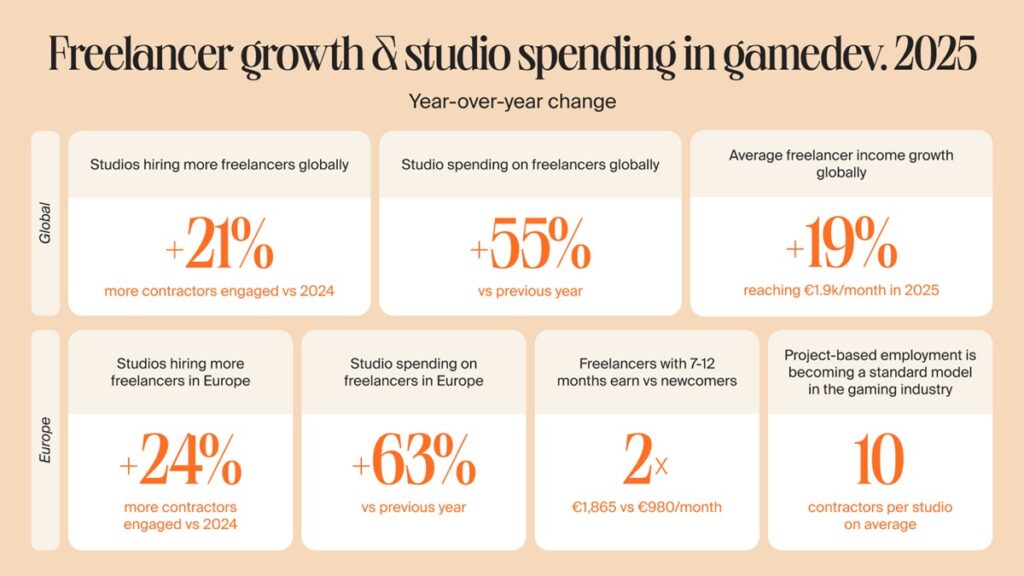
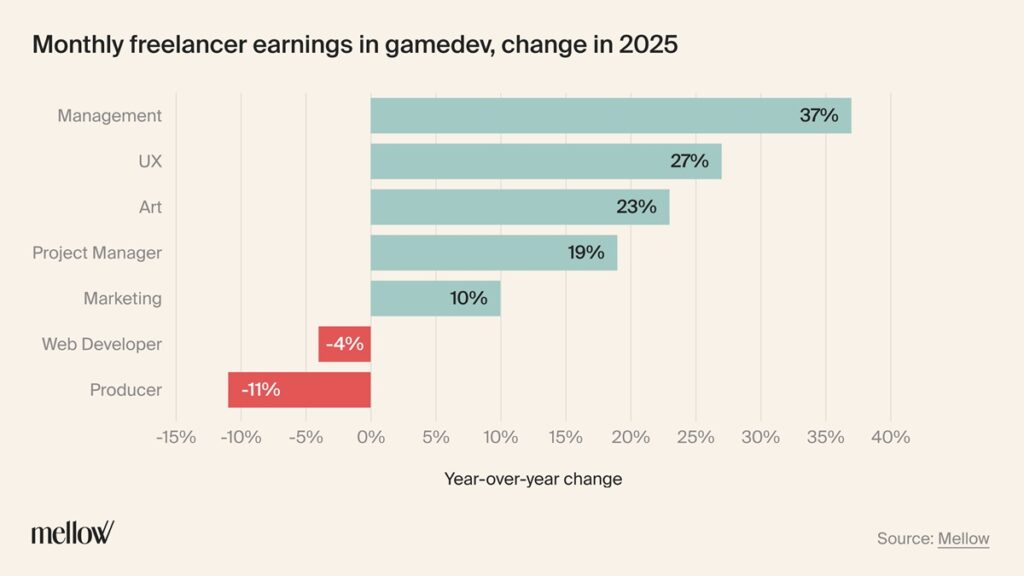
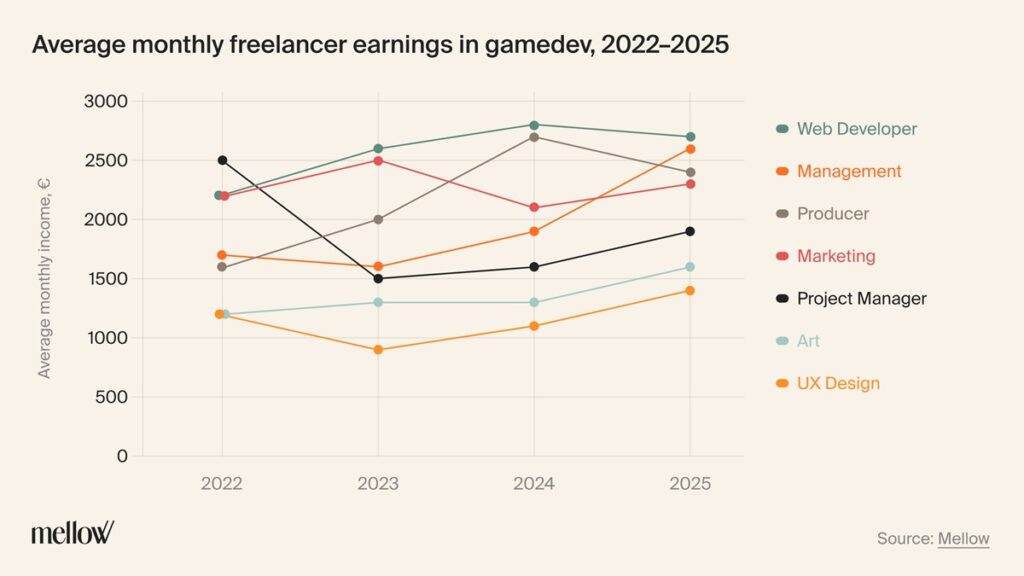
Mellow’s platform data confirms the trend: average monthly freelancer income in the game development industry rose 19% globally. This may be due to geographic arbitrage and the fact that freelancers are moving to countries where the cost of living is much lower than in the US or the UK.
Freelancing is a choice, not a fallback
According to survey respondents, the majority of game-dev professionals chose the path of independent work deliberately. Despite the widespread layoff narrative in game development, only 14.9% came to freelancing after being laid off.
The report said 43.3% started freelancing alongside a full-time job before transitioning fully. 23.9% have been freelancers throughout their entire career. In total, around 67% made a deliberate, planned shift — ahead of the disruption, not in response to it.
The market is moving toward flexible hiring
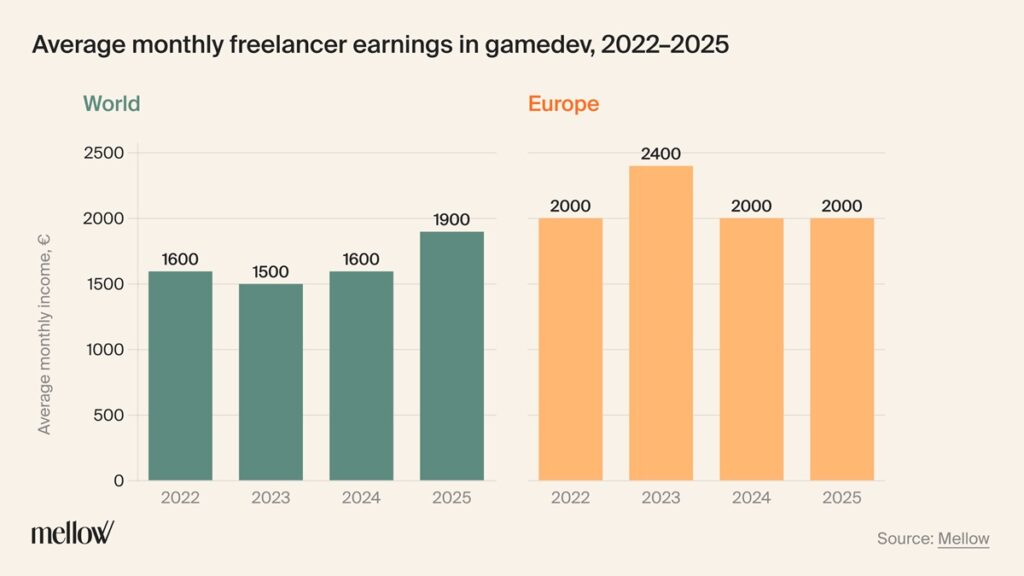
The freelancers themselves are operating across multiple clients: 72% worked with three or more studios in the past year, and more than a third — 35.8% — worked with three to five. This isn’t project-hopping. It’s a mature, multi-client operating model that mirrors how agencies and senior consultants work in other industries.
About 67% said they actually transitioning to this part-time role gradually from a full-time job or they started building independent career from the start, Norovyatkin said. Their work becomes more stable and they can make more money. About 95% described their income as stable.
More than half of them also said they were moving toward creating an independent agency or game studio.
2026 Survey of Freelancers includes answers from 1,000+ respondents, who are entirely game development industry freelancers from the US and UK.
Methodology
The State of Freelancing in Game Development 2025 report is based on Mellow’s data for 2025. The study sample includes freelancers and companies working only in the game development industry. In total, more than 2,000 freelancers and over 150 companies were examined, mainly with studios from the EU, Cyprus, the UK, MENA, and North America. The study presents both global and Europe-specific data. Global figures include European companies.
Mellow is a contractor management platform for companies and freelancers to seamlessly work together across the globe. The platform covers the full lifecycle of contractor-based work — from finding projects and matching with talent to signing contracts, managing compliance, and handling payments across 100+ countries.
Mellow partners with over 1,500 companies and connects 230,000 remote professionals worldwide, with a special tie and passion for the gaming industry, working with clients such as Gaijin, G2G, Sumsub, and others. It operates globally with offices in Cyprus, Amsterdam, Hong Kong, and New York.