
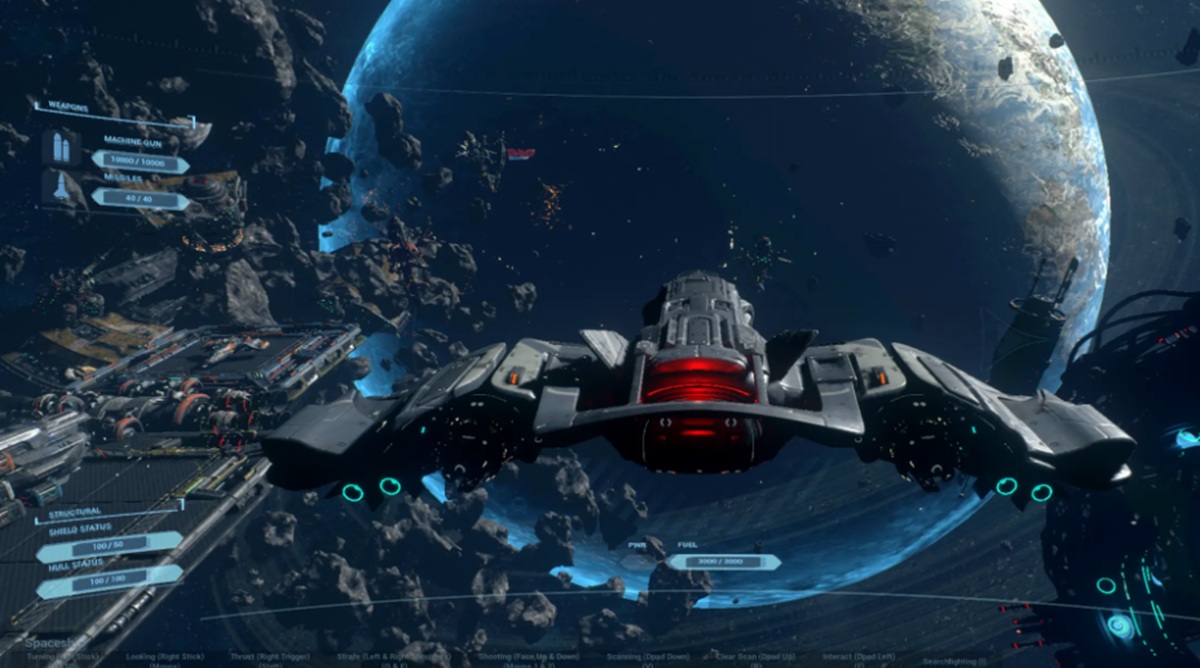
SimplyStream is an ambitious product from an ambitious company, Wonder Interactive. For years, the web gaming ecosystem has been viewed as a secondary, often even forgotten distribution channel for casual, low-fidelity games. Wonder Interactive wants to prove that this thinking is obsolete.
Wonder instead champions and positions the web as a distribution surface for demanding games and software, and provides the tools and services for game developers to viably target it.
Browser gaming is the primary use case, however the stack supports browser-based product configurators, real-time digital twins, and architectural visualizations that benefit from instant access and broad device reach without the high cost and latency associated with conventional cloud streaming solutions. They achieve this through WebGPU and WebAssembly technologies which are both open standards supported by the various browser vendors.
The company behind the SimplyStream platform, Canadian-based Wonder Interactive strongly believes in and champions open platforms such as the web, and views it as the foremost path for developers to bypass walled gardens that take 30% of a developer’s revenue.
I interviewed Alex St. Louis, cofounder and COO of Wonder Interactive, a few times over the past few years and he hasn’t wavered from that plan. He’s unveiling the tech during Unreal Fest, the Epic Games event in Chicago, to start a conversation about Unreal on the web.
He shared with me the company’s vision for high fidelity browser gaming. The company’s SDK for UE5 enables developers to ship Unreal Engine games to web-app format, while the platform layer manages the infrastructure required to deploy, host, and orchestrate these applications at scale.
Technical Architecture: WebGPU, Optimized Runtime, and MetaHumans
At the rendering layer, the SimplyStream SDK leverages the WebGPU API to bring modern GPU features—particularly, compute-driven workloads aided by compute shaders—to the browser. Wonder currently supports Unreal Engine 5.6 and 5.8, while maintaining an engine-agnostic approach for other engines and frameworks.
The team is notable as the only company in the industry to offer a web solution for UE5, which gives it a significant advantage over others in the web gaming infrastructure space that can only leverage pre-existing web engine support like Unity. This gives Wonder a significant advantage as a browser games infrastructure challenger in its efforts to court developers to its platform.
The runtime is highly optimized for browser delivery. An Unreal WebAssembly build can be as small as 8MB compressed through Basis texture compression and ZSTD for general game data. Multithreaded execution and CDN-assisted asynchronous streaming allow heavy applications to start instantly while scaling to complex content.
Additionally, SimplyStream supports 64-bit WebAssembly builds, which eliminates the traditional 4GB browser memory limitation to better accommodate larger, complex game assets. The platform also features a multi-threaded WebGPU implementation, utilizing WebAssembly Atomics and Atomics.wait() to enable efficient multicore usage across the filesystem, graphics, chaos physics, and more.
SimplyStream also supports bringing game-ready, optimized MetaHumans to the web. These assets average under 100MB by utilizing compressed textures, optimized materials, and aggressive Level of Detail (LOD) settings to maximize performance across diverse devices. Support for the new Lumen Lite is under active development along with Nanite, and the company says it’s seeing exciting progress with these features.
Adaptive Delivery Engine: Intelligent Routing and Hybrid Rendering
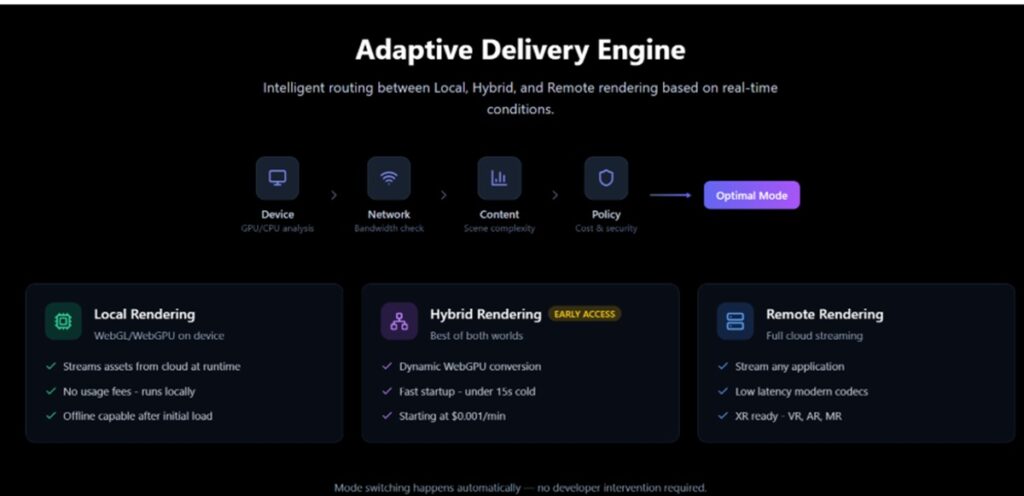
A core differentiator is SimplyStream’s Adaptive Delivery Engine, which determines the best version of an application to serve to users automatically. When a session starts, the platform performs a lightweight device profile that evaluates hardware, network conditions, and content complexity. Users on high-performance hardware such as Windows PCs with dedicated GPUs or Apple Silicon MacBooks, are served a client-side WebGPU build. Lower-power devices are automatically routed to a cloud-rendered, low latency pixel-streaming session.
Where it’s going
Interestingly, the team is developing a third delivery solution: a so-called “hybrid rendering mode”. It works by translating graphics calls (including Windows, Vulkan, and OpenGL) to WebGPU and executing them locally, while offloading the CPU computation to a server. This translation layer allows native binaries to run in the browser without traditional porting. This seems like a way to get a large catalogue of games online without having to port titles the traditional manner.
Platform Roadmap and Global Strategy
Wonder Interactive is currently expanding its infrastructure through a simple, downloadable plugin for the Fab marketplace. This custom engine version includes a Command Line Interface (CLI) allowing developers to rebuild and publish both new and existing Unreal Engine projects directly to the SimplyStream platform.
Developer Experience and Content Management
The SimplyStream dashboard (app.simplystream.com) serves as a backend-as-a-service and developer interface. Developers can manage the entire lifecycle of an application—from packaging and deployment to public URLs—while monitoring session quality, server configurations, and analytics. A revision-based system enables studios to push alpha builds and post-launch updates efficiently.
The tools themselves are free to use, but the company charges for premium development services and support. Game porting services are offered by the company Once a game is ported, Wonder Interactive charges a subscription fee to host it through its platform.The company offers different support tiers, including a studio tier and an enterprise tier for large publishers. Features offered on the studio plan includes game embedding on a developers site, custom domains, and more.
Where it’s going
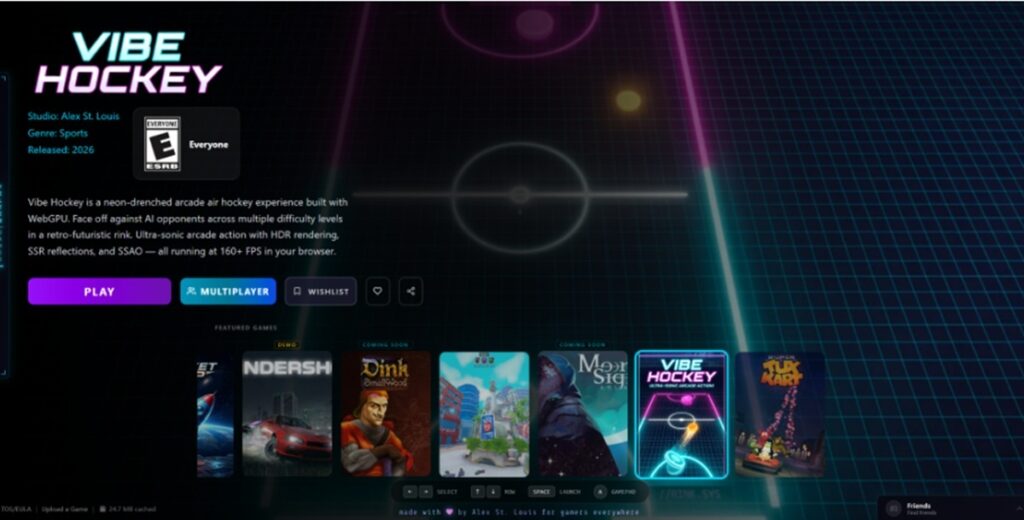
Wonder Interactive is currently preparing to raise a seed round to accelerate the development of an ambitious vision for the web: a premium portal that brings the community and social features of a modern game launcher to a browser-native environment. By focusing on high-fidelity, cross-platform WebGPU titles, the company aims to move beyond the quantity-over-quality model of current browser game portals.
“We’re really excited about our upcoming portal,” said St. Louis. “We’re building something for gamers, by gamers, who want to have a console-quality experience, but in their Chrome tab using their local GPU.”
Solving the Discoverability and Monetization Gap
Beyond the portal itself, the company is tackling the industry-wide stagnation in web-game monetization. While current browser games rely almost exclusively on ad-based models, Wonder is building a suite that enables in-app purchases (IAP) and premium rewarded video, creating a sustainable way to monetize for developers, in addition to conventional interstitial video and banner ads.
“Developers can upload their games, then launch to a community of billions of web users, and organically acquire customers on a discovery channel that’s less crowded than other walled gardens in the industry,” St. Louis said. “We are going to have the ability to do in-app purchases as well as premium rewarded video ads. The sky’s the limit here in terms of monetization. I can see a future where every big F2P multiplayer game launches day one on the web for players”
Supporting Emerging Trends
The platform is also positioning itself at the forefront of new development trends, including Discord integration.
Looking ahead, St. Louis believes that web technologies are the missing bridge for the gaming industry.
He said, “The missing thing is just industry-wide awareness that the technology is here. We can bring many classic and new games to the web. It’s a growth market for the industry, for example 15,000 web games were released last year and most of them were casual and hyper casual titles. Imagine once we see the same top tier titles that ships on consoles and Steam arrive day and date in your Chrome tab.”
“This is really a call to action for any game developers out there,” St. Louis said. “We would love to see industry-leading AAA games launch simultaneously on the web as on other platforms. We’d love to see the next Clair Obscure: Expedition 33 or Arc Raiders running in the browser using our tools and platform and that’s possible today using our tools, platform, and team expertise.”