
For more than 15 years, Jonathan Blow has been one of the most influential figures in modern puzzle game design. From Braid to The Witness, his games have consistently challenged players to rethink not just how puzzles are solved, but how rules, space, and their meanings intersect.
With Order of the Sinking Star, alongside publisher Arc Games, Jonathan Blow is attempting something even larger in scope: a multi-world puzzle adventure where distinct systems gradually overlap, collide, and reshape the player’s understanding of the entire game.
At a surface level, Order of the Sinking Star presents grid-based puzzles within a navigable overworld. In practice, it is closer to a constellation of interlocking games, each with its own logic, characters, and constraints. The central challenge is not simply solving puzzles, but learning how incompatible rule sets can be brought together, and of course, also what breaks when they are.
Jonathan Blow says the opening of the game was designed with particular care, not just mechanically, but structurally.
“Toward the beginning of the game, we intentionally leave that stuff undone until the end, because the beginning of the game forms the first impression,” Blow said during a video interview presentation with GamesBeat. “And so it’s very important that we make it very polished.”
That attention to first impressions extends directly into the game’s narrative framing.
A queen displaced, and a world that expects you
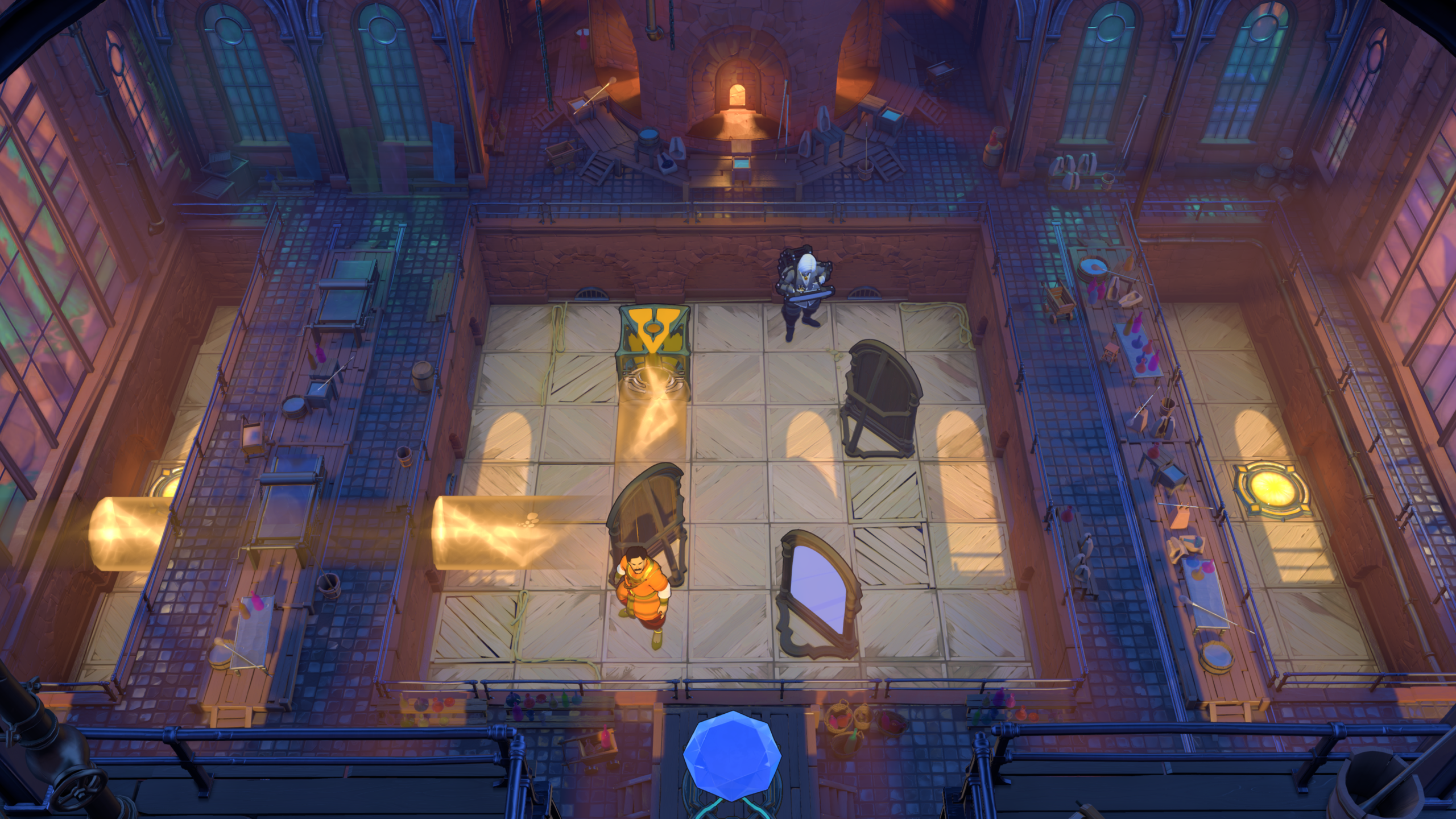
The game opens with a queen on the brink of execution, betrayed by an insurrection in her own kingdom. Before her death can occur, she is abruptly transported elsewhere to a place neither she nor the player understands.
“She’s the queen of a kingdom in another world who is a good leader, but she has opponents who have provoked an insurrection against her,” Blow said. “And so she’s been captured, and she’s about to be executed. But before this can happen, some kind of intervention happens that she didn’t cause. She doesn’t understand it at all, and she’s whisked away to a faraway place, which is where we start the game.”
That faraway place functions as both a tutorial and a narrative device. The space introduces basic mechanics, but also establishes a world that appears deliberately constructed for newcomers.
“It also becomes clear that it’s a tutorial in the fiction of the world,” Blow said. “Whoever built this is expecting people to show up, not knowing what’s going on, and to need acclimation. And so that’s sort of the first place that you land.”
From the outset, Order of the Sinking Star emphasizes experimentation over punishment. Players can undo actions freely, reset puzzles, and even undo resets. The intent, Blow says, is to encourage curiosity rather than anxiety.
Worlds within worlds
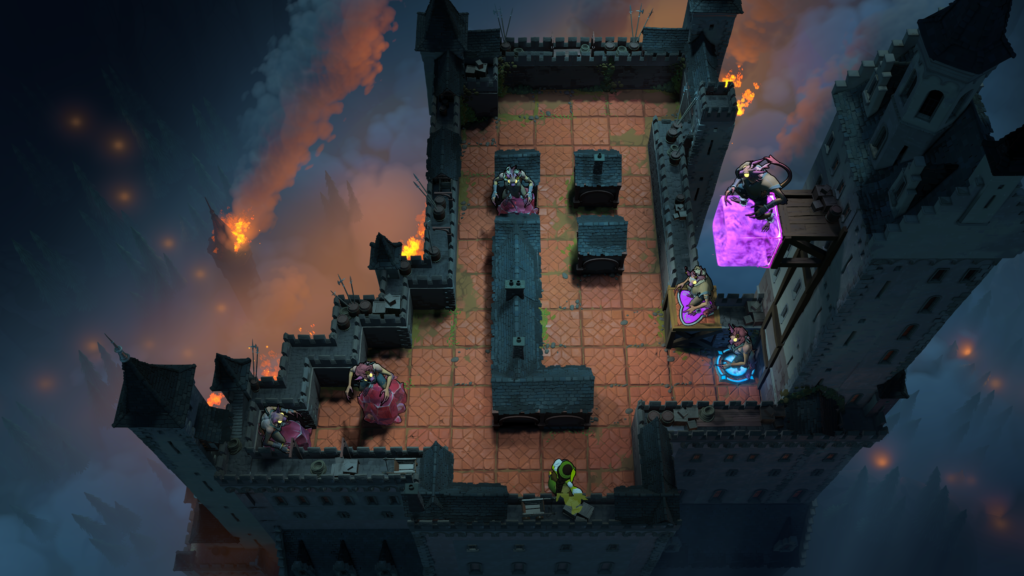
After leaving the opening area, players encounter a large overworld covered in fog. Exploration gradually reveals distinct regions, each housing what Blow describes as a “sub game” with complete systems, including their own mechanics, stories, and characters.
“You come to learn that each of these territories is host to a completely separate subgame which has its own story, its own characters, and its own game mechanics,” Blow said. “And those mechanics are not just like variations on the same thing. They’re very different from each other, and each one is kind of a complete game in its own right.”
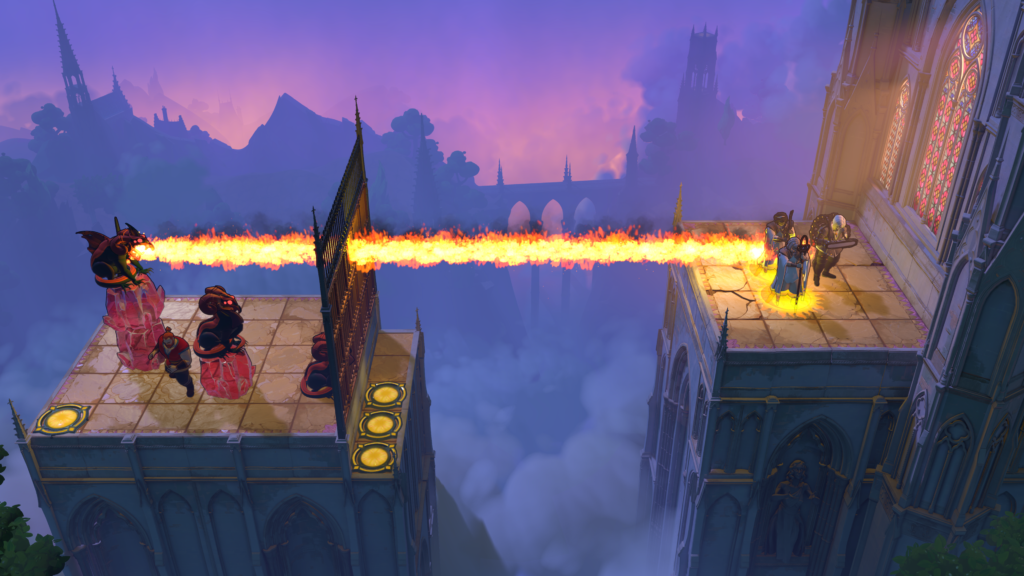
One early world focuses on a party of fantasy heroes, each bound to a single, inflexible ability. A warrior who can push objects. A thief who compulsively pulls objects behind her. A wizard who can only teleport by swapping positions with other objects.
“The warrior can push an arbitrarily long sequence of things, which makes him very powerful, but you can also make mistakes that are hard to recover from,” Blow said. “The thief cannot push things at all. She always pulls things behind her. Pulling is a very useful skill, but it can also cause problems. And the wizard can teleport, but he insists on teleporting if he can, which means you don’t always have full control over what happens.”
Initially, these characters are introduced in isolation. Later, they are combined, and the rigid nature of their abilities begins to clash in unexpected ways. What emerges is a puzzle structure built as much on failure and unintended consequences as on success.
The moment everything breaks open
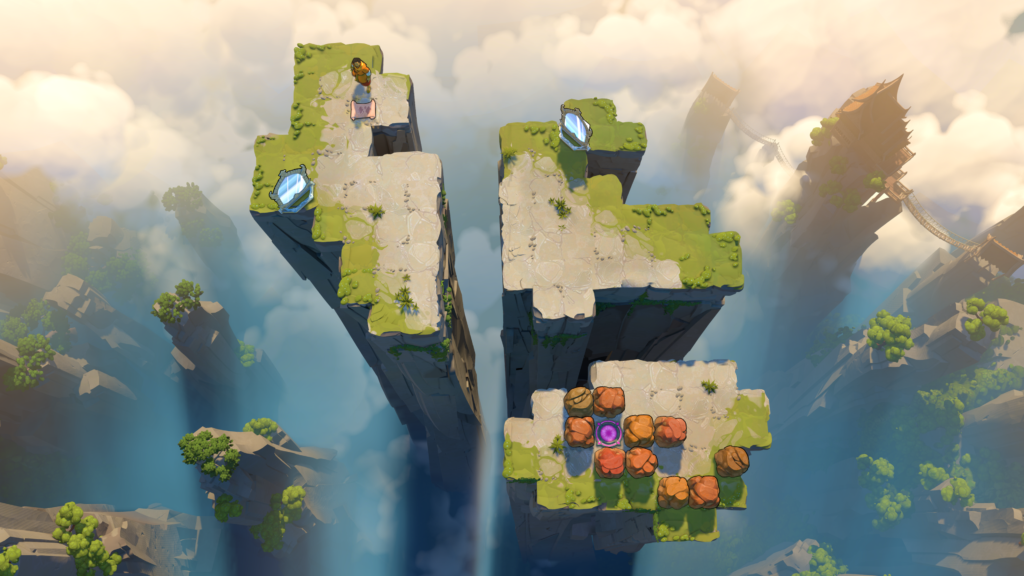
While the early game allows players to move freely between these worlds, a turning point occurs when they reach a central hub known as the Gold Room. This is where previously isolated systems are allowed to overlap.
“What this gold room does is it brings together the worlds for the first time,” Blow said. “You have two of these worlds open at once, and you can solve a puzzle using mechanics from both of them for the first time. And that’s a really big shift in how the game works.”
From that point forward, the overworld itself becomes a puzzle space, no longer just connective tissue between levels.
“Progress through the overworld becomes about using the mechanics that you’ve been introduced to, as opposed to just unlocking doors or doing some simple task,” Blow said. “You’re actually reasoning about the rules of the game at a higher level…You don’t really know how big this territory is until you’ve explored most of it. It keeps pulling outward in ways that you don’t expect, and that’s very intentional.”
Despite its complexity, Blow is adamant that players should not be permanently blocked by any single puzzle. It’s the kind of game that you’re able to massage into what you want it to be, either in terms of difficulty or experience and exposure to new areas.
“I don’t like it if people are blocked and can’t play the rest of the game just because they can’t figure one thing out,” Blow said. “That’s a really bad failure case for puzzle games. You want people to be able to see the whole experience, even if they don’t solve everything.”
To complete the game, players must activate a subset of teleporters tied to combined-world challenges, not all of them. It’s designed so that, ideally, if someone wants to see it through to roll credits, they can do that without achieving mastery of every single puzzle.
“You have to get four out of the six teleporters, which actually gives you a lot of freedom,” Blow said. “If you can’t figure some out, that’s okay. But you need to figure out enough that you basically understand what the game is doing…If you just put in hints and you let people spam them all the time, then they don’t really play the game. And so that’s one of the last elements we’re trying to solve, because it’s tricky to do it right.”
Blow’s puzzle design lineage
Viewed in isolation, Order of the Sinking Star is Jonathan Blow’s largest and most structurally complex game. Viewed in context, it is a clear continuation of ideas he has been developing for nearly two decades.
With Braid, Blow introduced the idea that puzzle mechanics could carry thematic and emotional weight. Time manipulation was not just a tool, but a lens through which players interpreted narrative meaning.
The Witness expanded that philosophy spatially. Rather than discrete levels, puzzles were embedded into an island, teaching players how to observe, infer, and reinterpret rules across contexts.
Order of the Sinking Star builds on both approaches, but pushes them further. Instead of a single dominant rule set, the game presents multiple complete systems and then asks players to reconcile them. It is less about mastery of one language and more about translation between many.
Jonathan Blow himself sees continuity rather than escalation.
“We just work really hard to make sure that everything really makes sense and everything feels connected and tied together,” Blow said. “Even when things are very different from each other, they’re still part of the same whole.”