
When it comes to gaming, a new data report suggests women might be more hardcore than men.
Today, December 18, the market research firm MarketCast has published a new report intended to bust myths about women’s role within the gaming industry and community. To get to the bottom of the differences between women’s and men’s perceptions of the gaming industry, as well as their personal gaming activity, MarketCast polled 1,679 women and 397 men living in the United States. Although the survey prioritized adult responses from both groups, it also included input from female respondents between the ages of 13 and 17, which MarketCast vice president and head of gaming Chris Tee said was meant to provide more context for the audience.
“One of the most meaningful takeaways from these findings is that surface-level inclusion in games is not enough to serve this audience,” Tee said in an interview with GamesBeat. “The industry and the communities they serve are still heavily dominated by men, so much so that many women gamers still do not feel welcome. There needs to be an active approach or strategy to create safe places for all their fans to come together.”
Ahead of the publication of the report, GamesBeat spoke with MarketCast to learn about the methodology and analysis behind the data. Here are some of the key takeaways.
Women are more likely to identify as “hardcore gamers”
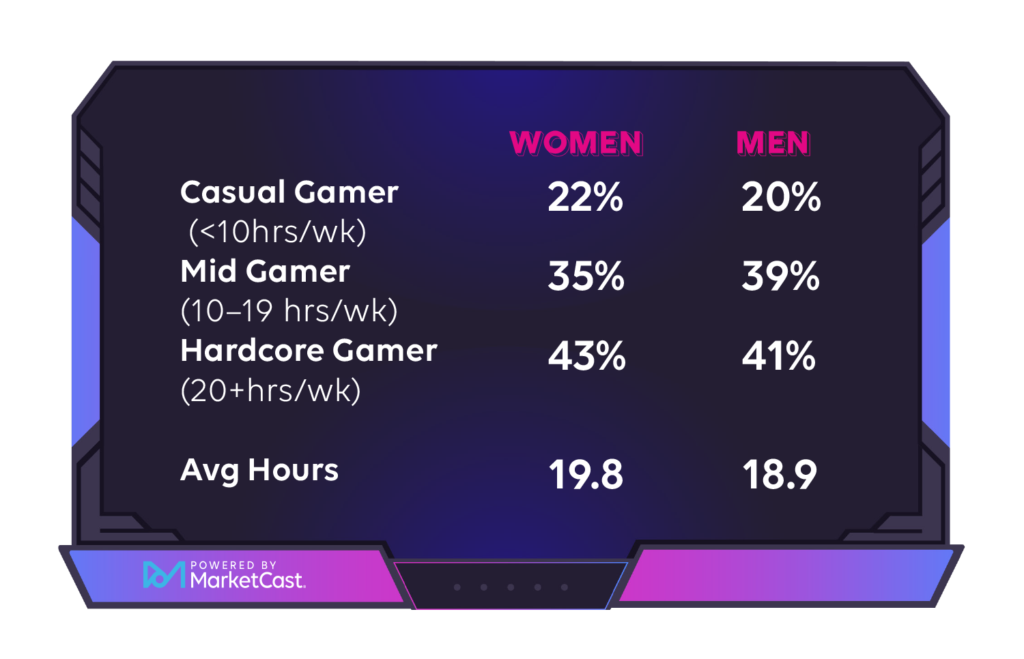
MarketCast asked survey respondents to share the average number of hours they game each week, classifying them into three categories — casual, mid-level and hardcore — based on their typical gaming level. To the surveyors’ surprise, 43 percent of women fit into the hardcore category, higher than the 41 percent of men who similarly said they game more than 20 hours per week. On average, women played 19.8 hours of games per week, while men played 18.9.
Although Tee was quick to point out that the difference between men’s and women’s numbers is not statistically significant, he said that the finding that women in gaming are just as engaged and hardcore as men breaks preexisting notions about the gaming audience.
“Our hypothesis, based on analyzing trends, was that there are more core women gamers than ever before,” he said. “What was surprising was the parity of this when compared to men.”
Women enjoy “cozy games” more than men
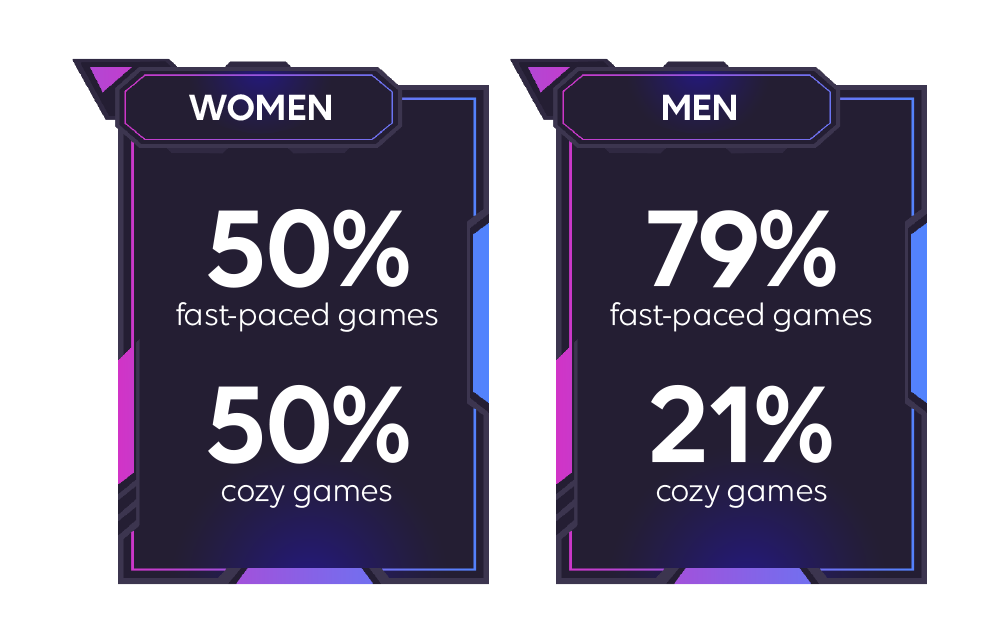
According to MarketCast’s survey, women and men have significantly different preferences when it comes to the pace of play. Female gamers are evenly split between fast-paced games and cozy games, whereas 79 percent of male gamers reported a preference for the former.
Tee said that he believed much of this difference comes down to longstanding cultural notions within the gaming space. The competitive gaming community is dominated by men at its top levels — but women have traditionally dominated social media. As so-called “cozy games” increasingly prioritize their community features over the stresses of competition, they are becoming social spaces that are increasingly welcome to women.
“The ‘cozy’ game community is seen as a place where women can be themselves and not be judged by others,” Tee said. “Beyond this, it lends itself to low-stress, slow-paced gameplay that allows for creative expression. Women can be just as competitive as men, but they have a more diverse set of habits and needs for games, and cozy games fit that perfectly.”
Character customization is a crucial motivation for gamers in 2025
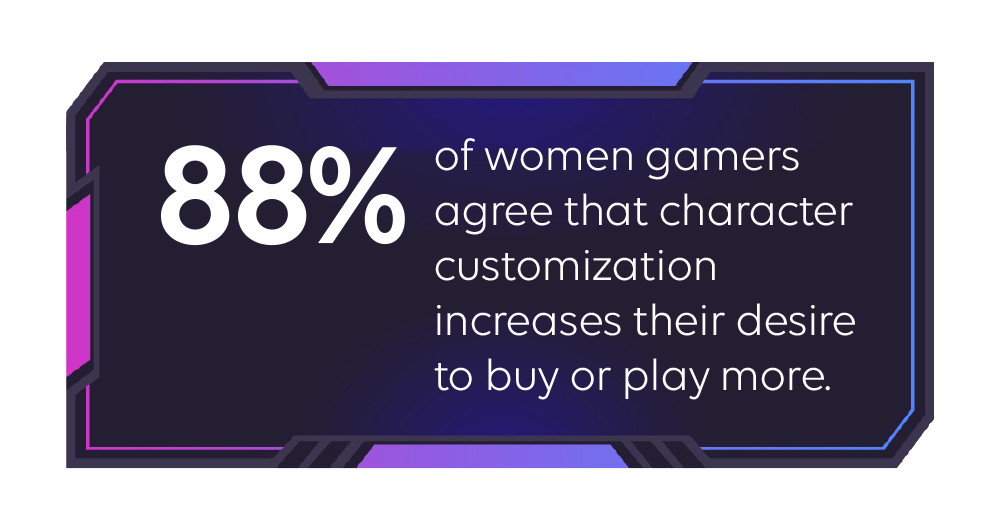
Character customization is an increasingly important feature for gamers across demographic groups, according to MarketCast’s report, which found that 88 percent of both men and women are encouraged to buy or play more when character customization is available. In its report, MarketCast specifically flagged the proportion of women who care about character customization, with Tee explaining that “the important takeaway here is that players want more than just surface-level options for customization. They’re looking for meaningful ways to express themselves through the medium they love to engage with.”
As a market research company that counts advertisers among its clients, it makes sense for MarketCast to highlight women’s perspective on character customization. Women account for roughly 55 percent of global clothing sales and up to 90 percent of cosmetic sales. As brands in these sectors look to market and sell their products inside games like Roblox and Fortnite, female gamers are a natural audience for them to reach on these platforms.