
Artificial intelligence is transforming the gaming industry — but how exactly those changes will manifest in the coming years remains shrouded in mystery and speculation.
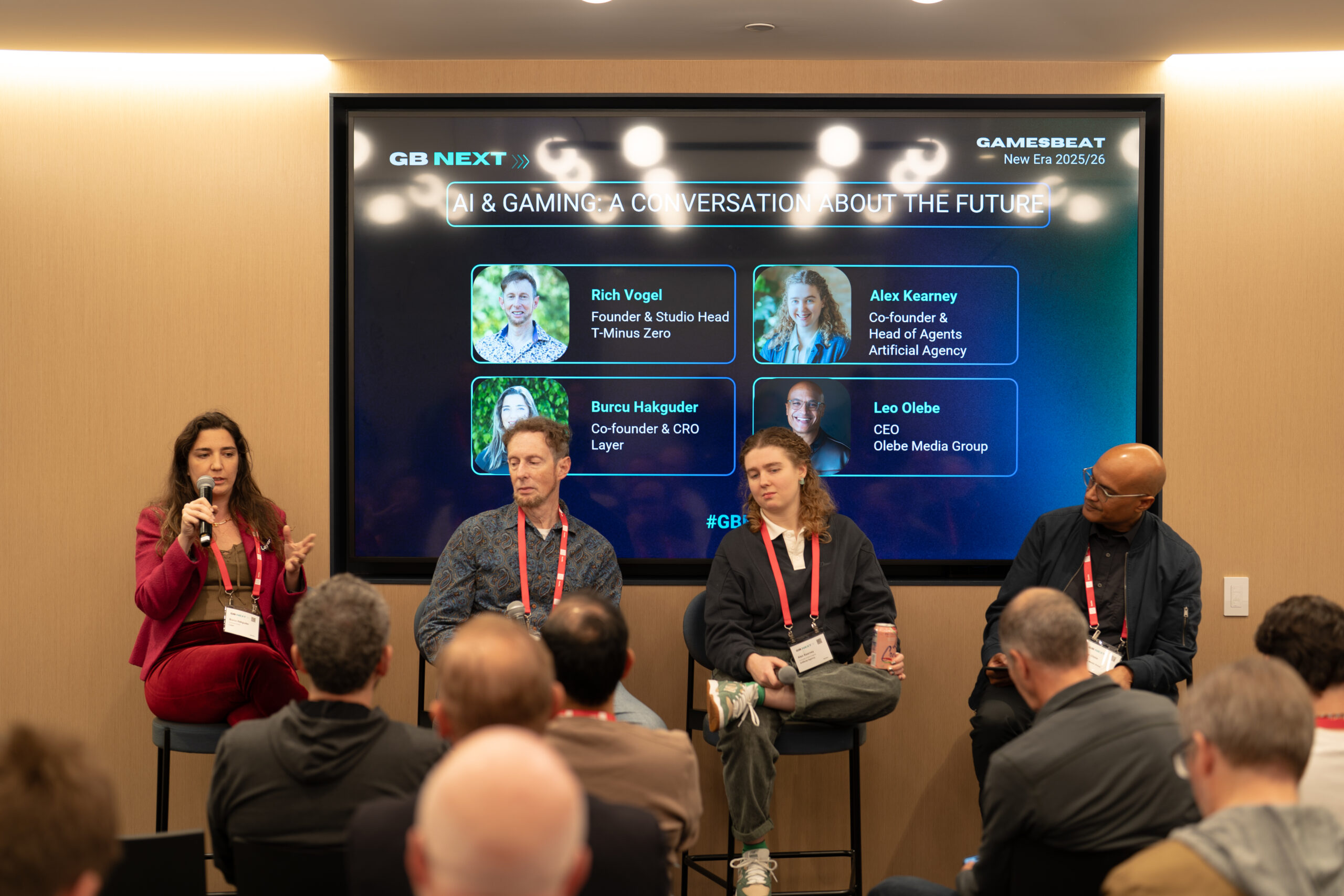
Unless you were at GamesBeat Next, that is. At last month’s conference, Olebe Media Group CEO Leo Olebe moderated a lively and authoritative panel exploring the impact of AI on game development, player experience and game industry business models featuring Richard Vogel, the founder and head of the studio T-Minus Zero, Artificial Agency co-founder and head of agents Alex Kearney and Layer co-founder and chief revenue officer Burcu Hakguder.
During a period of breathless enthusiasm and head-over-heels scrambles to invest in the AI sector, last month’s talk was not all sunshine and rainbows. Olebe kicked off the discussion by disclosing that he had personally been laid off from jobs — ”you could say due to AI” — twice over the past 18 months. Nevertheless, the speakers spent half an hour participating in a measured and insightful conversation about the potential strengths — and potential challenges — of AI in game development. Here are some of the key takeaways.
The legal risks of AI are still being explored
All of the participants of GamesBeat Next’s AI and gaming panel agreed that AI technology is transforming gaming — and that it’s here to stay, whether we like it or not. However, they urged caution with using AI for front-facing game development purposes, particularly given the potential copyright infringement risks of using generative AI content made with models built on copyrighted IP.
“If you’re using it, definitely have a lawyer,” Vogel said. “Look at the terms of service agreement, figure out where they’re getting their model from, and what implications there could be for legal issues in the future.”
One way game developers have learned to sidestep the copyright issue is by training their own models using libraries of content they produced and own entirely, according to Hakguder.
“Using AI as a tool to drive more variations from your own IP is the best practice that I’ve been seeing across game studios,” she said. “But for concepting and prototyping, I also see a lot of base models directly being used — and I’ve seen that game studios are less concerned about that.”
Studios will have to navigate changing cultural attitudes towards AI
Although audiences are gradually growing accustomed to AI-generated content and the use of AI in the game development pipeline, Vogel pointed out that audiences in some markets can still react negatively to the presence of AI in their games.
“There’s somewhat of a player-driven negative vibe with AI out there, especially in North America,” he said. “In Asia, that’s not the case, but definitely here in the West, things can be very sensitive about how you use it.”
Kearney said that the best way for game developers to implement AI in a way that satisfies their audiences is by using the technology to do things that truly could not have been done before without artificial intelligence, rather than simply using it to streamline or dumb down the development process.
“We have these new tools; they let us do things that we couldn’t do before. What drives value for the players? What can I do to fundamentally change — not just incrementally, but in the transformational sense — modify the way I’m thinking about this particular kind of game that I’m developing, so that it creates that fresh experience that resonates with players?” she said. “AI for AI’s sake is not compelling to me.”
Concepting is widely considered a safe way to use AI in game development
Transformational and fundamental changes notwithstanding, AI is certainly capable of speeding up all aspects of the game development process, and no part of the process has been made more efficient by AI than concepting. In addition to helping developers avoid any sticky copyright or IP infringement issues — it’s fair play for a piece of concept art to be inspired by another IP, as long as the end result is different enough — Vogel said that experimenting with AI concept art has made his team better at composing prompts and otherwise using AI tech in general.
“It’s all about prompting, and learning how to prompt, and getting it finer and finer and finer,” he said. “The ideation phase, I think, is really something that’s helped us iterate quicker by having AI do similar things.”
AI is sparking the resurgence of the generalist developer
Over the years, game development has become an exceedingly technical field, forcing individual developers to focus on specific tasks rather than leading a game’s development from beginning to end. Vogel said he believes AI could help simplify the process of game development — shifting not only how games are built, but the accessibility of the practice of game development itself.
“When I started about 30 years ago, everyone did coding — they did art, they did anything that we needed to do to get a game done. All the specialties, they just did not exist, because of the simpler graphics and things like that,” Vogel said. “AI is going to help bring back the generalist, where anybody can sit down and be a technical artist.”