
Kochava, which provides real-time data solutions for omnichannel marketers, announced StationOne as a way to extend marketing power with AI.
Charles Manning, CEO of Kochava, said in an interview with GamesBeat that StationOne is a universal integrative AI client. It enables anyone in the marketing ecosystem to connect Model Context Protocols (MCPs) and AdCPs with any large language model, and leverage pre-prompt templates to deliver consistent results.
Born from the AI industry, MCP (Model Context Protocol) is an open standard that allows AI agents to seamlessly connect with external tools, data sources, and workflows—making them more useful in mobile advertising and marketing automation.
StationOne acts as an enterprise orchestral conductor, enabling individuals to work as a unified team with AI tools ensuring that all components collaborate seamlessly to achieve complex business goals at scale, rather than operating in isolated silos. Manning said in our exclusive interview that this isn’t meant to replace marketing people but to extend what they can do, which is making marketing and ads more effective.
New Era of Integrative AI: Built for Humans Delivering Outcomes
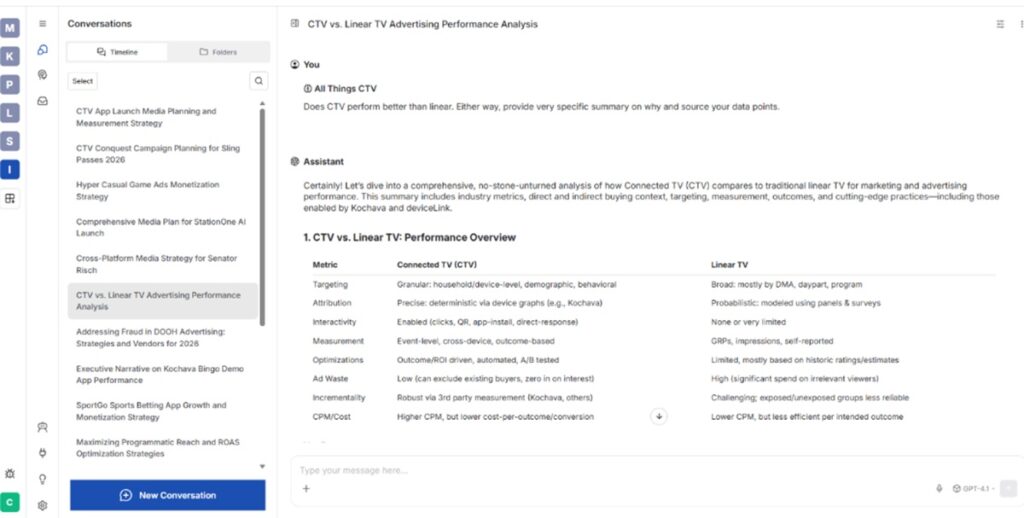
StationOne is an integrative orchestration layer; a centralized platform that lives on your own machine (not in the cloud) and integrates AI with the tools you already use and the models you’re authorized to access. This approach safeguards both employees and the enterprise, ensuring every interaction adheres to strict privacy, compliance, and data protection standards.
“We’re not just connecting tools. We’re defining a new layer of integrative intelligence,” said Manning. “AI should amplify human potential, not abstract it. This is about restoring control, trust, and creativity to the people at the center of the AI transformation in the workforce.”
By running the client directly on the user’s own machine or within the organization’s private environment, the platform provides control, privacy, and security unmatched by SaaS offerings or open public AI frameworks. StationOne empowers professionals to leverage AI confidently across their workflows balancing automation with agency.
While many solutions demand lock-in to a single large language model (LLM), StationOne’s architecture is built on choice and control. It’s too early and too limiting to commit to one model. Beyond model flexibility, Kochava is curating a living library of MCPs and AdCPs that not only meet rigorous requirements but actually work. In a landscape where everyone is rushing to offer a connector, Kochava’s focus is on quality, performance, and verifiable interoperability.
Sandpoint, Idaho-based Kochava has been around for a long time — since 2011. Kochava operates as a mobile advertising and data analytics company specializing in attribution for connected devices. Now it provides real-time data solutions for omnichannel measurement, multi-touch attribution, modern mobile measurement, and campaign management for data-driven brands and platforms.
The four elements of how StationOne works
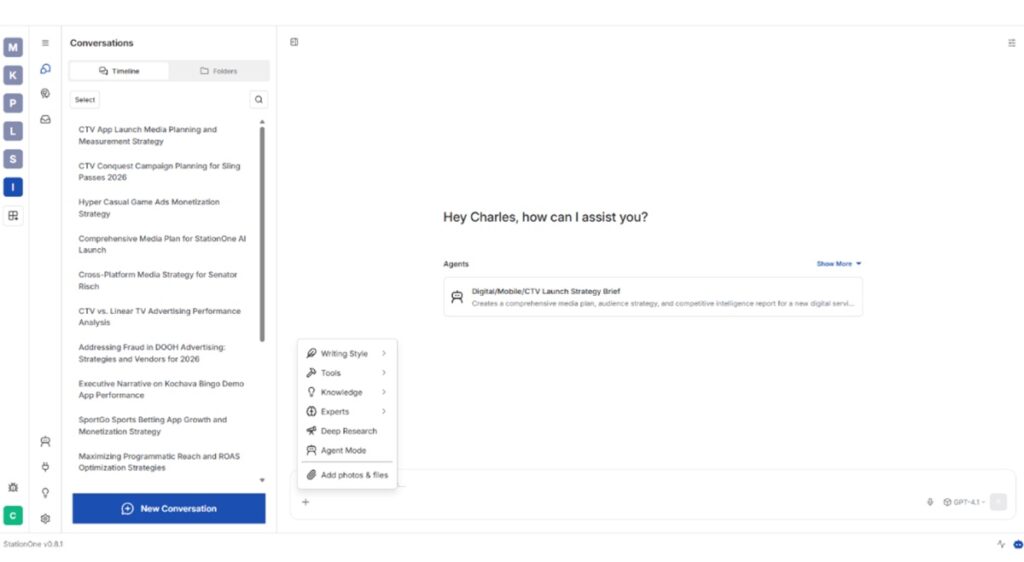
StationOne is a standalone app that you can download, much like a program like Slack, setting up a new kind of AI-infused workspace.
“These workspaces are effectively the containers of everything you want around your AI workflow, connected together,” Manning said. “That’s what we call an integrative AI platform. And the notion is that there’s four key elements inside of these workspaces.”
The first is that it has variable model support. So effectively, any AI model can be used, he said. You can not only configure any of these models out of the box with your own keys, which is also really good for privacy reasons, he said.
“You’re not proxying through our server side infrastructure. These are your own keys. You can also create your own net new model engines, provided that it works with the OpenAI completions API, which means you can also have small language models usable within the system, as well as the large foundation models.”
The second notion is that it provides experts, which are templates of free prompts. And so as an example, when you use AI, you could either decide you’re going to become an expert at prompt engineering, Manning said.
“But our thought process was that that prompting process is very specific to each model, and it’s very specific to the workflows you’re trying to accomplish. And what’s challenging in the world of AI today is that get on Twitter. You can get it on LinkedIn. People talk about their prompt library, but it’s really just an Excel spreadsheet,” Manning said.
This notion of workspaces, having these experts, means you can have content creators build workspaces for specific disciplines and specific industries and specific workflows, and have them all packed in as part of that workspace.
Kochava provides the attribution and analytics ecosystem for advertisers. And so as part of StationOne, it has a default workspace that comes out of the box. And you can see these experts, which are research tools to research everything there is to know about mobile monetization.
“Let’s say you’re a mobile games company, and you want to leverage a mobile monetization expert about best approach for ads and monetization for a hypercasual game deployed in the U.S.,” Manning said. “It’s a very basic problem, but because of all of the mobile monetization expertise, it creates a very structured and consistent response that is like a 10 times productivity gain for you as an individual.”
The third piece is this notion of connectors.
“Connectors are the way in which you connect to systems personally, individually, and give those connections access to your LLM. What we’ve done with this connector concept is we have built, effectively, a curated gallery of MCP servers that you can interconnect with StationOne, and now, all of a sudden, every tool that you authenticate against is now available to be used within StationOne, against any one of your models and any one of your experts,” Manning said.
If you are focused on monetizing a mobile app, Manning said, “You incorporate workflows around learning and understanding what’s your lifetime value per customer from an ad monetized perspective. StationOne connects your credentials into the tools and combines it with the experts and combines it with the models, all in one single pane of glass.”
The fourth element and final element is agents. So you have the ability in StationOne to create agents, to run them and to schedule them. And these are like multi stage workflows that help you appreciate and understand what you could do individually and manually, but you want to have automated.
“They bring together your experts. They bring together your connectors and the different models that you use. And we call it Agent Forge, because it’s the place where you can create agents that work on your behalf,” Manning said.
Eating your own dog food

Manning said Kochava’s efforts in this amount to figuring out how to make AI actually additive to your workflows.
“And the trick there is your workflows have to they’re going to morph with the AI tools. And AI needs build a morph to work with your workflows,” he said.
Manning said the company has been deploying StationOne during the summer of this year and it has been used internally at Kochava. The company built a product management workspace, and inside of that workspace there are experts that help with general product management tools like GTM strategist, a roadmap planner, a sprint planning coach and a pricing strategist.
StationOne formalizes the practices for using AI that can be consistent across the whole company, Manning said. Something that one person creates using AI can be shared with teammates.
That’s why building StationOne has taken some time. But the work has paid off for the company as it hires new employees who need to be onboarded yet will need to be trained for a long time to become as effective as veteras.
With StationOne, Manning said, “We have all this really proprietary and useful training data [at the company across its 12 years of history], and we were able to create a workspace that leverages all that training data once we had the platform itself.”
He added, “This workspace is what we built based on our internal understanding of the industry. So we built planning tools and expertise. We built activation tools and expertise. We built measurement analytics tools, even things like executive reporting, or how to use analyze ads. This is going to tie together all of our internal knowledge base.”
Manning said he doesn’t see competitors doing anything similar to what Kochava has done.
“What’s neat about having had the conviction to build this is that we have been eating our own dog food and using it internally to really develop new muscular structure as an organization around how do you have this kind of companion tool set for each individual that works on the team,” Manning said.
The company has about 200 people, he said, but he believes it can do what 1,200 people can do at its competition.
“From a scale and capacity perspective, it’s pretty amazing to be able to have tooling that makes up for a difference in virtual size,” he said. “I think station one is going to expand well beyond advertising over time, but we’re focusing on advertising first. Advertising is such an innovative and competitive space. It’s really one of the first to start to standardize around MCP for their vertical.”