
Napster, the company until recently known as the metaverse firm Infinite Reality, revealed Napster 26 for Mac — a hardware and software platform that uses AI agents to help you.
It comes 26 years after the original Napster sparked a music industry transformation with downloadable music. That company went through a revival and Infinite Reality acquired it for $207 million in March, and then, without skipping a beat, Infinite Reality changed its name to Napster. It also acquired AI agent firm Touchcast for $500 million in April, and now it’s got a launch that comes from that acquisition.
I spoke with Edo Segal, CTO of Napster (and former CEO of Touchcast), about the AI agents and the Napster View product.
Now Napster wants to launch another revolution. After the deals were announced, Napster announced two new AI products: the Napster Companion conversational AI platform with intelligent agents; and Napster View, a 3D second-screen device for two-way spatial conversations.
With Napster 26 for Mac, it has created a complete platform that it says reshapes how people create, work, and learn by giving everyone access to a full team of conversational AI video experts. The web version from Touchcast has been out for a while, and from that Touchcast has 300,000 paying subscribers and 15,000 user-generated AI agents.
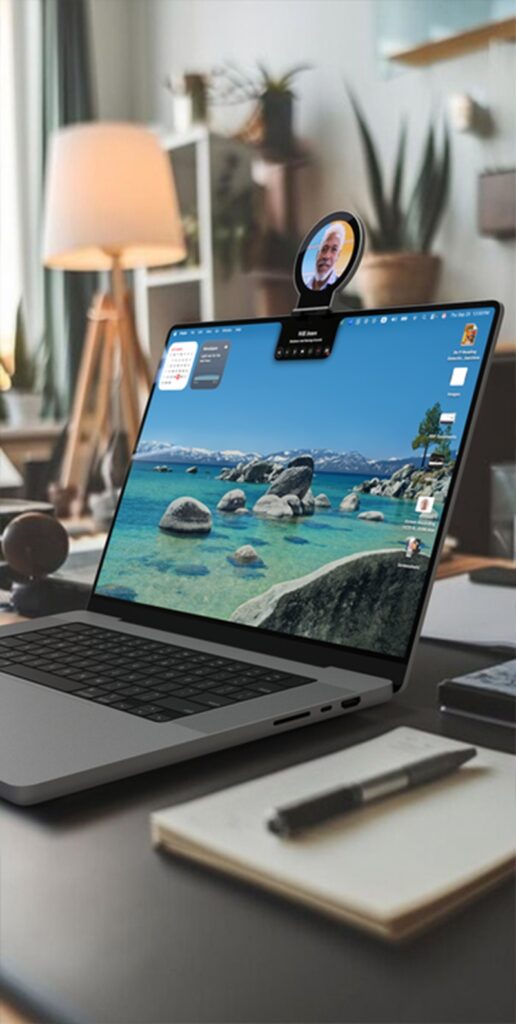
These virtual experts are fully visualized and you can see them through Napster View, a glasses-free holographic display that hangs just above your Mac’s camera.
The experts offer specialized collaboration, on-demand expertise across every domain, and the infrastructure to allow millions to create with the power of AI. Napster 26 can also be experienced online in a web browser and mobile versions for iOS and Android are coming soon with PC support next year.
Napster View holographic display
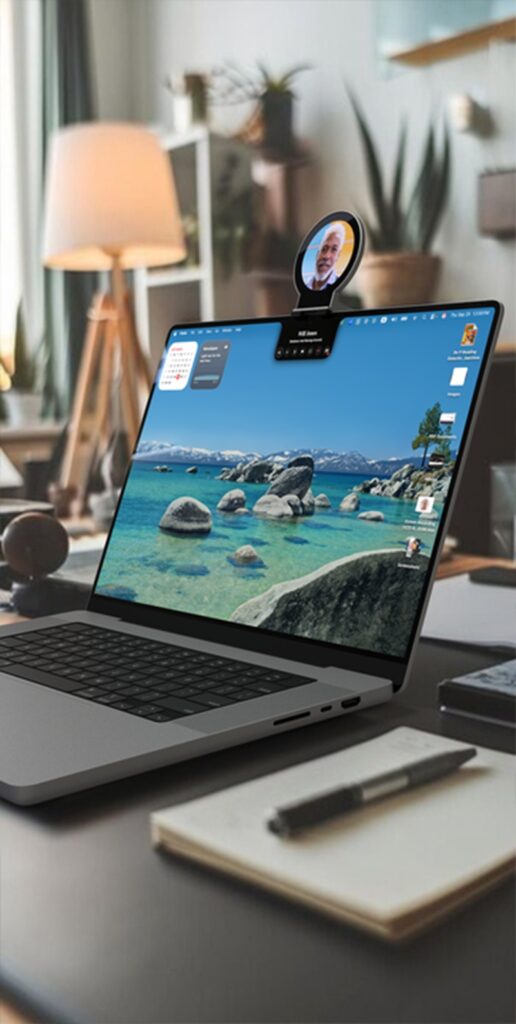
At the heart of the platform is Napster View, a glasses-free holographic display that the company says marks the end of the chatbot era by bringing AI companions to life as embodied 3D collaborators on your desk. With access to over 15,000 specialized AI companions—from coding instructors to language tutors to business advisors to wellness coaches—and the ability to create AI-powered digital twins, the company said Napster 26 transforms AI from a tool into a colleague who sees your work, understands your context, and collaborates in real-time.
Napster View includes privacy-first features like push-to-talk activation, ensuring users maintain control.
“The creative economy has been locked behind barriers of access, expertise, and cost. Napster 26 tears down those walls,” said John Acunto, CEO of Napster, in a statement. “This isn’t an app—it’s the infrastructure for a new era of human creativity. Your digital twin. Your expert crew across every domain. Your collaborators are available 24/7. We’re not just enabling what people couldn’t do before—we’re fundamentally redefining what’s possible when AI becomes your creative partner, not just your tool.”
Asked why Napster chose to launch the display, Segal said in our interview, “You can look at AI in so many different ways. One of the things we’re exploring deeply is, ‘How does AI impact the future of how we communicate, not just how we collaborate or productivity, but how do we actually communicate?’ And we found that putting ourselves in that position to explore it by taking these steps.”
He added, “Being in the frontier of the AI world, this idea of AI devices is obviously a very interesting and open space. There’s been a few failed attempts so far. There’s obviously a lot of discussion about what OpenAI will do as a consequence of [acquisitions]. But I think the only player really is Meta with their AI glasses that you can argue is an AI device with ambience, ambient AI. It’s just so much room for innovation in finding new form factors that are not just the phone that we’re glued to all day long. And that’s part of what we’re exploring with this.”
The user experience of Napster View and Napster Companion
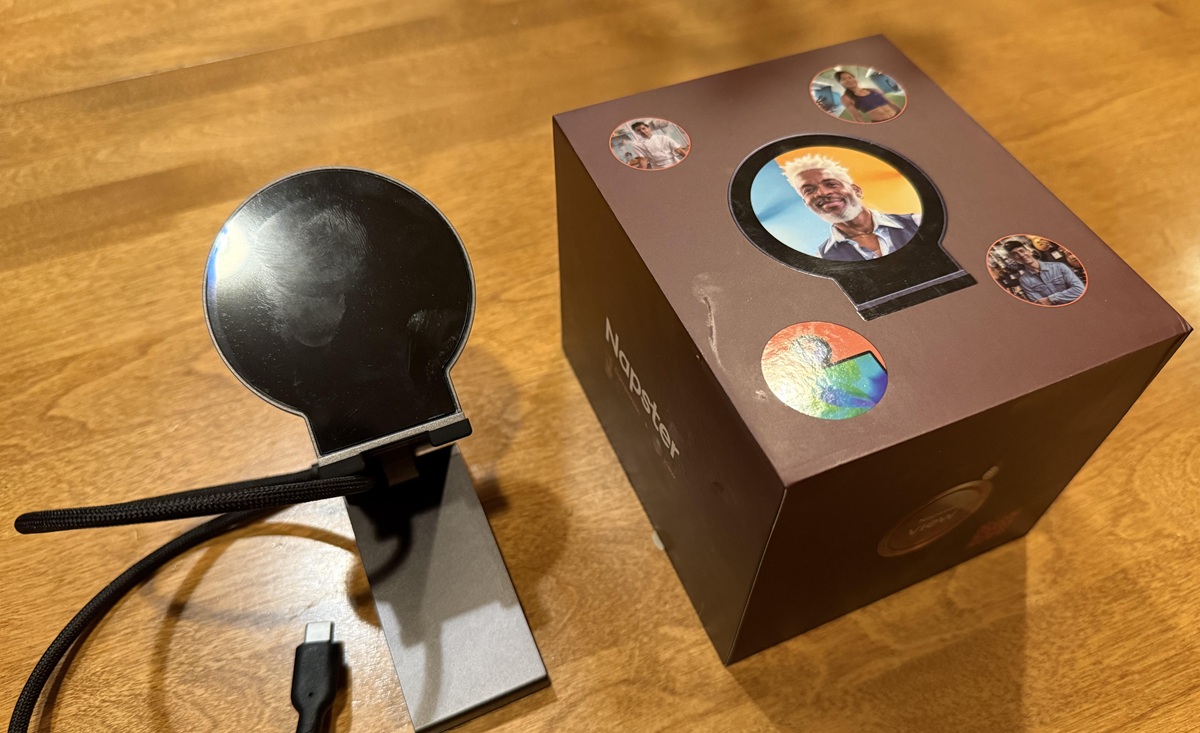
I got a very pretty box in the mail ahead of the launch and I played around with it a bit. When I first looked at Napster View, I thought it was a camera. It turns out, as noted, it’s a display. It’s meant to always show you an image of your AI companion.
The collective tools seek to evolve how consumers engage with AI everyday by offering lifelike personas built to help you learn new skills, solve problems, create, and grow – all over video.
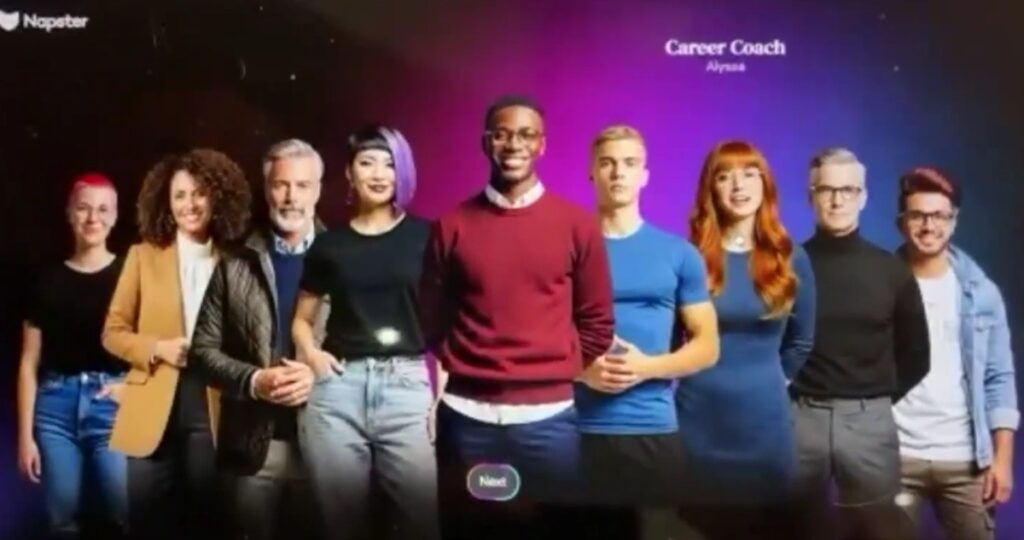
Mine was a team of nine led by Kai in a red sweater. The image in the circular display above the Mac is a 3D stereoscopic image. It shows these digital companions in a realistic light.
The nine AI agents are brought to us in a friendly format. They’re a bunch of people with various titles, like your chief of staff. In addition to Kai, the AI agent companions include Kevin, the financial guide; May, the creative guru; Jordan, the fitness coach; JC, the code wizard; Alyssa, the career coach; Elena, the wellbeing guide; Amit, tech support; and Richard, the learning mentor.
You can also create a digital twin of yourself and send it to coworkers or friends. You can then send it and then the twin will appear rather than you as you send a message over to someone. They can have a full conversation with you. Mind you, you’re talking to the digital twin, not the actual person. Your friend can talk with the twin, which is based on information you feed to the twin like your LinkedIn profile. After the conversation is over, a transcript of the conversation and a summary of it is sent by email to the real person, who can review it for accuracy. If all is well, then the real person can sign off on the convo.
There are 15,000 such companions now. The agents are there so you can figure out in a human way how to find the right agent for you. If you like talking to them, you can keep doing that. If you don’t, you can find another agent. You can search for agents in a directory.
“We have 15,000 different types of experts from whom you can basically find out a ton of information,” Segal said.
You can also use the 2.1-inch 3D display to hold a real-life, real-time conversation with your friend, telling them to review the transcript of the twin conversation. Your friend appears in holographic form.
The box has images of the different AI agent companions that you can converse with. The display connects via a USB-C cable and it hangs on the edge of a laptop or display. The face of the agent is pretty compelling and it really does feel like talking to a real person.
I signed into a demo unit and it asked me to sign up for a subscription, with a month of free service. I didn’t really want to do that but went along for the demo. Then Kai started talking to me. On the Mac, I had to first turn on the microphone and give permission for my camera to be used. And then I started chatted with Kai. I asked Kai how to get my Napster View up and running, but he didn’t know what that was and then I asked him about the Napster AI companion. But he told me his knowledge was limited to 2023 and before, and so clearly he didn’t even know that there was a brand new Napster company.
Hopefully other folks will have better experiences with this tech. And I’ll see how this works out over time. Based on another recorded demo from the company, Segal showed the product has a lot of depth. He says it’s a beta version now and its going to improve on a weekly basis.
Edo Segal’s view of the AI advances
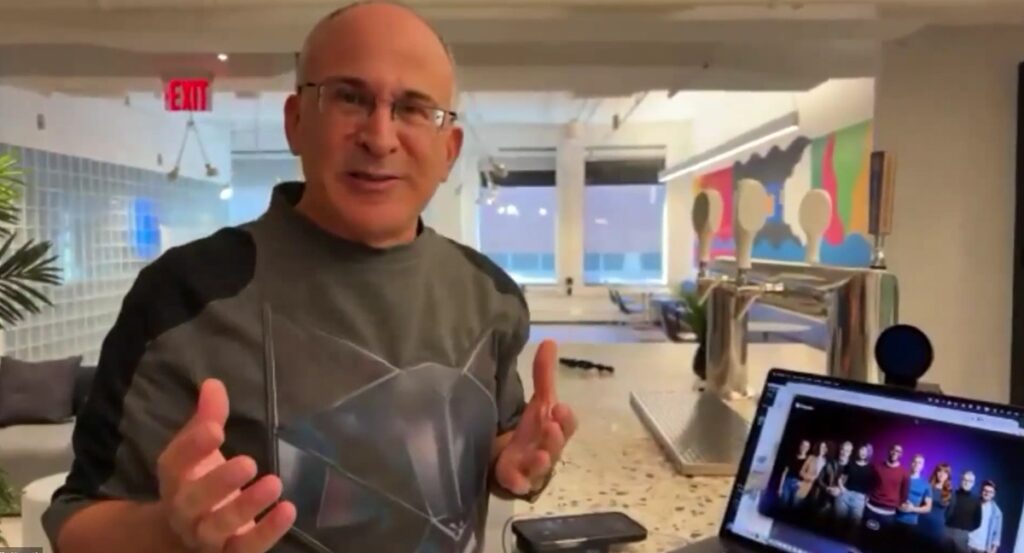
Segal has been in the AI space for 30 years, and he has sold five companies now.
Asked about the tech breakthroughs, Segal noted the large language models (LLMs) of the last couple of years have really made a difference in getting AI that works. He noted the company gets access to the best frontier models through partnerships with Microsoft, Google and others.
“We can basically sit on top of these tens of billions of dollars of investments that they’re making to basically embody the potential of these models in an application like what you saw today,” Segal said.
Segal said his digital twin actually interviews over 120 team members on his team every month. The engineers have a call with his digital twin every Monday. He gets a concise summary of the conversations.
“It’s just been transformative for me, this idea that we’ll have digital twins that can do things for us,” he said.
Regarding the user-generated agents, Segal said, “This is a massive universe of talent, and, as a consequence of us also now having the music as Napster, we’ve started to explore the future of music as well. And what you’re seeing here are additional AI agents that are creative music creators. We actually have a massive universe of these artists that create incredible music that you can listen to.”
In fact, the music AI agents will be able to create new songs. Segal did demos where the AI can create songs almost instantly.
“We think this will really change a lot of people’s lives and support them. We can now scaffold people with all of these capabilities,” Segal said.
Built for AI collaboration
Despite remarkable advances in artificial intelligence, users remain confined to typing prompts into text boxes and reading responses—an interaction model that hasn’t fundamentally changed since early computing, the company said.
Napster 26 replaces this paradigm with the first holographic AI platform, where companions see users’ screens, understand context, and provide real-time guidance through complex tasks.
“ChatGPT and similar platforms represent incredible technology, but they’re essentially sophisticated command lines,” said Edo Segal, CTO of Napster. “The Napster 26 platform brings AI to life through holographic companions who see your work, understand your goals, and collaborate in real-time. They live on the frontier of Agentic AI.”
Starting today, Napster View puts a crew of AI companions on your desk—living, breathing holograms that think with you, create with you, and work even when you sleep. Music artists, business strategists, engineers, wellness coaches, and designers are all there, all yours, all the time.
The full stack: Hardware + platform + ecosystem

Napster 26 represents a complete infrastructure for creation in the AI era: The Hardware: Napster View sits above your Mac, projecting holographic AI companions who live in your
workspace. No VR headset. No special glasses. Just three-dimensional collaborators who make eye contact and work alongside you in real space. The device creates a dedicated spatial environment for AI collaboration, keeping expert interactions separate from primary work screens while enabling natural, face-to-face conversations.
The Platform: Napster 26 gives users access to over 15,000 specialized AI companions—from coding instructors to language tutors to business advisors to wellness coaches. Each companion adapts to your work style, learns your preferences, and delivers expertise that feels less like querying a database and more like collaborating with someone who understands your creative vision. All are available 24/7 for real-time collaboration.
The Ecosystem: Access 15,000+ specialized AI companions across every creative domain—from music production and graphic design to content strategy and software development. Collaborate with other creators and their expert companions, then publish your work to Napster’s platform, contributing to a creative economy where making matters more than consuming.
Your crew is waiting

Just as the original Napster grew the music market by democratizing access, Napster 26 positions the company to expand the emerging AI creator economy. The platform addresses a fundamental barrier: Until now you needed geography, connections, and wealth to access top-tier expertise.
Napster 26 delivers a full creative crew to all – music producers who help you compose, arrange, and master tracks; designers who turn concepts into brand identities and apps; engineers who code alongside you in real time; writers who workshop everything from emails to dissertations; and strategists who scale ideas into businesses.
Key platform capabilities:
- Napster View is a Holographic Second Screen for Your AI – A dedicated spatial display that keeps AI interactions separate from your primary workspace, preventing screen clutter while maintaining natural eye contact.
- Live 3D Holographic Video Calling—Use Napster View for live calling with AI companions and digital twins of other Napster users; no glasses are needed.
- Natural Conversation Interface – Move beyond texting with a chatbot to face-to-face interactions with AI companions. These aren’t assistants—they’re collaborators who know you, remember your prior conversations and grow with you. Expertise that feels less like querying a chatbot and more like working with a trusted colleague who understands your creative vision.
- Hyperreal Digital Twin—Create an AI-powered version of yourself that enables you to be in multiple places at once. It takes a few minutes to create and is grounded in your existing LinkedIn profile and personal knowledge base for authentic representation.
Availability
Napster View is available for $99 (includes one free month of Napster 26 platform access). Monthly and annual subscription plans are available after the first month. Requires Mac app download. The Napster View holographic display works seamlessly with your existing Mac setup. To order Napster View or download the Napster app for Mac, visit: napster.ai/apps.
Segal said the team designed it as if it were an Apple product. It fits well as a peripheral for an Apple laptop, which it turns into an “AI powerhouse like nothing ever seen before,” he said.
A PC version is coming later. Segal said the reason for choosing Mac first was that it had a uniform platform and Macs have strong graphics processing units (GPUs) and AI-capable CPUs in the M1 generation and after. He noted the web version, which doesn’t work with the display, has more than 300,000 subscribers so far.
Requirements for the system include a Mac with Apple silicon (M1 or newer); macOS Sequoia (15) or later; a broadband internet connections; microphone and camera access; and a note for Mac Mini: external microphone, speakers/headphones and camera required.