

Agate Sensors, a startup developing smart sensors for material analysis, has raised $6.6 million to let consumers figure out the materials in any given object.
The Finnish company aims to commercialize a breakthrough that shrinks spectroscopy from suitcase-sized lab equipment to a single pixel smaller than a grain of sand—integrated into a chip compact enough to sit on your fingertip. Others have done this kind of work before, but Agate Sensors says it has miniaturized the tech the most.
The funding round will accelerate production of chip-scale sensors that give any camera the ability to instantly analyze what it sees, from food and health checks to counterfeit detection and critical defense applications.
“This is a new kind of technology that really can change the world. And no, nobody has a similar kind of kind of structure,” said Tommi Leino, CEO of Agate Sensors, in an interview with GamesBeat. “So that’s what really motivates me and the whole founding team. We are in the middle of something completely new.”
The Finnish startup’s technology allows devices to analyze the spectral signatures of materials in real time, bringing high-precision material sensing out of the lab and into everyday devices, from smartphones and wearables to medical equipment and defense systems.
Cool technology
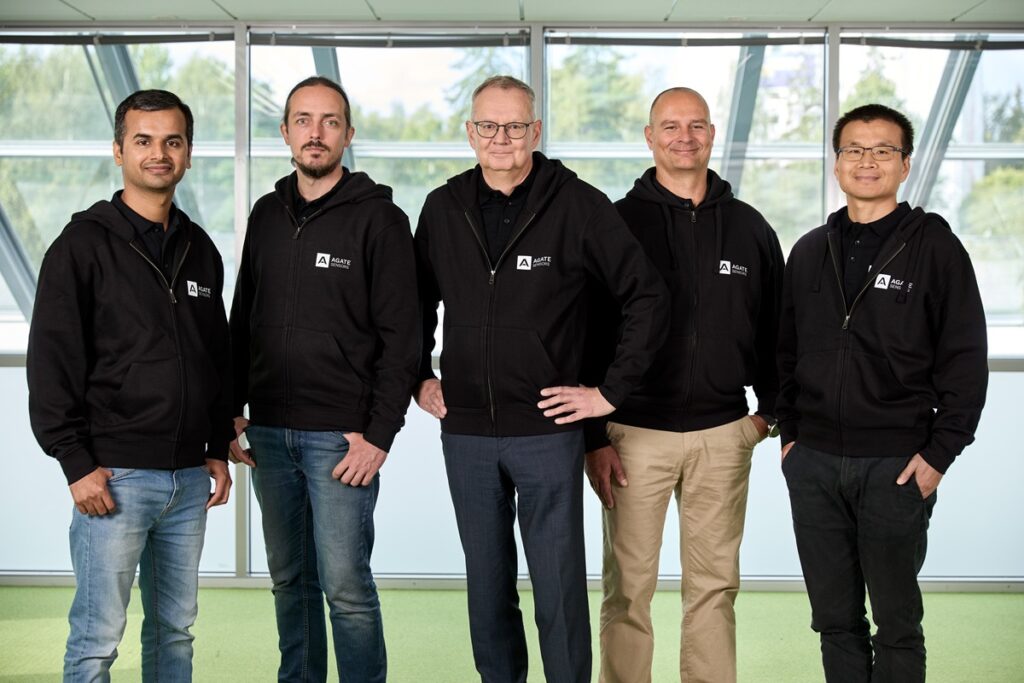
The €5.6 million round includes €4 million in seed funding led by Voima Ventures and LIFTT, plus €1.6 million in grants from Business Finland.
I covered a similar pitch from Trinamix back in 2020. (Sadly, the story is no longer live on VentureBeat). BASF still owns Trinamix, which used near-infrared technology to discern the makeup of a material.
Spectral vision extends far beyond the three color bands visible to the human eye. By distinguishing hundreds of bands at once, Agate’s sensors give machines a kind of “superhuman” vision, enabling them to perceive details and distinctions invisible to conventional cameras.
“We’ve taken a spectrometer once confined to specialized labs and made it small and affordable enough to live inside everyday devices,” said Leino. “One sensor can shift between functions entirely through software — from diagnosing a health condition to detecting, identifying, and classifying objects and materials — changing how we interact with the physical world.”
Manufacturing of initial chips is expected by year-end, enabling proof-of-concept demonstrators throughout 2026 and first commercial smart wearable products targeted for late 2027.
Investor views

“This funding allows us to commercialize a technology that fundamentally changes how machines perceive the world,” said Mikael Westerlund, chief business officer of Agate Sensors, in a statement. “We’re not just building sensors, but enabling a new layer of light-based intelligence.”
Agate Sensors’ software-defined spectroscopy platform reads the “spectral signatures” of materials through light analysis. “This technology is the result of over a decade of research in semiconductor physics and nanotechnology at Aalto University,” said Andreas Liapis, CTO of Agate Sensors, in a statement. “For the first time, we are able to bring laboratory-grade spectroscopy to an integrated form factor suitable for mass market use.”
“Agate Sensors’ platform is a leap forward in hyperspectral sensing: software-defined, scalable, and truly high-performance,” said Niko Elers, investment director at Voima Ventures, in a statement. “It holds immense potential to reshape industries that rely on precise optical measurement, and we are very excited to support the company on the journey ahead.”
As AI and autonomous systems demand richer environmental understanding, Agate’s platform opens new dimensions in machine vision, enabling applications from multi-biomarker health monitoring in wearables, to detecting counterfeit goods in supply chains, identifying environmental hazards in industry, early intervention in smart agriculture and forestry, and more.
These smart sensors capture rich spectral data and use advanced algorithms powered by AI to identify objects and classify materials in real time, allowing machines to see and understand their surroundings beyond what is possible by human vision, and to share this intelligence across networks for coordinated analysis.
Defense is among the earliest market-ready applications. For example, the sensors can distinguish between real foliage and synthetic camouflage materials, or identify specific vehicle types through their paint signatures.
“We believe this innovation will play a critical role in strengthening Europe’s technological sovereignty in defense and security,” said Pierluigi Freni, project manager at LIFTT, in a statement. “For the first time, we have a technology capable of mass deployment that allows machines to understand what they see. This changes everything we know about spectral data usability and usage. We confirm our trust and belief in the Finnish innovation ecosystem, in which we have decided to continue investing together with LIFTT Euroinvest, the investment vehicle we share with the European Investment Bank.”
Origins

The Espoo, Finland-based company was founded in 2024 as a spinout from Aalto University in Finland. The research had been conducted over a decade by the photonics group of professor Zhipei Sun at Aalto University’s Department of Electronics and Nanoengineering.
The company has an exclusive license to the tech and it is commercializing a breakthrough in semiconductor physics that miniaturizes spectral sensing to the scale of a single camera pixel. Leino said that license enabled a small semiconductor company to get started in this space that is normally full of very large chip companies.
“It’s all about the designing of the pixel, and the software that controls it,” Leino said. “We hold the patents at the company. The key thing is that we have ownership of that pixel technology, and that makes us to be able to do it with very capable design houses.”
Backed by top-tier publications including Science, Nature Communications, and Science Advances, Agate’s patented technology enables the convergence of photography, video, hyperspectral imaging, biosensing, and spectroscopy into a single, ultra-compact platform. This positions Agate at the forefront of a global shift in light-based intelligence, from defense and security to healthcare, environmental monitoring, and consumer electronics, the company said.
The CEO is Tommi Leino, a veteran of Nokia and Microsoft with over 30 years in semiconductor product development, and CTO Andreas Liapis, a scientist and innovator whose previous appointments include Aalto University and Harvard Medical School. The chief business officer is Mikael Westerlund, who scaled a startup from seven to 400 employees across global production sites.
The company has 14 people and it may grow to 18 this year.
Finding the opportunity
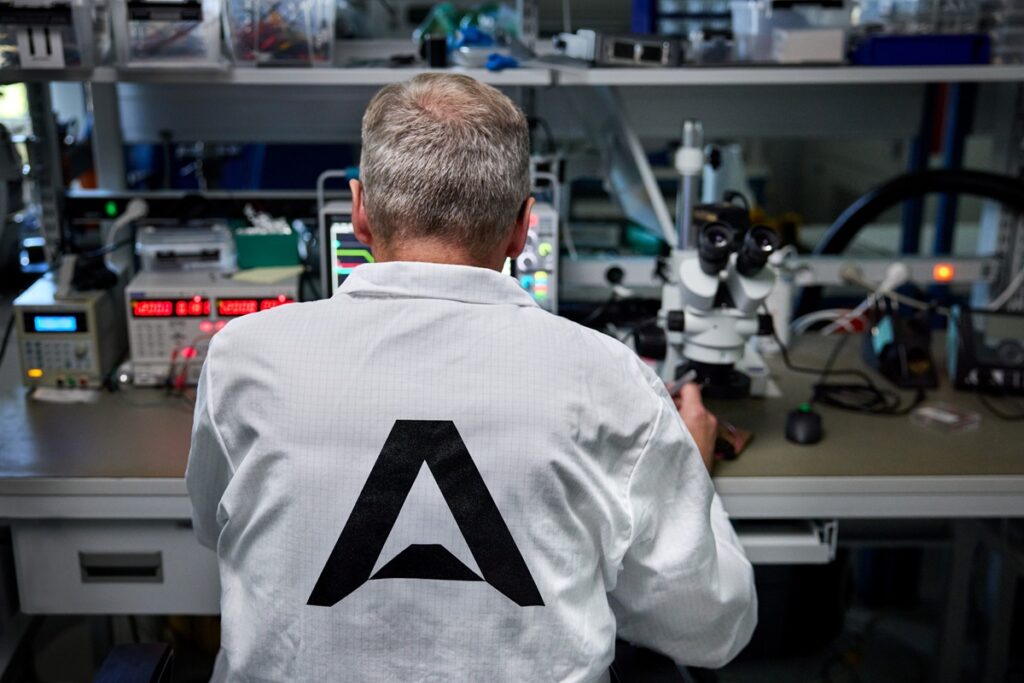
Leino was previously running a semiconductor startup and it started its exit process. So Leino came upon the opportunity with Agate Sensors last fall and seized it. He joined the founding team.
“They made the breakthrough with that tech four years ago, when they started to see that you can indeed measure the full range of the light spectrum with one or more pixels. So every individual pixel is a kind of spectrometer,” Leino said. “For me, that was really, really interesting. I started to investigate that further and I saw the potential. It’s really something new that nobody else has.”
The sensor measures the light coming out of any given object, and it can figure out the different materials because every material reflects light in a different way. The sensor measures the reflections of the applied light, or the reflections of the light. It can be measured more accurately than a human eye can see. It consists of an optical element that requires no filter so that all the light goes onto the sensor, Leino said.
“You can teach your system to recognize certain materials, like the light reflection from a living tree. It is quite different from the plastic that tries to mimic a tree or even a tree that has been cut down. It can be measured very accurately within 10 nanometers or less” in terms of the light measurement.
The sensor measures light in the visible light spectrum and near infrared. If the company uses special materials, then it can go far beyond the infrared domain. The sensor is essentially a camera, built like a pixel, with a camera module.
“We can put tens of millions of these Agate Sensor pixels together, and then we can create the picture,” he said. “We can measure the light way more accurately. When you see a sunset with a digital camera, you can’t really capture all of the colorful view you see with your eyes.”
It’s like the difference between a digital photo and a more accurate analog photograph that captures more colors. In this case, one pixel on the sensor is two microns by two microns. The chip itself with the full sensor is a few millimeters squared. The chip is connected to a CPU that runs the algorithm. That could serve as the processor for a smartphone or for a smartwatch.
Leino believes his company’s solution is better as it has a broader sensor range, can pack many more of them in a space, and it is simple to manufacture.
“We can run it through a standard fab (chip factory) without any changes today,” Leino said. “It can be produced in any fab with an older CMOS process. We are working with one for mass production.”
Potential applications

One of the big advantages of the tech is that it has a long range. You can put a sensor on a drone and it can use the optics to detect materials in an object from a long distance. In this case, there is no optical filter that removes light from the sensor, so all the light from the object hits the sensor and its photosensitive element. It works in the night and low-light conditions, he said.
“You can easily control the light, so you can have full control of the light source and full control on the measurement device,” Leino said. “In an outside environment, you need to take into account all kinds of light reflections, sunlight conditions and so forth. It makes it a bit more complicated, and we control both the incoming light and the measurement.
The company is just starting to work with potential customers to figure out applications. The company will do proof of concepts and evaluation kits and move into its next phase of development.
One of the defense markets is putting sensors on drones so they can better discern targets. With a drone, you could scan a battlefield with the tech and see if there are any decoy vehicles made out of plastic. You could detect an explosive device that someone is trying to sneak through airport security.