
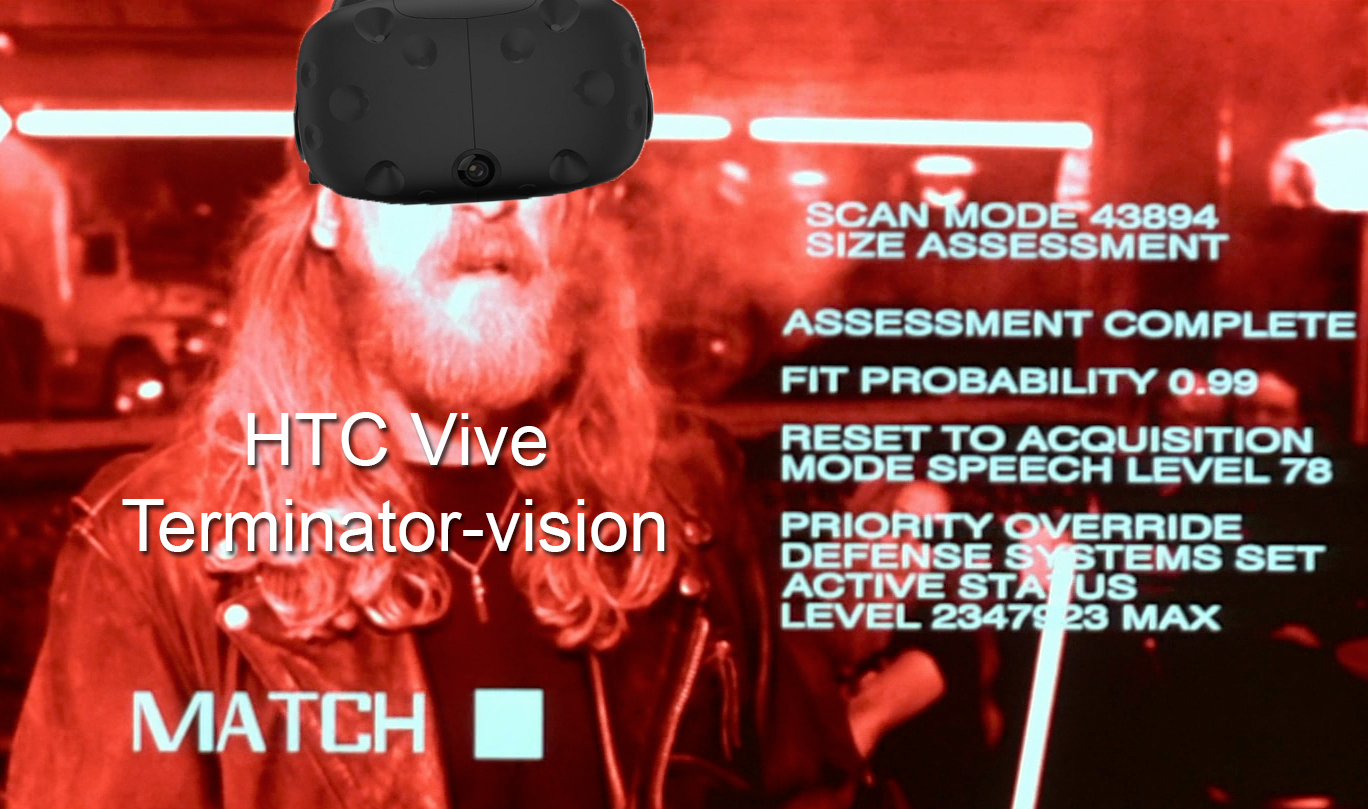
You want to play virtual reality games, but you don’t want to rack up a $10,000 veterinarian bill because you stepped on the dog. That’s reasonable, and one of the headsets has a solution to this.
HTC’s Vive, which it built in partnership with SteamVR creator Valve, has an outward-facing camera that can show you the world around you. The device launched today for $800, and it specializes in room-scale VR. This is a kind of simulated environment that tracks your movement as you walk around a space that’s at most 15-feet-by-15-feet. It’s difficult to walk around a room while you have a screen strapped to each one of your eyeballs. To solve this, Valve enables players to instantly call up the camera at any time by double-tapping the System button on either one of the Vive motion controllers. But this doesn’t work exactly like you would expect. Instead of filling your vision with a high-definition color image, you get something more along the lines of Terminator vision.
Go ahead and check out the video below to see what I mean, and then I’ll explain why SteamVR works this way:
The camera on the front of the Vive could give you a full-color picture, but you’d probably find it really uncomfortable. Looking at the world through a camera that is sitting a few inches off your face would likely give you some woozy feelings in your stomach. Additionally, most camera lenses do not match the same field-of-view as your vision. If Valve gave you that 1-to-1 vision, your brain would likely reject it.
Because of this, SteamVR abstracts the camera feed. It gives you an outline of the items in the world in a monotone color. This is all the information you need to avoid ramming your shin into a table.
It’s a clever trick, and it’s one more example of how the engineers behind VR are figuring out how to present this new tech to consumers in a safe way.