
At the Devcom developer conference 2025, Europe’s biggest game developer event, Google Cloud today released new research, conducted by The Harris Poll, that reveals the widespread adoption of generative (gen) AI in the games industry and its transformative impact on game development and player experiences.
The study of 615 game developers in the United States, South Korea, Norway, Finland, and Sweden found that 97% of respondents believe gen AI is reshaping the industry, with a majority (90%) already integrating the technology into their workflows. The findings come at a time when the industry is grappling with rising development costs, market saturation, and players gravitating toward older games, underscoring the need for continuous innovation.
Google Cloud is at the forefront of enabling the next generation of “living games” – titles that dynamically adapt, evolve, and generate content in real-time based on player interactions, ultimately creating infinitely immersive and personalized experiences. Jack Buser, global head of games for Google Cloud, unveiled the concept ahead of the Game Developers Conference in 2024.
He noted the era of living games represents a big shift, as fundamental as the transition from cartridges to CD-ROMs or 2D to 3D graphics. It’s made possible by AI’s ability to create an instantaneous, AI-driven feedback loop, turning a process that used to take weeks or months into a real-time event.
Google Cloud is announcing new and expanded collaborations with games companies and startups, providing the compute and scalable infrastructure to bring the “living games” vision to life. And Google Cloud said it is uniquely positioned to empower this transformation by fostering a robust ecosystem for “living games.”

The company’s approach provides horizontal technologies that game developers can use and build upon, ensuring they have the foundational tools and flexibility to innovate independently and stand on their own feet.
Survey methodology and respondent profile
This survey was conducted online by The Harris Poll on behalf of Google Cloud from June 20 to July 9, 2025. It surveyed 615 adults working in game development across the United States, South Korea, Finland, Norway, and Sweden. The sampling precision for this study is accurate to within ±3.9 percentage points using a 95% confidence level.
The survey respondents primarily represent developers from large-scale studios. A vast majority (86%) work at companies with 500 or more employees worldwide, with 43% at studios of 1,000 to 4,999 employees. Technically, the developers surveyed are deeply embedded in the game creation process, with 86% stating they primarily work on game engines such as Unity and Unreal.
Generative AI is driving impact across key areas in games
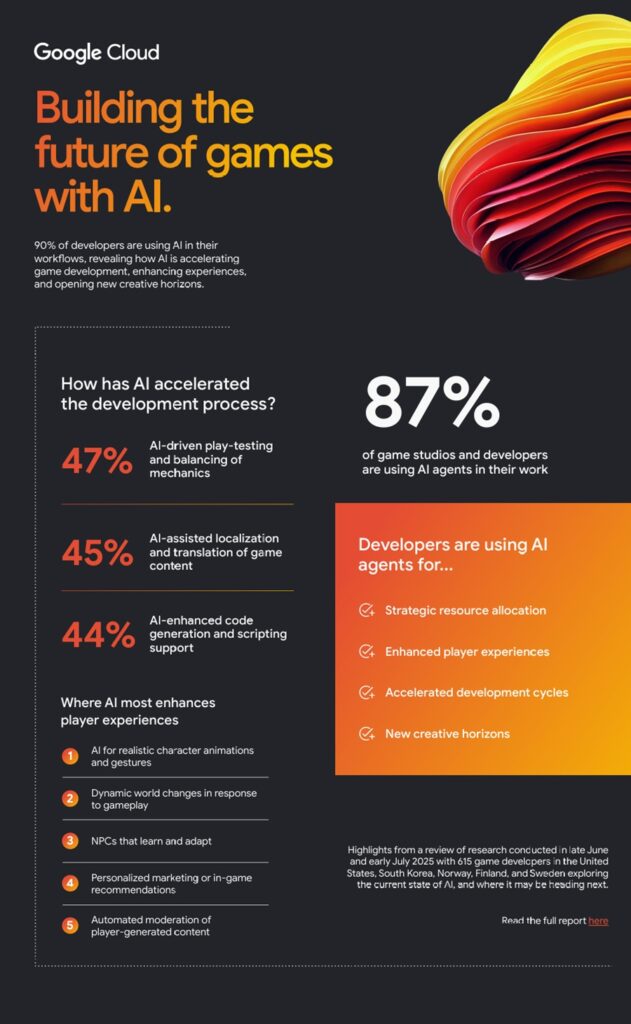
The study also highlights a significant shift in how developers see creativity and efficiency in the development process, from automating repetitive tasks (95%) to exploring new gameplay possibilities, like developing new mechanics (93%) and developing new genres (92%).
The research also indicates a strong belief that this technology will fundamentally reshape how games are produced, as 94% of developers surveyed say it is already driving innovation.
Developers have coalesced around several key areas where they see gen AI as most impactful:
Accelerating workflows: An overwhelming 90% of developers are already using some form of AI in their game development workflows. In fact, 95% say that AI is reducing repetitive tasks, freeing them up to focus on more strategic and creative concerns. This acceleration is particularly strong in key areas like playtesting and balancing (47%), localization and translation (45%), and code generation and scripting support (44%).
Driving creative innovation: AI is also being used in core parts of the creative workflow, with 36% of respondents personally using it for dynamic level design, animation, and dialogue writing. This is leading to enhanced experimentation with new gameplay and narrative concepts (37%) and increased flexibility in creative exploration (36%).
Enhancing player experiences: The use of AI is changing what players expect from games, with 89% of developers observing these shifts. Players are seeking games that feel more “alive” and dynamic (37%) and expect smarter, more adaptive nonplayer characters (NPCs) (34%). Developers see opportunities to enhance these experiences through dynamic world changes in response to gameplay (23%) and NPCs that learn and adapt (23%).
The rise of AI agents: AI agents are software systems that use AI to pursue goals and complete tasks on behalf of users. Developers who are using AI agents are implementing them to create more dynamic and intelligent gameplay with 44% using them for content optimization that adapts to in-game needs, and 38% for dynamic balancing and tuning of gameplay. Other uses include procedural world generation (37%) and automated content moderation (37%).
Industry democratization: The survey indicates that developers also see AI as a powerful tool for democratization, with a third (29%) believing it can level the playing field for smaller, independent studios to compete with more established players. This optimism is balanced by a keen understanding of the challenges of gen AI, such as the cost of AI integration (24%), difficulty measuring the success of AI implementations (22%), and the need for upskilling staff (23%).
Navigating ownership and IP concerns: While the outlook is positive, the survey also points to developers’ concerns regarding data ownership with AI applications and games (63%). It uncovers challenges such as player data privacy (35%) and uncertainty around who owns AI-generated content (32%).
“The survey results underscore a clear message: AI is no longer a futuristic concept for the games industry—it’s a present-day reality that’s driving innovation and changing the very nature of how games are made and played,” said Jack Buser, global director for Games, Google Cloud, in a statement. “From creating more responsive and immersive player experiences, to accelerating development cycles, generative AI is empowering developers to push creative boundaries and build the next generation of games.”
When it comes to the implementation of AI, developers are already outlining a clear path forward for effective integration. For example, 40% of developers recommend using small-scale pilots or testing before full implementation. A similar portion (39%) emphasize the need to align AI use with the creative vision and goals, while another 39% stress the importance of providing training or upskilling for staff on AI tools. Lastly, 38% of developers recommend establishing clear criteria for evaluating the success of AI implementations to ensure agreed-upon metrics are in place.
Customers in more than 200 countries and territories turn to Google Cloud as their trusted technology partner.
In another post, Buser wrote, “The games industry is on a powerful ride, surging forward with innovation and a sharp focus on the player experience. For years, the industry’s evolution was defined by familiar IPs getting better graphics and gameplay. At Google Cloud, we believe we’re on the cusp of something far more radical — a shift on the scale of the transition from cartridges to CD-ROMs, or 2D to 3D graphics. This new era is defined by the rise of ‘living games,’ a new form of dynamic, ever-evolving experiences powered by AI that captivate players for years.”
He said that with the global market for games surpassing $180 billion in 2024, this fundamental shift in how games are developed, played, and experienced creates an entirely new opportunity for the industry. A big part of what’s driving this shift is the transformative power of cloud computing and AI, and many cutting-edge developers and startups are already taking advantage of these advances, Buser said.
This new technology is turning the weeks-long live-operations cycle into an instantaneous, AI-driven feedback loop that creates a game world that feels truly alive, he said.
“The vision of truly living games is no longer a distant dream; it’s a reality unfolding today. Google Cloud is helping drive this forward through the powerful combination of Google’s deep live service expertise and cutting-edge cloud and generative AI technologies,” Buser said. “It’s this kind of innovation that’s driving new and expanded collaborations with incredible games customers and partners, including Atlas, Ludeo, Nacon, and Nitrado. These pioneers are pushing the boundaries of what’s possible in games, from creating more immersive player experiences to accelerating game development and scaling their operations.”
Atlas: AI for creating vast 3D game worlds
Atlas is an agentic 3D-content creation platform designed for professional game studios, enabling them to generate game-ready assets, environments, tools, and workflows. It focuses on production-scale workflows rather than one-off asset generation, acting as a creative assistant through its multi-agent AI system. Developers can co-create with intelligent AI agents using natural language prompts, ensuring the output is tailored to their specific technical and aesthetic goals. Atlas integrates with industry-standard pipelines like Unreal Engine, Unity, and Houdini, making it ideal for AA+ teams building complex games at scale.
“We believe AI-native games will define the next chapter in interactive entertainment,” said Ben James, chief executive officer, Atlas. “These experiences will be dynamic, personalized, and constantly evolving – and they’ll require a new creative infrastructure. Partnering with Google Cloud gives us the compute foundation and orchestration support to bring that vision to life.”
Atlas is collaborating with Google Cloud to supercharge its multi-agent AI infrastructure and accelerate the development of AI-native games. The platform is built entirely on Google Cloud’s infrastructure and uses our model orchestration tools, including Vertex AI. This provides Atlas with the robust compute foundation and orchestration support necessary to bring its vision to life, enabling a new era of dynamic, evolving interactive entertainment.
“Atlas’s ability to seamlessly integrate with our highly customized workflows has been a game changer,” said Joseph Burnette, technical director of the Innovation Technology Division at SQUARE ENIX. “By deeply understanding the nuances of our pipeline, they’ve become an invaluable partner, enabling us to deliver high-quality, performance-optimized solutions with impressive agility.”
Ludeo: redefining game discovery with playable moments
Ludeo is the world’s first playable media platform, enabling users to instantly play game highlight clips. Unlike gameplay content consumed today – which turns the experience of playing games into passive videos – Ludeo works directly with studios and publishers to create “playable moments,” called Ludeos, that users can instantly jump into and experience themselves. They can do so whether they own the game or not, without any downloads or lengthy installs.
These Ludeo moments can be shared with a link anywhere, from social media platforms to messaging apps. Passive viewers become active participants in seconds. This helps game studios attract new players, re-engage existing ones by showcasing new content, and even lets players “try before they buy” in-game items, boosting interest and conversion.
To power this vision, Ludeo will bolster its core infrastructure with Google Cloud, using Google Kubernetes Engine (GKE) and GPUs to create a highly optimized, low-latency infrastructure that’s required for their platform. Ludeo will also aim to build the “playable YouTube,” fundamentally changing how players discover and socially engage with games, from popular AAA titles to AAs and indies.
“Google Cloud’s infrastructure strengthens the capabilities and scale of the Ludeo platform,” said Uri Levanon, vice president of business development and partnerships at Ludeo. “This powerful combination will give players the magic of instantly playing game highlights instead of just watching them, in addition to unlocking new growth opportunities for game studios.”
NACON: Accelerating game production with AI transformation
NACON stands as a prominent AA video games company and a leader in high-end games hardware, known for popular titles like RoboCop: Rogue City, Ravenswatch and Test Drive Unlimited Solar Crown. With 15 game studios under its belt, NACON is making a bold strategic pivot, embedding AI at the core of its operations, from game development to marketing.
NACON’s goal is to increase annual game launches, a move heavily reliant on streamlining processes and boosting creativity with AI. This vision encompasses everything from crafting captivating trailers and in-game cinematics to optimizing game maps for racing titles, all designed to enhance player experience and developer efficiency.
Google Cloud is NACON’s partner in this AI-driven transformation, helping NACON innovate faster and deliver unforgettable games experiences. NACON has selected Google Cloud as its preferred partner for game servers, ensuring scalable and reliable infrastructure for their diverse portfolio.
They are also using Google’s Veo 3 model as a complementary tool to help produce cinematic trailers and Google’s Gemini model to support localization efforts, enabling NACON to reach new global markets more efficiently. Additionally, NACON will use Looker for deep insights into in-game analytics and player behavior, and Google Threat Intelligence to help their ability to proactively secure their operations against industry threats.
“Partnering with Google Cloud marks a pivotal moment in NACON’s journey to transform game development with AI at its core,” said Alain FALC, president and chief executive officer, NACON. “Google Cloud’s cutting-edge tools empower our teams to innovate faster, streamline production, and deliver richer, more immersive experiences to gamers worldwide.”
Nitrado: Hybrid cloud scaling for flawless multiplayer gaming
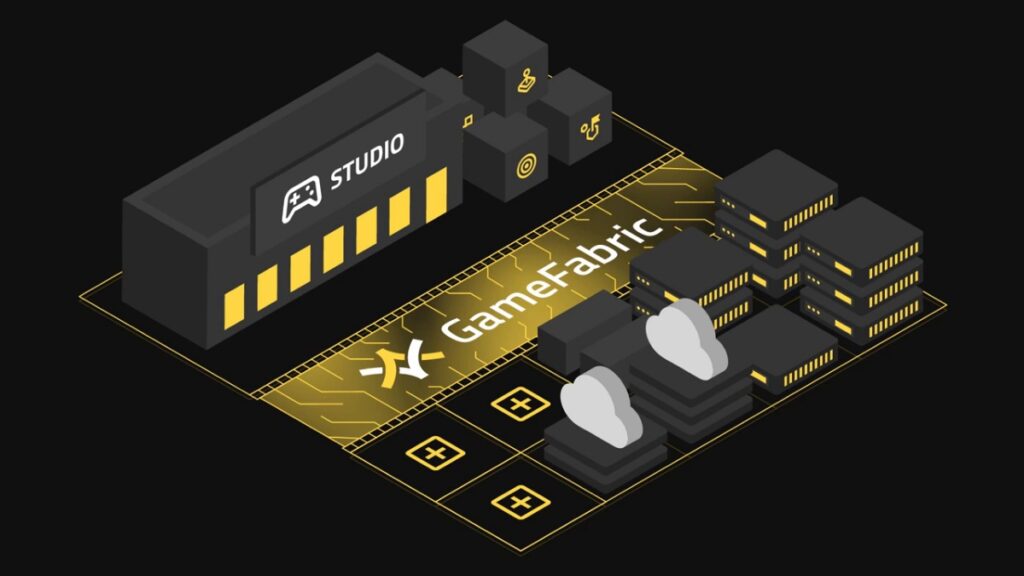
Nitrado, a global leader in game server hosting, is making multiplayer game creation even easier for studios with a new capability for their orchestration solution, GameFabric. This platform acts as a unified orchestration layer, allowing game developers to seamlessly combine Nitrado’s high-performance bare metal infrastructure with the elasticity of the cloud, all managed through GameFabric.
This means studios can automatically use Google Cloud to support traffic spikes, like during a big game launch or a busy weekend. Furthermore, studios can bring games closer to their players by instantly deploying servers in new regions, using Google’s planet-scale network to ensure low-latency performance for a global audience. GameFabric can scale up or down automatically, allowing developers to focus on the player experience, not the infrastructure, and studios to keep their games running smoothly and cost-efficiently, no matter how many players jump online or where they are.
With Google Cloud as GameFabric’s preferred cloud provider, studios benefit from Google Cloud’s low-latency global network for a flawless player experience and elastic infrastructure for unlimited scalability. This partnership is built on operational tools like GKE and Agones, which are trusted for managing game servers efficiently and reliably. Plus, Google Cloud’s built-in security and reliability protect game and player data around the clock.
“GameFabric brings together bare metal and cloud in a unified orchestration layer, so studios can scale up, stay fast, and keep costs predictable,” said Raphael Stange, chief executive officer, Nitrado. “This partnership strengthens the hybrid model we’ve built to serve multiplayer studio needs.”