
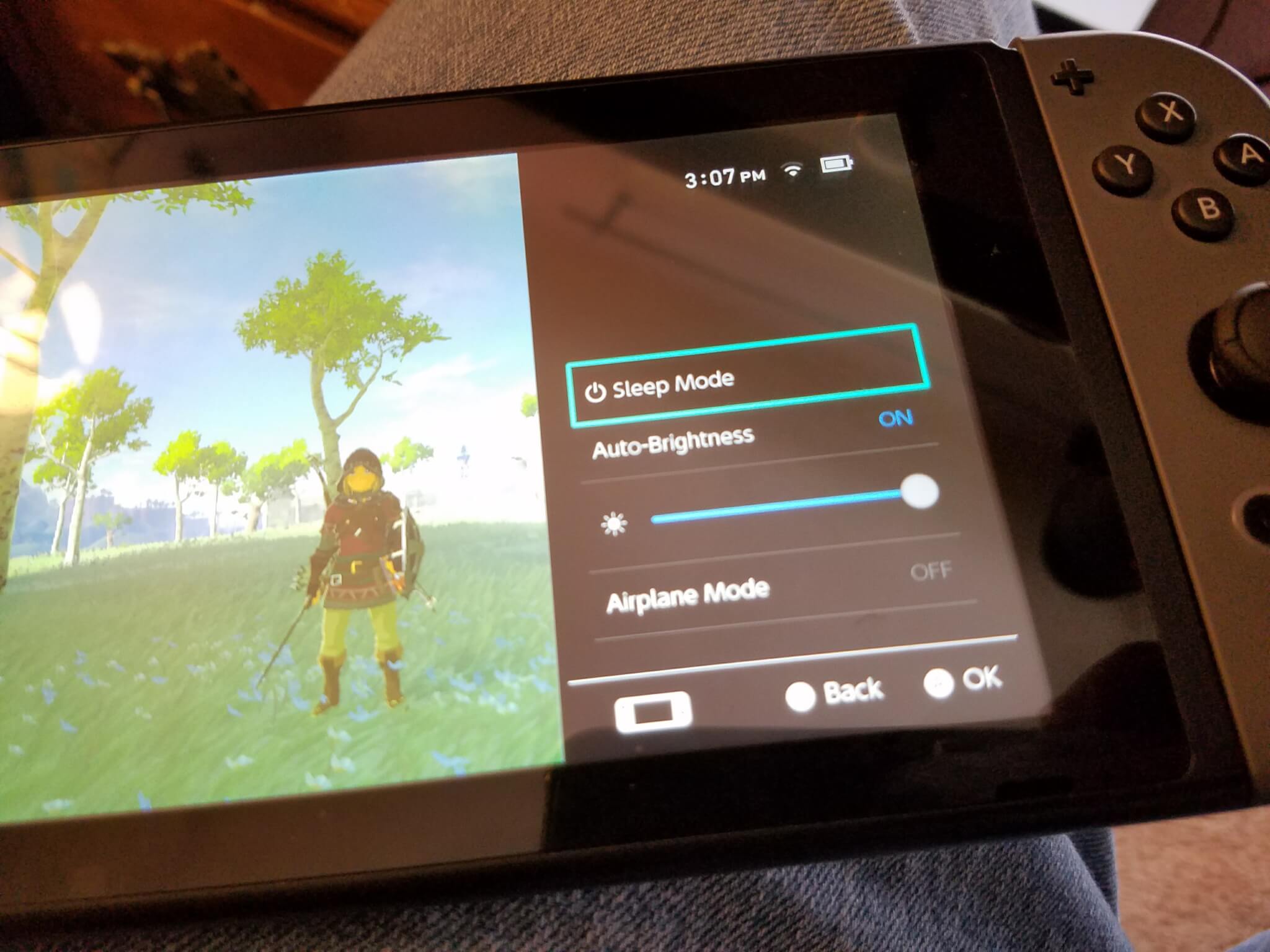
If you are thinking about buying the Nintendo Switch, I don’t think it’s battery life should play a big factor in your final determination.
Nintendo’s new console can play Zelda on battery power for about 3 hours, and that’s long enough for me so far. The $300 hybrid handheld/home system launches March 3, and maybe you’re thinking that 3 hours doesn’t sound like a long time. And maybe you have a lengthy daily commute or you fly across the country a lot. In those situations, 3 hours of Zelda isn’t enough. But even if those are the times you plan to play games the most, I don’t think the battery is the biggest concern.
I’ve already detailed some of the early problems I’ve spotted with the Switch, and I didn’t include the battery life among those issues. That’s because, in reality, three hours of game time on a portable device is not shockingly low. Maybe you’re thinking that your iPhone lasts all day with battery to spare, but I urge you to see the results if you tried to play a game nonstop on your phone. Did you play Pokémon Go over the summer? Remember how that ate through your battery in a couple of hours? It’s the same thing with the Switch, only Breath of the Wild uses much more power to run those high-def visuals and more complicated actions than Pokémon Go does for its limited gameplay. And if you put your Switch in sleep mode, it would last a couple of days.
Let’s get some perspective. Here’s a look at how long Nintendo and Sony have said that their respective portable systems last on a full charge:
- Nintendo Switch: 2.5 hours-to-6 hours
- Nintendo 3DS: 3 hours-to-5 hours
- New Nintendo 3DS: 3.5 hours-to-6 hours
- New Nintendo 3DS XL: 3.5 hours-to-7 hours
- PlayStation Vita: 3 hours-to-5 hours
Switch sits comfortably alongside all of those devices in terms of battery life, and the results I’ve seen in real-world use reflect that. Playing Zelda from a full charge until the system died doesn’t feel all that different from wearing down the battery on my New 3DS XL.
In my tests, I got over 3 hours of use playing Zelda on the Switch at the lowest brightness setting. On auto-brightness, where the system adjusts automatically based on the ambient lighting in the room, I ended up closer to 2.75 hours. But it’s important to remember that Zelda started its life on the Wii U, and a lot of the games that are going to rub up against the 2.5-hour side of the spectrum are the ones that weren’t made with the unique capabilities of this hardware in mind. In the future, Nintendo may find a way to make games that look as impressive but are better at optimizing the Switch’s power.
Finally, if 3 hours won’t do it for you no matter what, I would guess that 5 hours wouldn’t make you that much happier. It’s unlikely that any device — whether it’s a laptop, smartphone, or tablet — could last for 5 hours while running a modern 3D game at 720p on a battery charge. That means the answer here is to take advantage of the Nintendo Switch’s USB-C port, which will accept a charge from a portable power bank. While I doubt you’ll use it often, you’ll still have the battery power when you need it in those rare circumstances.
But maybe I’m biased because I’m relieved that 3 hours is just enough to cover most of my trips to the bathroom.